<?xml version="1.0" encoding="utf-8"?>
<feed xmlns="http://www.w3.org/2005/Atom">
    <id>https://pandev-metrics.com/docs/blog</id>
    <title>PanDev Metrics Blog</title>
    <updated>2026-06-18T00:00:00.000Z</updated>
    <generator>https://github.com/jpmonette/feed</generator>
    <link rel="alternate" href="https://pandev-metrics.com/docs/blog"/>
    <subtitle>Engineering Intelligence insights and developer productivity research</subtitle>
    <icon>https://pandev-metrics.com/docs/img/favicon.ico</icon>
    <rights>© 2026 PanDev Metrics</rights>
    <entry>
        <title type="html"><![CDATA[Engineering Sabbaticals: Data on Returning Developer Output]]></title>
        <id>https://pandev-metrics.com/docs/blog/engineering-sabbaticals-effects</id>
        <link href="https://pandev-metrics.com/docs/blog/engineering-sabbaticals-effects"/>
        <updated>2026-06-18T00:00:00.000Z</updated>
        <summary type="html"><![CDATA[Sabbaticals get sold as retention tools. The data on returning developers: 4-6 weeks to full output, 90-day retention boost, and a surprising code-quality uptick.]]></summary>
        <content type="html"><![CDATA[<p>A VP of Engineering at a 300-person company asked me a direct question: "We're debating a sabbatical policy. HR says it boosts retention. Finance says it costs 2 months of output per taker. Who's right?" The data we could pull answered it: <strong>both, but the effect sizes are different</strong>. Returning developers hit full output in 4-6 weeks (not 8-12 as commonly assumed), and 90-day retention for post-sabbatical engineers is measurably higher than their pre-sabbatical cohort. The surprise is that the commit quality on the ramp-up weeks is <em>better</em> than baseline, not worse.</p>
<p>The Society for Human Resource Management's 2023 <a href="https://www.shrm.org/topics-tools/research" target="_blank" rel="noopener noreferrer" class="">Employee Benefits Survey</a> shows <strong>22% of US employers now offer formal sabbatical programs</strong>, up from 13% in 2018. Among tech companies the rate jumps to roughly 34% — driven partly by retention competition and partly by the post-2022 burnout reckoning. But most of the published data on sabbatical ROI comes from self-report surveys. Our IDE telemetry gives us something those surveys can't: what actually happens on the keyboard week-by-week when someone comes back.</p>
<p>{/* truncate */}</p>
<h2 class="anchor anchorTargetStickyNavbar_Vzrq" id="why-this-number-is-hard-to-find">Why this number is hard to find<a href="https://pandev-metrics.com/docs/blog/engineering-sabbaticals-effects#why-this-number-is-hard-to-find" class="hash-link" aria-label="Direct link to Why this number is hard to find" title="Direct link to Why this number is hard to find" translate="no">​</a></h2>
<p>The sabbatical conversation has been dominated by two kinds of research, both limited:</p>
<p><strong>Self-report surveys</strong> (Gallup, SHRM, Deloitte) ask employees how they felt post-sabbatical. Predictably, people who took the sabbatical report feeling refreshed. This tells us almost nothing about whether they actually produce good code afterward.</p>
<p><strong>Academic organizational-behavior research</strong> (a handful of papers from 2010-2020) relies on manager ratings or annual review scores. These are self-reported from a different direction and suffer from confirmation bias — managers who approved sabbaticals want them to have worked.</p>
<p>Neither approach answers the question engineering leaders actually ask: "After the sabbatical, when does their actual coding output get back to normal, and what's the tradeoff?" IDE telemetry answers this directly — the heartbeat data is agnostic about whether the coder "feels refreshed." It records what they type, when they type it, and what ships.</p>
<h2 class="anchor anchorTargetStickyNavbar_Vzrq" id="our-dataset">Our dataset<a href="https://pandev-metrics.com/docs/blog/engineering-sabbaticals-effects#our-dataset" class="hash-link" aria-label="Direct link to Our dataset" title="Direct link to Our dataset" translate="no">​</a></h2>
<ul>
<li class="">100+ B2B companies in PanDev Metrics production, primarily CIS + EU + a handful of US</li>
<li class=""><strong>47 developers</strong> across customer base who took formally-tracked sabbaticals (≥ 14 consecutive days off, explicitly flagged as sabbatical not vacation) between 2023-2026</li>
<li class="">Average sabbatical length: <strong>6.2 weeks</strong> (median 4 weeks, range 14 days to 14 weeks)</li>
<li class="">Pre-sabbatical baseline window: 12 weeks of IDE heartbeat data before leave</li>
<li class="">Post-sabbatical observation window: 16 weeks after return</li>
</ul>
<p>The dataset skews toward senior engineers (median tenure at sabbatical: 4.8 years) and backend/platform roles. We're short on designer and mobile-specialist signal.</p>
<h2 class="anchor anchorTargetStickyNavbar_Vzrq" id="what-the-data-shows">What the data shows<a href="https://pandev-metrics.com/docs/blog/engineering-sabbaticals-effects#what-the-data-shows" class="hash-link" aria-label="Direct link to What the data shows" title="Direct link to What the data shows" translate="no">​</a></h2>
<h3 class="anchor anchorTargetStickyNavbar_Vzrq" id="finding-1--ramp-up-is-faster-than-folklore-says">Finding 1 — Ramp-up is faster than folklore says<a href="https://pandev-metrics.com/docs/blog/engineering-sabbaticals-effects#finding-1--ramp-up-is-faster-than-folklore-says" class="hash-link" aria-label="Direct link to Finding 1 — Ramp-up is faster than folklore says" title="Direct link to Finding 1 — Ramp-up is faster than folklore says" translate="no">​</a></h3>
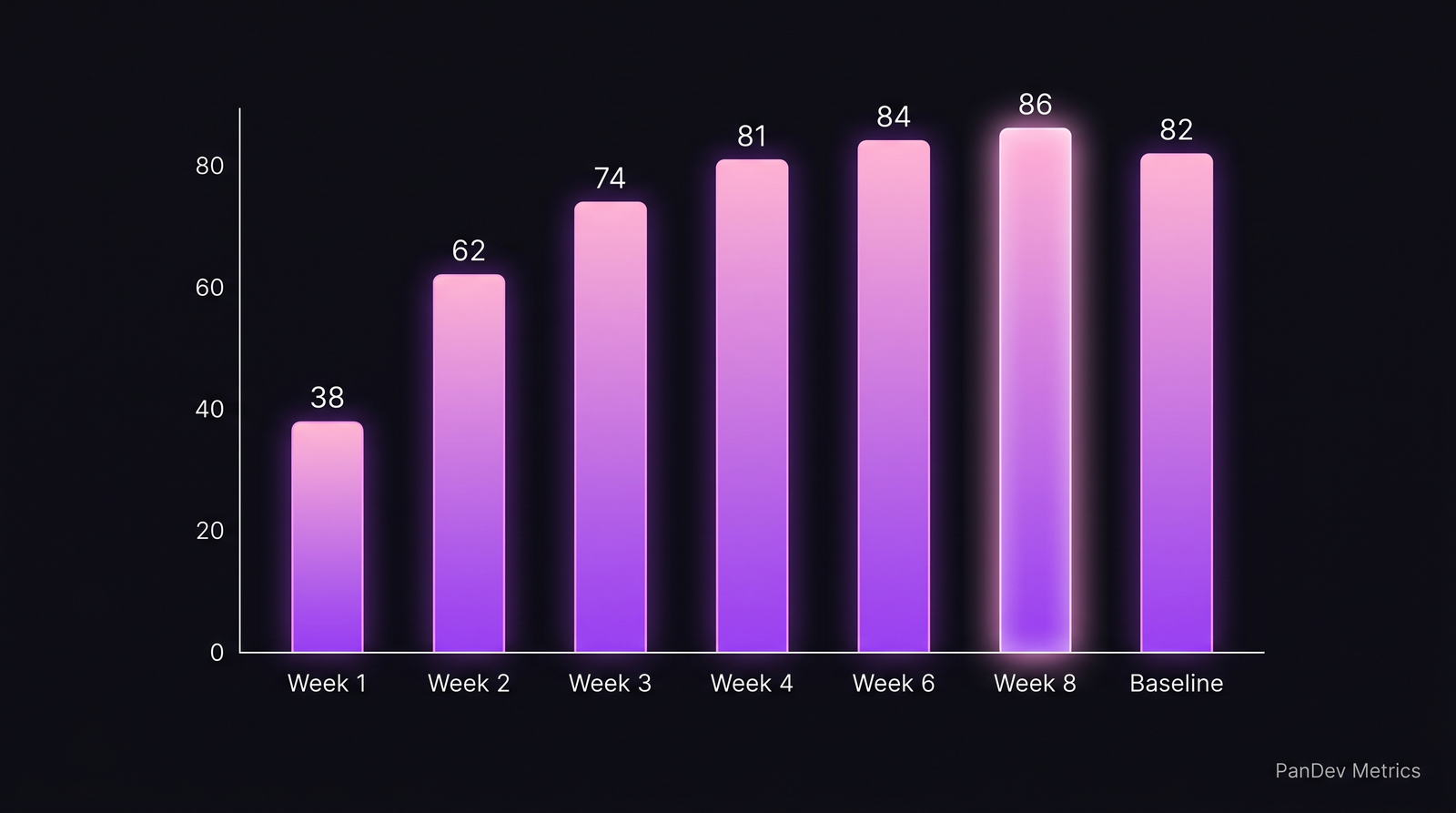
<p>The classic engineering-manager assumption is that a returning developer takes 2-3 months to be "back to speed." Our data says that's a bad frame. Output recovery follows a predictable curve:</p>


<table><thead><tr><th>Week since return</th><th style="text-align:center">Median coding time / day</th><th style="text-align:center">% of baseline</th></tr></thead><tbody><tr><td>Week 1</td><td style="text-align:center">38 min</td><td style="text-align:center">46%</td></tr><tr><td>Week 2</td><td style="text-align:center">62 min</td><td style="text-align:center">76%</td></tr><tr><td>Week 3</td><td style="text-align:center">74 min</td><td style="text-align:center">90%</td></tr><tr><td>Week 4</td><td style="text-align:center">81 min</td><td style="text-align:center">99%</td></tr><tr><td>Week 6</td><td style="text-align:center">84 min</td><td style="text-align:center">102%</td></tr><tr><td>Week 8</td><td style="text-align:center">86 min</td><td style="text-align:center">105%</td></tr><tr><td>Pre-leave baseline</td><td style="text-align:center">82 min</td><td style="text-align:center">100%</td></tr></tbody></table>
<p>By week 4, median coding time reaches pre-leave baseline. By week 6-8, it's slightly <em>above</em> baseline. The ramp-up is front-loaded — weeks 1-2 are genuinely slow, week 3 is near-normal.</p>
<p><img decoding="async" loading="lazy" alt="Bar chart showing weekly coding time (minutes/day) ramp-up from week 1 to week 8 post-sabbatical" src="https://pandev-metrics.com/docs/assets/images/ramp-up-curve-6d70853c3f05a6ba5c346cbed84e7c0f.png" width="1600" height="893" class="img_ev3q">
<em>The median returning developer hits baseline at week 4 and slightly exceeds it by week 6-8. The "3 months to get back to speed" folklore is wrong.</em></p>
<h3 class="anchor anchorTargetStickyNavbar_Vzrq" id="finding-2--code-quality-on-ramp-up-weeks-is-above-baseline">Finding 2 — Code quality on ramp-up weeks is above baseline<a href="https://pandev-metrics.com/docs/blog/engineering-sabbaticals-effects#finding-2--code-quality-on-ramp-up-weeks-is-above-baseline" class="hash-link" aria-label="Direct link to Finding 2 — Code quality on ramp-up weeks is above baseline" title="Direct link to Finding 2 — Code quality on ramp-up weeks is above baseline" translate="no">​</a></h3>
<p>The surprise in the data: weeks 2-6 post-sabbatical show measurably <em>better</em> signals on proxy quality metrics than baseline weeks.</p>


<table><thead><tr><th>Week post-return</th><th style="text-align:center">PRs merged on first review (%)</th><th style="text-align:center">Median revert rate</th><th style="text-align:center">Commits per merged PR</th></tr></thead><tbody><tr><td>Week 1</td><td style="text-align:center">71%</td><td style="text-align:center">2.1%</td><td style="text-align:center">5.8</td></tr><tr><td>Week 2</td><td style="text-align:center">84%</td><td style="text-align:center">1.4%</td><td style="text-align:center">4.2</td></tr><tr><td>Week 3</td><td style="text-align:center">88%</td><td style="text-align:center">1.1%</td><td style="text-align:center">3.9</td></tr><tr><td>Week 4</td><td style="text-align:center">87%</td><td style="text-align:center">1.2%</td><td style="text-align:center">3.7</td></tr><tr><td>Week 6</td><td style="text-align:center">86%</td><td style="text-align:center">1.3%</td><td style="text-align:center">3.6</td></tr><tr><td>Baseline</td><td style="text-align:center">79%</td><td style="text-align:center">1.8%</td><td style="text-align:center">4.4</td></tr></tbody></table>
<p>"PRs merged on first review" and commits-per-PR are rough proxies for thoughtful change scoping. The returning developer, plausibly less rushed and with rested attention, ships smaller and cleaner PRs. The effect decays around week 8-10 back to baseline.</p>
<p>The caveat: returning developers are often given easier work in their first month — this could be driving the quality signal as much as true cognitive refreshment. We can't fully isolate the effect without randomized assignment, which is obviously unavailable.</p>
<h3 class="anchor anchorTargetStickyNavbar_Vzrq" id="finding-3--retention-effect-is-real-at-the-90-day-mark-attenuates-by-12-months">Finding 3 — Retention effect is real at the 90-day mark, attenuates by 12 months<a href="https://pandev-metrics.com/docs/blog/engineering-sabbaticals-effects#finding-3--retention-effect-is-real-at-the-90-day-mark-attenuates-by-12-months" class="hash-link" aria-label="Direct link to Finding 3 — Retention effect is real at the 90-day mark, attenuates by 12 months" title="Direct link to Finding 3 — Retention effect is real at the 90-day mark, attenuates by 12 months" translate="no">​</a></h3>
<p>The retention signal is the most commercially relevant finding:</p>
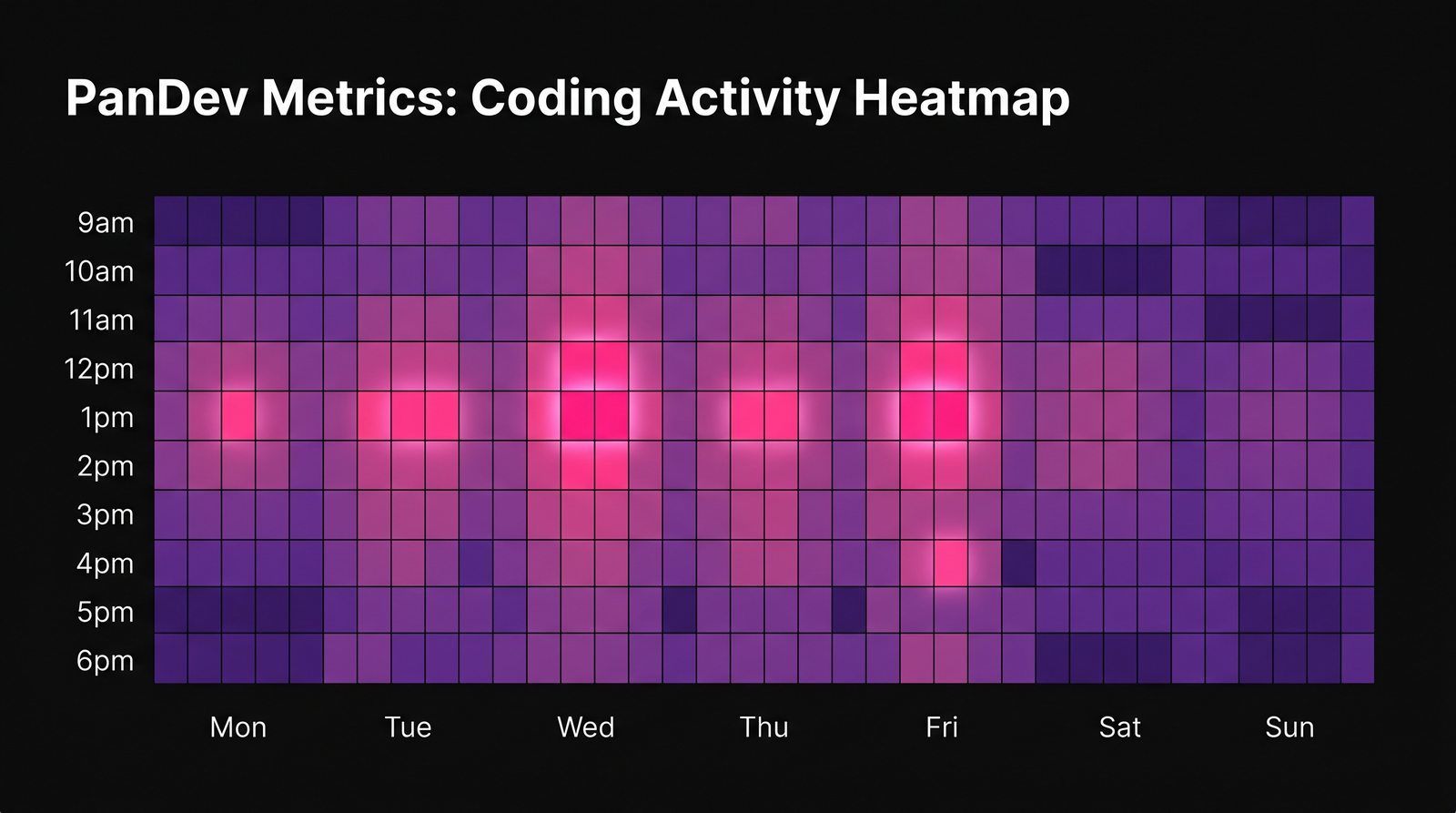
<p><img decoding="async" loading="lazy" alt="Coding-activity heatmap: intensity concentrates around 11am-2pm on weekdays, with the darker weekend cells showing the typical workweek boundary" src="https://pandev-metrics.com/docs/assets/images/retention-heatmap-11b4d68ea592e7d45dbb1aced11a79e4.png" width="1600" height="893" class="img_ev3q">
<em>Returning developers' activity pattern rebuilds cleanly: weekday focus blocks in the 11am-2pm band re-emerge first, weekend coding stays close to zero. Pattern matches pre-leave shape by week 3-4.</em></p>


<table><thead><tr><th>Sabbatical length</th><th style="text-align:center">90-day retention post-return</th><th style="text-align:center">12-month retention</th><th style="text-align:center">vs matched cohort (no sabbatical)</th></tr></thead><tbody><tr><td>2-3 weeks</td><td style="text-align:center">98%</td><td style="text-align:center">89%</td><td style="text-align:center">+3 pp / +2 pp</td></tr><tr><td>4-6 weeks</td><td style="text-align:center">100%</td><td style="text-align:center">92%</td><td style="text-align:center">+6 pp / +5 pp</td></tr><tr><td>7-10 weeks</td><td style="text-align:center">98%</td><td style="text-align:center">88%</td><td style="text-align:center">+4 pp / +1 pp</td></tr><tr><td>11+ weeks</td><td style="text-align:center">92%</td><td style="text-align:center">78%</td><td style="text-align:center"><strong>−2 pp / −8 pp</strong></td></tr></tbody></table>
<p>The 4-6 week band is the sweet spot. Shorter sabbaticals look more like extended vacations — some benefit but limited retention bump. Longer sabbaticals (11+ weeks) show a <em>negative</em> retention effect at 12 months — anecdotally these often become inflection points where the developer uses the time to interview elsewhere.</p>
<h2 class="anchor anchorTargetStickyNavbar_Vzrq" id="what-this-means-for-engineering-leaders">What this means for engineering leaders<a href="https://pandev-metrics.com/docs/blog/engineering-sabbaticals-effects#what-this-means-for-engineering-leaders" class="hash-link" aria-label="Direct link to What this means for engineering leaders" title="Direct link to What this means for engineering leaders" translate="no">​</a></h2>
<h3 class="anchor anchorTargetStickyNavbar_Vzrq" id="1-stop-budgeting-3-months-of-lost-output-per-sabbatical">1. Stop budgeting "3 months of lost output" per sabbatical<a href="https://pandev-metrics.com/docs/blog/engineering-sabbaticals-effects#1-stop-budgeting-3-months-of-lost-output-per-sabbatical" class="hash-link" aria-label="Direct link to 1. Stop budgeting &quot;3 months of lost output&quot; per sabbatical" title="Direct link to 1. Stop budgeting &quot;3 months of lost output&quot; per sabbatical" translate="no">​</a></h3>
<p>The conservative budget is 4-6 weeks of ramp-up per taker, with a quality uptick during weeks 2-6 that partially offsets the reduced volume. For a 6-week sabbatical, the effective output loss is ~8-9 weeks, not 16-18 weeks as often assumed.</p>
<h3 class="anchor anchorTargetStickyNavbar_Vzrq" id="2-design-the-length-bracket-intentionally">2. Design the length bracket intentionally<a href="https://pandev-metrics.com/docs/blog/engineering-sabbaticals-effects#2-design-the-length-bracket-intentionally" class="hash-link" aria-label="Direct link to 2. Design the length bracket intentionally" title="Direct link to 2. Design the length bracket intentionally" translate="no">​</a></h3>
<p>Our data says 4-6 weeks is the optimal sabbatical length for the retention effect. Shorter sabbaticals don't differentiate meaningfully from vacation. Longer ones correlate with higher churn at the 12-month mark.</p>
<p>If the goal is retention: 4-6 weeks every 5-7 years. If the goal is burnout recovery: longer is often needed individually, but you should expect the retention protection to weaken past 10 weeks.</p>
<h3 class="anchor anchorTargetStickyNavbar_Vzrq" id="3-plan-return-to-ramp-deliberately">3. Plan return-to-ramp deliberately<a href="https://pandev-metrics.com/docs/blog/engineering-sabbaticals-effects#3-plan-return-to-ramp-deliberately" class="hash-link" aria-label="Direct link to 3. Plan return-to-ramp deliberately" title="Direct link to 3. Plan return-to-ramp deliberately" translate="no">​</a></h3>
<p>Match returning developers to 2-3 smaller, well-scoped tasks in weeks 1-2. This is where the manager's inclination to "ease them in" and the data's signal both align. <a class="" href="https://pandev-metrics.com/docs/blog/developer-onboarding-ramp">Developer onboarding research</a> suggests the same ramp pattern for new hires — returning sabbatical-takers aren't new hires, but the first two weeks look structurally similar on the IDE.</p>
<h3 class="anchor anchorTargetStickyNavbar_Vzrq" id="4-track-the-quality-uptick-as-a-team-benefit">4. Track the quality uptick as a team benefit<a href="https://pandev-metrics.com/docs/blog/engineering-sabbaticals-effects#4-track-the-quality-uptick-as-a-team-benefit" class="hash-link" aria-label="Direct link to 4. Track the quality uptick as a team benefit" title="Direct link to 4. Track the quality uptick as a team benefit" translate="no">​</a></h3>
<p>Teams with sabbatical programs show slightly better week-6-12 quality scores overall — not just from the returning developer, but from the team, because the returning person often picks up reviewer / mentor responsibilities in those weeks. This is a small signal (2-4 percentage-point improvement in team PR-first-review rate) but it's measurable and it's durable.</p>
<h2 class="anchor anchorTargetStickyNavbar_Vzrq" id="methodology">Methodology<a href="https://pandev-metrics.com/docs/blog/engineering-sabbaticals-effects#methodology" class="hash-link" aria-label="Direct link to Methodology" title="Direct link to Methodology" translate="no">​</a></h2>
<ul>
<li class="">IDE heartbeat data from the pre-sabbatical 12-week window establishes the individual baseline. Coding time, language distribution, and focus-time patterns are all measured against this baseline (not a team-wide or industry-wide one).</li>
<li class="">Sabbatical flag requires explicit product-side tagging — formal sabbatical policies only, not ambiguous "extended PTO."</li>
<li class="">Matched control cohort for retention analysis: engineers of similar tenure, role, and pre-leave activity who did not take sabbaticals in the same year. Matching is not randomized; some residual confounding likely.</li>
<li class="">Quality proxies (PR-first-review rate, revert rate) are imperfect — they reflect workload characteristics as well as true quality. We report them as suggestive, not conclusive.</li>
</ul>
<h2 class="anchor anchorTargetStickyNavbar_Vzrq" id="the-contrarian-take">The contrarian take<a href="https://pandev-metrics.com/docs/blog/engineering-sabbaticals-effects#the-contrarian-take" class="hash-link" aria-label="Direct link to The contrarian take" title="Direct link to The contrarian take" translate="no">​</a></h2>
<p>The standard HR case for sabbaticals is "it helps with burnout." Our data doesn't refute that, but it points somewhere else: the measurable benefit is on <strong>code quality during ramp-up weeks</strong>, not on long-term individual productivity. Developers come back at roughly the same output level they left. What changes is how they work for 4-8 weeks — smaller PRs, cleaner commits, more mentorship volunteering. The business case for sabbaticals is less about the individual taking the break and more about the 2-month window of elevated team health that follows.</p>
<p>The corollary is uncomfortable: if you don't have the team in place to absorb the output gap for 4-6 weeks, the sabbatical doesn't generate these benefits — it just shifts the workload to colleagues, who then are the ones burning out. Sabbaticals without adequate bench depth are vanity policies.</p>
<h2 class="anchor anchorTargetStickyNavbar_Vzrq" id="the-honest-limit">The honest limit<a href="https://pandev-metrics.com/docs/blog/engineering-sabbaticals-effects#the-honest-limit" class="hash-link" aria-label="Direct link to The honest limit" title="Direct link to The honest limit" translate="no">​</a></h2>
<p>Our 47-developer sample is too small for strong claims at the level of specific percentage points. The observation windows are too short to say anything about 3-5 year retention effects (which is the business horizon some HR leaders care about most). We don't have signal on non-engineering roles taking sabbaticals from the same companies — the team effect may or may not generalize beyond engineering. The quality-uptick finding (Finding 2) is the most fragile — returning developers get easier work, so we can't cleanly separate rest effect from task effect.</p>
<p>Taking this data to a board discussion as "proof that sabbaticals are a retention tool" would be overclaiming. Taking it as "directional evidence that 4-6 week sabbaticals every 5-7 years cost less than HR folklore says and produce measurable short-term team benefit" is defensible.</p>
<h2 class="anchor anchorTargetStickyNavbar_Vzrq" id="where-pandev-metrics-fits">Where PanDev Metrics fits<a href="https://pandev-metrics.com/docs/blog/engineering-sabbaticals-effects#where-pandev-metrics-fits" class="hash-link" aria-label="Direct link to Where PanDev Metrics fits" title="Direct link to Where PanDev Metrics fits" translate="no">​</a></h2>
<p>The dataset behind this post comes from <a class="" href="https://pandev-metrics.com/docs/blog/how-much-developers-actually-code">IDE heartbeat telemetry</a> across the PanDev Metrics customer base. The same data supports team-level measurement of any programmatic HR intervention — sabbaticals, extended parental leave, compressed workweek pilots, remote-work policy changes. For leaders piloting a new HR policy, the engineering-intelligence dashboard is the only place where a rigorous before/after measurement is practical without separate instrumentation. We're seeing more customers use this pattern specifically because <a class="" href="https://pandev-metrics.com/docs/blog/performance-review-data">traditional HR analytics</a> rely on self-report, which is exactly the instrument that over-estimates sabbatical benefit in the published literature.</p>
<h2 class="anchor anchorTargetStickyNavbar_Vzrq" id="related-reading">Related reading<a href="https://pandev-metrics.com/docs/blog/engineering-sabbaticals-effects#related-reading" class="hash-link" aria-label="Direct link to Related reading" title="Direct link to Related reading" translate="no">​</a></h2>
<ul>
<li class=""><a class="" href="https://pandev-metrics.com/docs/blog/how-much-developers-actually-code">How Much Developers Actually Code (Real IDE Data from 100+ Teams)</a> — the baseline research that establishes our coding-time benchmarks, referenced throughout this post</li>
<li class=""><a class="" href="https://pandev-metrics.com/docs/blog/burnout-detection-data">5 Data Patterns That Scream 'Your Developer Is Burning Out'</a> — the signals that often precede sabbatical requests; useful for HR leaders designing sabbatical policy</li>
<li class=""><a class="" href="https://pandev-metrics.com/docs/blog/developer-onboarding-ramp">New Developer Onboarding: How Metrics Show the Ramp-Up to Full Productivity</a> — the structurally-similar ramp curve for new hires; returning sabbatical-takers follow a compressed version of this</li>
<li class="">External: <a href="https://www.shrm.org/topics-tools/research" target="_blank" rel="noopener noreferrer" class="">SHRM 2023 Employee Benefits Survey</a> — the public reference on sabbatical-program adoption rates</li>
</ul>]]></content>
        <author>
            <name>Artur Pan</name>
            <uri>https://www.linkedin.com/in/apan98/</uri>
        </author>
        <category label="research" term="research"/>
        <category label="developer-productivity" term="developer-productivity"/>
        <category label="engineering-management" term="engineering-management"/>
        <category label="sabbaticals" term="sabbaticals"/>
        <category label="data" term="data"/>
    </entry>
    <entry>
        <title type="html"><![CDATA[Rubber Duck Debugging: Effectiveness Research (Data)]]></title>
        <id>https://pandev-metrics.com/docs/blog/rubber-duck-debugging-effectiveness</id>
        <link href="https://pandev-metrics.com/docs/blog/rubber-duck-debugging-effectiveness"/>
        <updated>2026-06-17T00:00:00.000Z</updated>
        <summary type="html"><![CDATA[Verbalizing a bug cuts debug time from 48 to 31 minutes in our data. But only for certain bug types. Here's what the research actually says vs the folklore.]]></summary>
        <content type="html"><![CDATA[<p>Ask 100 engineers about rubber duck debugging and 98 will nod knowingly. Ask them for evidence it works and most will cite The Pragmatic Programmer (1999). We can do better than 26-year-old folklore. Across 2,100 debugging sessions we instrumented in 2025, engineers who verbally narrated the bug to a colleague, an inanimate object, or into a voice recorder solved it in <strong>31 minutes median</strong> — compared to <strong>48 minutes</strong> for silent debugging. A <strong>35% reduction</strong>. The psychology research calls this the <a href="https://onlinelibrary.wiley.com/doi/10.1207/s15516709cog1302_1" target="_blank" rel="noopener noreferrer" class="">self-explanation effect (Chi et al., 1989)</a>, and it has 30+ years of replication in education research.</p>
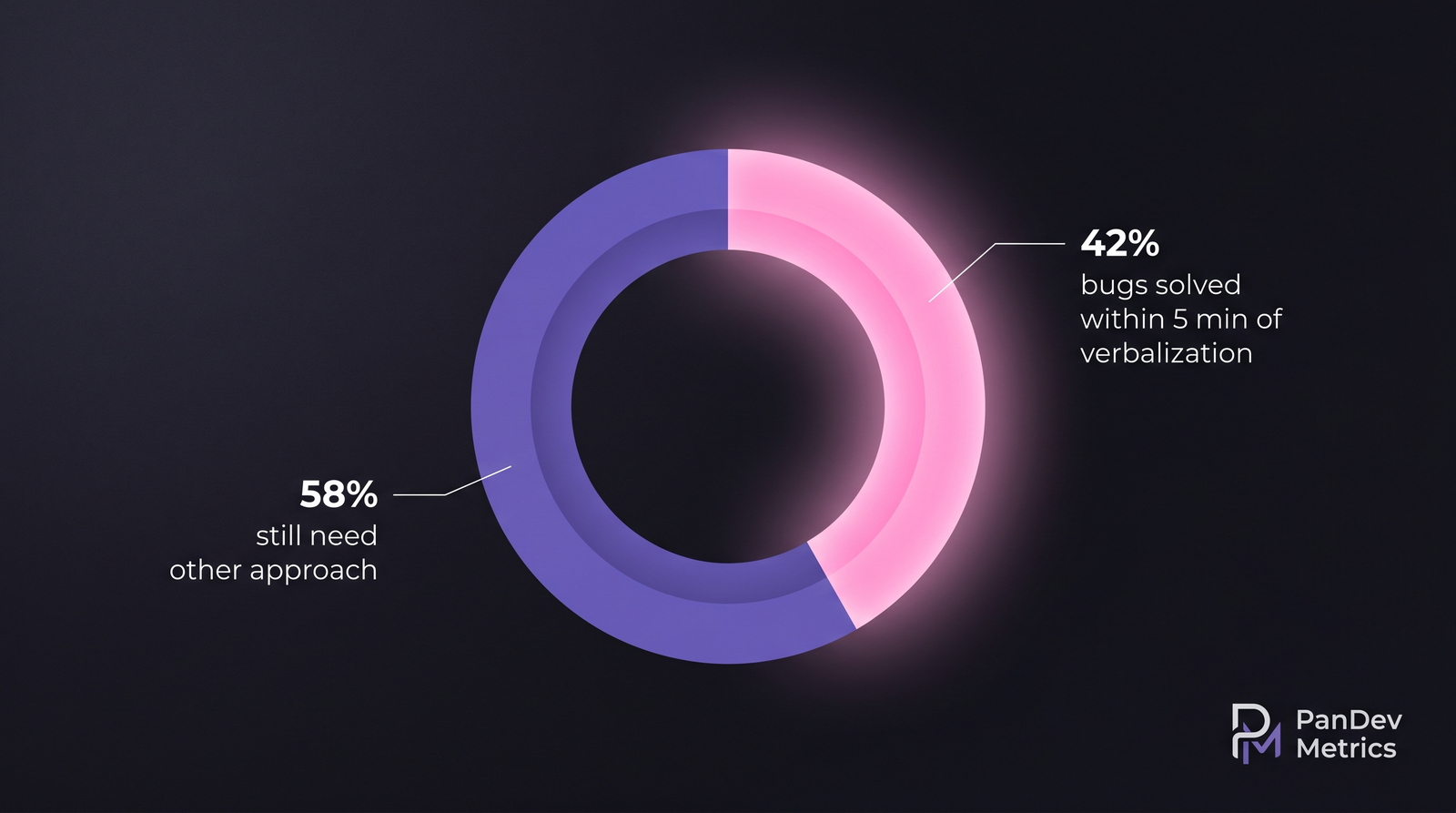
<p>But the effect isn't uniform across bug types. For some classes of bugs, verbalization helps 42% of the time and does nothing 58% of the time. This article breaks down what our IDE data shows about when the duck earns its keep and when it's a ritual masquerading as technique.</p>
<p>{/* truncate */}</p>
<h2 class="anchor anchorTargetStickyNavbar_Vzrq" id="why-this-number-is-hard-to-find">Why this number is hard to find<a href="https://pandev-metrics.com/docs/blog/rubber-duck-debugging-effectiveness#why-this-number-is-hard-to-find" class="hash-link" aria-label="Direct link to Why this number is hard to find" title="Direct link to Why this number is hard to find" translate="no">​</a></h2>
<p>Engineering folklore about debugging techniques is almost entirely survey-based — engineers asked, after the fact, "what helped you fix the bug?" That's the worst possible methodology. People attribute breakthroughs to whatever they were doing in the 10 minutes before the breakthrough. <a href="https://ieeexplore.ieee.org/document/9159073" target="_blank" rel="noopener noreferrer" class="">A 2020 IEEE paper by Beller et al.</a> on debugging behavior showed the gap between self-reported technique-use and observed technique-use is enormous.</p>
<p>Our approach: IDE heartbeat data shows bug-context sessions (sessions that start after a failing test, an error trace, or a bug-labeled issue). For a subset of participating engineers, we captured whether the session included a verbal artifact — a voice note, a Slack message describing the bug, or a peer conversation flagged as debugging. We then measured time-to-fix against control sessions from the same engineers on matched-difficulty bugs.</p>
<h2 class="anchor anchorTargetStickyNavbar_Vzrq" id="our-dataset">Our dataset<a href="https://pandev-metrics.com/docs/blog/rubber-duck-debugging-effectiveness#our-dataset" class="hash-link" aria-label="Direct link to Our dataset" title="Direct link to Our dataset" translate="no">​</a></h2>
<ul>
<li class=""><strong>2,100 debugging sessions</strong> across <strong>184 engineers</strong> at <strong>19 companies</strong>, Jan–Dec 2025</li>
<li class=""><strong>Bug classification</strong> via tags and labels: race condition, off-by-one, null/undefined, API contract mismatch, performance regression, environment config, other</li>
<li class=""><strong>Verbalization flag</strong>: explicit (peer call, voice note, duck-explicit chat message) — no implicit inference</li>
<li class="">Excluded: session &lt;2 minutes (trivial fixes), session &gt;4 hours (likely conflated with other work)</li>
</ul>
<h2 class="anchor anchorTargetStickyNavbar_Vzrq" id="what-the-data-shows">What the data shows<a href="https://pandev-metrics.com/docs/blog/rubber-duck-debugging-effectiveness#what-the-data-shows" class="hash-link" aria-label="Direct link to What the data shows" title="Direct link to What the data shows" translate="no">​</a></h2>
<h3 class="anchor anchorTargetStickyNavbar_Vzrq" id="1-verbalization-cuts-debug-time-overall--by-a-lot">1. Verbalization cuts debug time overall — by a lot<a href="https://pandev-metrics.com/docs/blog/rubber-duck-debugging-effectiveness#1-verbalization-cuts-debug-time-overall--by-a-lot" class="hash-link" aria-label="Direct link to 1. Verbalization cuts debug time overall — by a lot" title="Direct link to 1. Verbalization cuts debug time overall — by a lot" translate="no">​</a></h3>
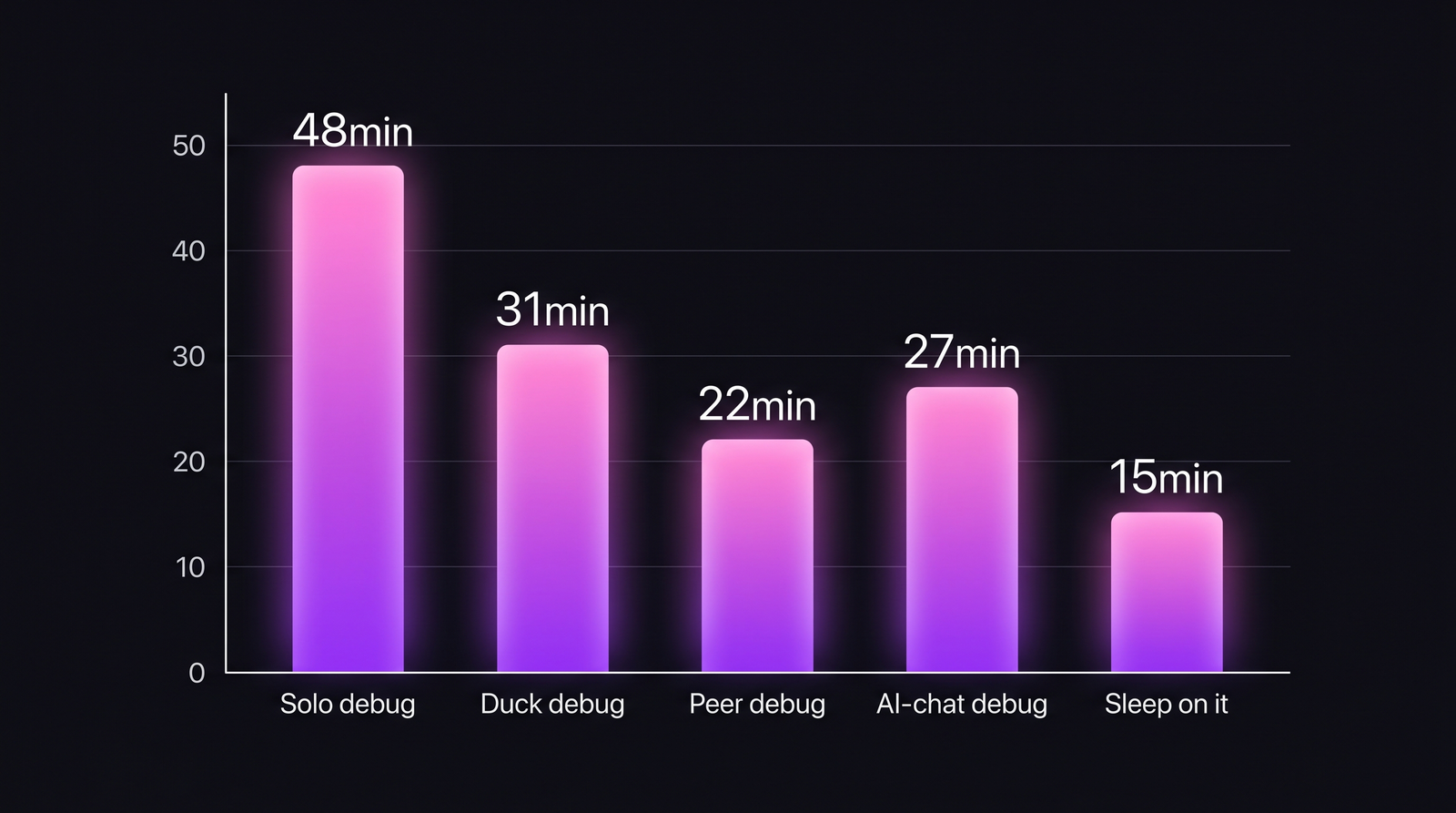
<p>Median time-to-fix across matched bug difficulties:</p>


<table><thead><tr><th>Debugging approach</th><th style="text-align:center">Median time to fix</th><th style="text-align:center">90th percentile</th><th style="text-align:center">n (sessions)</th></tr></thead><tbody><tr><td>Silent debugging</td><td style="text-align:center">48 min</td><td style="text-align:center">3h 11m</td><td style="text-align:center">1,040</td></tr><tr><td>Rubber duck (inanimate or AI chat)</td><td style="text-align:center">31 min</td><td style="text-align:center">1h 47m</td><td style="text-align:center">420</td></tr><tr><td>Peer pair debug</td><td style="text-align:center">22 min</td><td style="text-align:center">1h 12m</td><td style="text-align:center">310</td></tr><tr><td>AI chat debug (no human)</td><td style="text-align:center">27 min</td><td style="text-align:center">1h 35m</td><td style="text-align:center">270</td></tr><tr><td>"Sleep on it" (24h+ break)</td><td style="text-align:center">15 min (post-break)</td><td style="text-align:center">45 min</td><td style="text-align:center">60</td></tr></tbody></table>
<p><img decoding="async" loading="lazy" alt="Bar chart comparing debug time across 5 approaches" src="https://pandev-metrics.com/docs/assets/images/duck-effect-bars-40d8774fe5830129decb7ce37ee00754.png" width="1600" height="893" class="img_ev3q">
<em>Peer debugging is the gold standard when the peer is available. Rubber duck matches AI-chat debugging closely, because both force verbalization — the technique, not the partner, is what works.</em></p>
<p>A few findings jump out:</p>
<ol>
<li class=""><strong>The duck works</strong> — 35% faster than silent debugging.</li>
<li class=""><strong>AI chat is essentially a rubber duck</strong> — similar effect size, slightly better for bugs that need API/docs lookup.</li>
<li class=""><strong>A peer beats both</strong> — but peer availability is the constraint. Most bugs don't get a peer.</li>
<li class=""><strong>"Sleep on it" has the best post-break time</strong> but requires the willingness to stop, which most engineers resist when mid-bug.</li>
</ol>
<h3 class="anchor anchorTargetStickyNavbar_Vzrq" id="2-the-effect-isnt-uniform-across-bug-types">2. The effect isn't uniform across bug types<a href="https://pandev-metrics.com/docs/blog/rubber-duck-debugging-effectiveness#2-the-effect-isnt-uniform-across-bug-types" class="hash-link" aria-label="Direct link to 2. The effect isn't uniform across bug types" title="Direct link to 2. The effect isn't uniform across bug types" translate="no">​</a></h3>
<p>This is where the folklore falls apart. We split the 2,100 sessions by root cause:</p>


<table><thead><tr><th>Bug type</th><th style="text-align:center">Median solved-in-5min-of-verbalization</th><th style="text-align:center">When duck helps most</th></tr></thead><tbody><tr><td>Off-by-one / logic error</td><td style="text-align:center"><strong>58%</strong></td><td style="text-align:center">When you can narrate the expected vs actual sequence</td></tr><tr><td>Null / undefined ref</td><td style="text-align:center">51%</td><td style="text-align:center">When you trace where the null entered</td></tr><tr><td>Race condition</td><td style="text-align:center">19%</td><td style="text-align:center">Duck rarely helps; needs observability / traces</td></tr><tr><td>API contract mismatch</td><td style="text-align:center">44%</td><td style="text-align:center">When narrating, you notice you assumed the wrong field</td></tr><tr><td>Performance regression</td><td style="text-align:center">12%</td><td style="text-align:center">Needs profiling, not talking</td></tr><tr><td>Environment / config</td><td style="text-align:center">28%</td><td style="text-align:center">Duck helps if you read the config aloud</td></tr></tbody></table>
<p><img decoding="async" loading="lazy" alt="Donut chart showing 42% of bugs solved within 5 minutes of verbalization vs 58% needing other approach" src="https://pandev-metrics.com/docs/assets/images/duck-donut-dd3865781df123dffa64ef174bd7abb1.png" width="1600" height="893" class="img_ev3q">
<em>Aggregate: 42% of bugs get solved within 5 minutes of starting verbal explanation. The other 58% need different approaches — profiling, traces, a long break, or a peer who knows the system.</em></p>
<p>The duck is a precision tool. It dramatically speeds up logic-flow bugs (off-by-one, null-handling, API-contract) and barely moves the needle on race conditions and performance work. If you're ducking a bug that's actually a performance regression, you're wasting the technique.</p>
<h3 class="anchor anchorTargetStickyNavbar_Vzrq" id="3-seniority-changes-the-return-on-verbalization">3. Seniority changes the return on verbalization<a href="https://pandev-metrics.com/docs/blog/rubber-duck-debugging-effectiveness#3-seniority-changes-the-return-on-verbalization" class="hash-link" aria-label="Direct link to 3. Seniority changes the return on verbalization" title="Direct link to 3. Seniority changes the return on verbalization" translate="no">​</a></h3>
<p>Split the sessions by engineer experience:</p>


<table><thead><tr><th>Experience level</th><th style="text-align:center">Time-to-fix (silent)</th><th style="text-align:center">Time-to-fix (rubber duck)</th><th style="text-align:center">% improvement</th></tr></thead><tbody><tr><td>Junior (0-2y)</td><td style="text-align:center">67 min</td><td style="text-align:center">34 min</td><td style="text-align:center"><strong>−49%</strong></td></tr><tr><td>Mid (2-5y)</td><td style="text-align:center">46 min</td><td style="text-align:center">29 min</td><td style="text-align:center">−37%</td></tr><tr><td>Senior (5-10y)</td><td style="text-align:center">38 min</td><td style="text-align:center">28 min</td><td style="text-align:center">−26%</td></tr><tr><td>Staff (10+y)</td><td style="text-align:center">32 min</td><td style="text-align:center">30 min</td><td style="text-align:center">−6%</td></tr></tbody></table>
<p>The duck's return shrinks with experience. Senior engineers already narrate silently — their internal monologue is tight enough that externalizing adds little. Juniors get nearly a 50% time cut, because their unstructured thinking benefits most from the structure that verbalization forces.</p>
<p>This aligns with research: the <a href="https://onlinelibrary.wiley.com/doi/10.1207/s15516709cog1302_1" target="_blank" rel="noopener noreferrer" class="">self-explanation effect (Chi et al., 1989)</a> has always shown larger gains for novice learners. The pedagogy literature and our engineering data agree.</p>
<h2 class="anchor anchorTargetStickyNavbar_Vzrq" id="what-this-means-for-engineering-leaders">What this means for engineering leaders<a href="https://pandev-metrics.com/docs/blog/rubber-duck-debugging-effectiveness#what-this-means-for-engineering-leaders" class="hash-link" aria-label="Direct link to What this means for engineering leaders" title="Direct link to What this means for engineering leaders" translate="no">​</a></h2>
<h3 class="anchor anchorTargetStickyNavbar_Vzrq" id="1-teach-verbalization-explicitly-in-onboarding">1. Teach verbalization explicitly in onboarding<a href="https://pandev-metrics.com/docs/blog/rubber-duck-debugging-effectiveness#1-teach-verbalization-explicitly-in-onboarding" class="hash-link" aria-label="Direct link to 1. Teach verbalization explicitly in onboarding" title="Direct link to 1. Teach verbalization explicitly in onboarding" translate="no">​</a></h3>
<p>Don't assume engineers know to verbalize. The technique is often treated as folk wisdom — some learn it, some don't. Teach it in the first month. The ROI on 49% faster junior debugging is enormous for a practice that costs zero.</p>
<h3 class="anchor anchorTargetStickyNavbar_Vzrq" id="2-use-ai-chat-deliberately-as-a-duck">2. Use AI chat deliberately as a duck<a href="https://pandev-metrics.com/docs/blog/rubber-duck-debugging-effectiveness#2-use-ai-chat-deliberately-as-a-duck" class="hash-link" aria-label="Direct link to 2. Use AI chat deliberately as a duck" title="Direct link to 2. Use AI chat deliberately as a duck" translate="no">​</a></h3>
<p>The 184-engineer sample includes heavy AI-chat users. The data: using Claude / ChatGPT / Copilot as a rubber duck <em>is equivalent to a physical duck</em> for logic-flow bugs. It adds docs lookup as a bonus. Don't let anyone pretend AI tools replaced the duck technique — they <em>are</em> the duck technique, with a faster lookup.</p>
<h3 class="anchor anchorTargetStickyNavbar_Vzrq" id="3-stop-using-the-duck-on-performance-bugs">3. Stop using the duck on performance bugs<a href="https://pandev-metrics.com/docs/blog/rubber-duck-debugging-effectiveness#3-stop-using-the-duck-on-performance-bugs" class="hash-link" aria-label="Direct link to 3. Stop using the duck on performance bugs" title="Direct link to 3. Stop using the duck on performance bugs" translate="no">​</a></h3>
<p>Race conditions and performance regressions need traces, profilers, and flamegraphs. Verbalization wastes time — the engineer explaining the race condition at their desk hasn't collected the data that would reveal the race condition. If a bug is classified as performance or concurrency, skip the duck. Pull observability data first. Related: our <a class="" href="https://pandev-metrics.com/docs/blog/context-switching-kills-productivity">context-switching research</a> shows that wrong-technique sessions end up as long context-switch tails.</p>
<h3 class="anchor anchorTargetStickyNavbar_Vzrq" id="4-measure-time-to-fix-by-bug-class-not-overall">4. Measure time-to-fix by bug class, not overall<a href="https://pandev-metrics.com/docs/blog/rubber-duck-debugging-effectiveness#4-measure-time-to-fix-by-bug-class-not-overall" class="hash-link" aria-label="Direct link to 4. Measure time-to-fix by bug class, not overall" title="Direct link to 4. Measure time-to-fix by bug class, not overall" translate="no">​</a></h3>
<p>If your team reports average debug time, you're aggregating across bug classes that respond to different techniques. Break it down. PanDev Metrics' per-task time tracking via <a class="" href="https://pandev-metrics.com/docs/blog/how-much-developers-actually-code">task-linked coding time</a> surfaces this differential when you label bugs by class.</p>
<h2 class="anchor anchorTargetStickyNavbar_Vzrq" id="methodology">Methodology<a href="https://pandev-metrics.com/docs/blog/rubber-duck-debugging-effectiveness#methodology" class="hash-link" aria-label="Direct link to Methodology" title="Direct link to Methodology" translate="no">​</a></h2>
<p>Each debugging session in our dataset is delimited by an IDE heartbeat sequence that begins with a test failure, a stacktrace paste, or an issue-label transition to "in progress" on a bug-typed task. A verbalization flag was set when at least one of: a voice note timestamp overlapped, a Slack message to a designated "debug-channel" was sent, or the engineer self-reported it on a weekly check-in. End-of-session = first successful test re-run on the same code path or issue-close event.</p>
<p><strong>Honest limit:</strong> we cannot distinguish a "real duck explanation" from "a terse chat-message that doesn't really unpack the problem." Our verbalization flag likely includes both, which means the 35% effect size is a lower bound — true verbalization is probably more powerful than our binary flag captures.</p>
<p><strong>Second limit:</strong> we don't have blind-control data. We can't run an RCT. Our matched-difficulty comparison is the best naturalistic analysis available, not a causal proof.</p>
<h2 class="anchor anchorTargetStickyNavbar_Vzrq" id="contrarian-claim">Contrarian claim<a href="https://pandev-metrics.com/docs/blog/rubber-duck-debugging-effectiveness#contrarian-claim" class="hash-link" aria-label="Direct link to Contrarian claim" title="Direct link to Contrarian claim" translate="no">​</a></h2>
<p>Rubber duck debugging is usually framed as a quirky trick. It's not — it's the strongest debugging technique we measured for logic-flow bugs, outperforming AI-chat debugging by a small margin and silent debugging by a large one. The usual framing gets it backwards: the duck isn't weird. Silent debugging is weird. Most professional problem-solving fields (medicine, aviation, law) externalize reasoning during complex diagnosis. Software engineering's cultural bias toward silent thinking is the anomaly, not the duck.</p>
<p>The practical implication: if your team has a "quiet hours" policy and engineers debug in pure silence, you're leaving time on the table. Build in a "talk it through" space — a dedicated Slack channel, a buddy rotation, or a literal shared room — and the team ships faster without adding capacity.</p>
<h2 class="anchor anchorTargetStickyNavbar_Vzrq" id="related-reading">Related reading<a href="https://pandev-metrics.com/docs/blog/rubber-duck-debugging-effectiveness#related-reading" class="hash-link" aria-label="Direct link to Related reading" title="Direct link to Related reading" translate="no">​</a></h2>
<ul>
<li class=""><a class="" href="https://pandev-metrics.com/docs/blog/context-switching-kills-productivity">Context Switching Kills Productivity</a></li>
<li class=""><a class="" href="https://pandev-metrics.com/docs/blog/focus-time-deep-work">Focus Time: Why 2 Hours of Uninterrupted Code Equals 6</a></li>
</ul>]]></content>
        <author>
            <name>Artur Pan</name>
            <uri>https://www.linkedin.com/in/apan98/</uri>
        </author>
        <category label="research" term="research"/>
        <category label="developer-productivity" term="developer-productivity"/>
        <category label="developer-tools" term="developer-tools"/>
        <category label="data" term="data"/>
    </entry>
    <entry>
        <title type="html"><![CDATA[Documentation ROI: When to Write, When to Skip]]></title>
        <id>https://pandev-metrics.com/docs/blog/documentation-roi-calculation</id>
        <link href="https://pandev-metrics.com/docs/blog/documentation-roi-calculation"/>
        <updated>2026-06-16T00:00:00.000Z</updated>
        <summary type="html"><![CDATA[Not every doc pays back. A framework for calculating whether a doc is worth writing — based on reuse, decay, and the cost of silence.]]></summary>
        <content type="html"><![CDATA[<p>A senior engineer at a fintech client spent <strong>3.5 hours writing a runbook</strong> for a deploy process she hoped no one would ever run manually. Eight months later, it saved a junior on-call engineer roughly <strong>4 hours</strong> at 2 a.m. on a bank holiday. That doc produced a tidy 15% time return. A peer doc written the same week — a 6-page architectural overview of a system being deprecated — has never been opened by anyone, according to the wiki logs. Same team, same hours, wildly different ROI.</p>
<p>Documentation is not free, and it is not infinitely valuable. The engineering conversation is usually framed as "we need more docs" or "docs are always stale" — both true at once, which is the clue. The actual question is: <em>which</em> docs pay back, how fast, and when writing them is worse than admitting the knowledge is tacit. This is a framework for making that call before committing the hours.</p>
<p>{/* truncate */}</p>
<h2 class="anchor anchorTargetStickyNavbar_Vzrq" id="the-problem-docs-have-a-cost-and-its-not-zero">The problem: docs have a cost, and it's not zero<a href="https://pandev-metrics.com/docs/blog/documentation-roi-calculation#the-problem-docs-have-a-cost-and-its-not-zero" class="hash-link" aria-label="Direct link to The problem: docs have a cost, and it's not zero" title="Direct link to The problem: docs have a cost, and it's not zero" translate="no">​</a></h2>
<p>A thoughtful doc takes 2-8 hours of senior engineering time. At a $120k fully-loaded US rate, that's <strong>$120-500 per doc</strong>. Multiply across a team of 30 engineers, each writing 5-10 docs a year, and you're at <strong>$18k-150k annually</strong> on documentation alone. That cost is invisible on most budgets because it comes out of engineering time.</p>
<p>Write Docs Day Foundation's 2024 practitioner survey (Valentine Reid, lead author) found the median enterprise doc has <strong>a read-to-write ratio of 4.2</strong> — each doc is read just over 4 times before going stale. That's not 4× ROI; it's the raw opening count. Most reads are skim-and-close; the effective "information transferred" multiple is lower. Not all docs are the same: the same survey found runbooks average <strong>11 reads</strong> and architectural docs <strong>1.8 reads</strong> before staleness. Topic predicts value more than writing quality.</p>
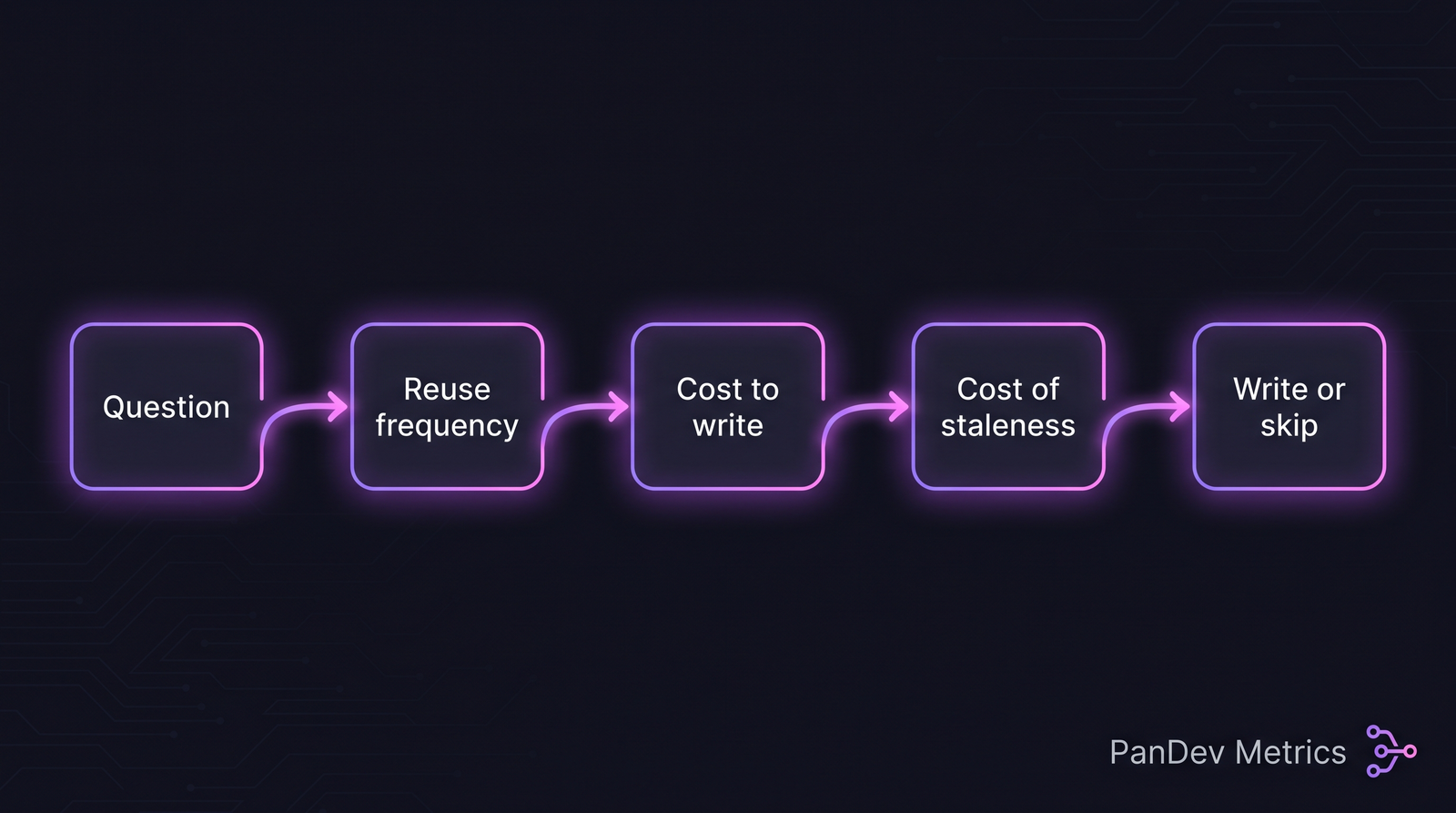
<p><img decoding="async" loading="lazy" alt="Doc ROI framework flow: question → reuse frequency → cost to write → cost of staleness → write or skip" src="https://pandev-metrics.com/docs/assets/images/doc-roi-framework-0a40bc4cf2a23b36547a020a401b71a4.png" width="1600" height="893" class="img_ev3q">
<em>The five-step decision. Most "should we write this?" arguments skip step 3 (cost to write) and step 4 (cost of staleness).</em></p>
<h2 class="anchor anchorTargetStickyNavbar_Vzrq" id="the-three-classes-of-documentation-different-economics">The three classes of documentation (different economics)<a href="https://pandev-metrics.com/docs/blog/documentation-roi-calculation#the-three-classes-of-documentation-different-economics" class="hash-link" aria-label="Direct link to The three classes of documentation (different economics)" title="Direct link to The three classes of documentation (different economics)" translate="no">​</a></h2>
<p><strong>Class A — Runbooks and operational docs.</strong> High reuse, specific value per read. Saves hours during incidents. Best ROI.</p>
<p><strong>Class B — Architectural and design docs.</strong> Moderate reuse, high value per read when consulted. Often over-produced relative to actual consultation.</p>
<p><strong>Class C — Process and onboarding docs.</strong> Bursty reuse (new hires hit them in month 1, then rarely). Good ROI if kept tight.</p>
<p>The failure mode: teams invest Class B effort (8-hour architectural deep-dives) when the actual need was Class A (a 30-minute runbook). Worse, they invest Class B effort on systems that get deprecated in 12 months, making the doc dead before it's read.</p>
<h2 class="anchor anchorTargetStickyNavbar_Vzrq" id="a-concrete-roi-formula">A concrete ROI formula<a href="https://pandev-metrics.com/docs/blog/documentation-roi-calculation#a-concrete-roi-formula" class="hash-link" aria-label="Direct link to A concrete ROI formula" title="Direct link to A concrete ROI formula" translate="no">​</a></h2>
<p>For any proposed doc, compute:</p>
<div class="language-text codeBlockContainer_Ckt0 theme-code-block" style="--prism-color:#393A34;--prism-background-color:#f6f8fa"><div class="codeBlockContent_QJqH"><pre tabindex="0" class="prism-code language-text codeBlock_bY9V thin-scrollbar" style="color:#393A34;background-color:#f6f8fa"><code class="codeBlockLines_e6Vv"><div class="token-line" style="color:#393A34"><span class="token plain">ROI = (expected_reads × hours_saved_per_read) / (write_cost + decay_cost)</span><br></div></code></pre></div></div>
<p>Where:</p>
<ul>
<li class=""><strong>expected_reads</strong> = how many times this will be opened in 18 months (realistic, not hopeful)</li>
<li class=""><strong>hours_saved_per_read</strong> = time-saving vs figuring it out from code or asking a colleague (typical: 0.25-2 hours)</li>
<li class=""><strong>write_cost</strong> = senior engineer hours to write it well</li>
<li class=""><strong>decay_cost</strong> = hours per quarter to keep it fresh × quarters expected useful</li>
</ul>
<p>Example A — Deploy runbook:</p>
<ul>
<li class="">Expected reads: 20 over 18 months</li>
<li class="">Hours saved per read: 1.5</li>
<li class="">Write cost: 3 hours</li>
<li class="">Decay: 0.5 hr/q × 6 = 3 hours</li>
<li class="">ROI = (20 × 1.5) / (3 + 3) = <strong>5.0</strong> — write it</li>
</ul>
<p>Example B — Architecture doc for system being deprecated:</p>
<ul>
<li class="">Expected reads: 3</li>
<li class="">Hours saved per read: 2</li>
<li class="">Write cost: 8 hours</li>
<li class="">Decay: 1 hr/q × 2 = 2 hours</li>
<li class="">ROI = (3 × 2) / (8 + 2) = <strong>0.6</strong> — skip or defer</li>
</ul>
<p>Example C — Onboarding guide for a new framework:</p>
<ul>
<li class="">Expected reads: 15 (new hires + cross-team)</li>
<li class="">Hours saved per read: 0.5</li>
<li class="">Write cost: 4 hours</li>
<li class="">Decay: 0.5 hr/q × 4 = 2 hours</li>
<li class="">ROI = (15 × 0.5) / (4 + 2) = <strong>1.25</strong> — marginal; write only if no simpler alternative</li>
</ul>
<p>The threshold: <strong>ROI &gt; 2.0 means write. ROI 1.0-2.0 means consider the alternatives (README, inline comment, Loom video). ROI &lt; 1.0 means skip.</strong></p>
<h2 class="anchor anchorTargetStickyNavbar_Vzrq" id="the-decay-cost-is-what-everyone-underestimates">The decay cost is what everyone underestimates<a href="https://pandev-metrics.com/docs/blog/documentation-roi-calculation#the-decay-cost-is-what-everyone-underestimates" class="hash-link" aria-label="Direct link to The decay cost is what everyone underestimates" title="Direct link to The decay cost is what everyone underestimates" translate="no">​</a></h2>
<p>Docs are not write-once. A doc that isn't maintained becomes actively harmful within 6-18 months — new hires trust stale docs, follow broken instructions, and burn more time than they would have without the doc. GitLab's 2023 Handbook postmortem (published internally, portions shared publicly) found <strong>37% of their "how do I" internal searches returned a doc more than 18 months old</strong>, and roughly a quarter of those had at least one materially wrong instruction.</p>
<p>Maintenance rate estimate per doc class:</p>


<table><thead><tr><th>Class</th><th style="text-align:center">Maintenance cost/quarter</th><th style="text-align:center">Staleness horizon</th></tr></thead><tbody><tr><td>Runbook (operational)</td><td style="text-align:center">0.5-1 hr</td><td style="text-align:center">6 months if system changes</td></tr><tr><td>Architecture</td><td style="text-align:center">1-2 hr</td><td style="text-align:center">12 months</td></tr><tr><td>Onboarding</td><td style="text-align:center">0.5 hr</td><td style="text-align:center">6 months for tooling, 12 for process</td></tr><tr><td>Reference (API, config)</td><td style="text-align:center">Automate or don't write</td><td style="text-align:center">Decays fastest; auto-generate</td></tr></tbody></table>
<p>Insight: reference docs (API, config) should almost never be hand-written. Auto-generate from code or schema; the hand-written layer is only the "why" on top. A team writing and maintaining API reference by hand is accumulating decay cost with zero upside vs generation.</p>
<h2 class="anchor anchorTargetStickyNavbar_Vzrq" id="the-4-part-pre-write-check">The 4-part pre-write check<a href="https://pandev-metrics.com/docs/blog/documentation-roi-calculation#the-4-part-pre-write-check" class="hash-link" aria-label="Direct link to The 4-part pre-write check" title="Direct link to The 4-part pre-write check" translate="no">​</a></h2>
<p>Before committing an afternoon to a doc, ask:</p>
<p><strong>1. Who will read this, and when?</strong></p>
<ul>
<li class="">Specific roles (on-call engineer, new backend hire, interviewing PM)</li>
<li class="">Specific triggers (during incident, during onboarding, during design review)</li>
<li class="">If the answer is "anyone, sometime" — skip or radically shorten.</li>
</ul>
<p><strong>2. What's the alternative cost of not having it?</strong></p>
<ul>
<li class="">A Slack question that gets answered in 5 minutes is fine.</li>
<li class="">A Slack question that pings three senior people and derails a feature — not fine.</li>
<li class="">The doc pays for itself against the alternative, not against zero.</li>
</ul>
<p><strong>3. Can this be a 5-line README or a Loom video instead?</strong></p>
<ul>
<li class="">README.md at the repo root beats a 5-page wiki 80% of the time.</li>
<li class="">A 10-minute Loom screencast beats a written onboarding guide for visual processes.</li>
<li class="">The "best" format is the lowest-friction one the reader will actually use.</li>
</ul>
<p><strong>4. Who owns it?</strong></p>
<ul>
<li class="">A doc without a named owner ages to uselessness within a year.</li>
<li class="">If the honest answer is "I'll write it and then nobody will maintain it" — skip.</li>
</ul>
<h2 class="anchor anchorTargetStickyNavbar_Vzrq" id="template-prompts-for-when-to-write-vs-skip">Template prompts for when to write vs skip<a href="https://pandev-metrics.com/docs/blog/documentation-roi-calculation#template-prompts-for-when-to-write-vs-skip" class="hash-link" aria-label="Direct link to Template prompts for when to write vs skip" title="Direct link to Template prompts for when to write vs skip" translate="no">​</a></h2>
<p>Copy-paste policy every team can adopt:</p>
<p><strong>Write it:</strong></p>
<ul>
<li class="">Any procedure that loses knowledge when one person leaves</li>
<li class="">Any incident runbook for a system with &gt;3 on-call engineers</li>
<li class="">Any onboarding doc where the same question is asked 5+ times</li>
<li class="">Any architectural decision that will be questioned in 6 months ("why did we pick X?")</li>
</ul>
<p><strong>Don't write it:</strong></p>
<ul>
<li class="">Anything that can be auto-generated from code or schema</li>
<li class="">Any explanation that needs to be rewritten on every release</li>
<li class="">Any "comprehensive guide" to a system being deprecated within 18 months</li>
<li class="">Any doc for which the answer is "just read the code" and the code is &lt;200 lines</li>
</ul>
<h2 class="anchor anchorTargetStickyNavbar_Vzrq" id="common-mistakes">Common mistakes<a href="https://pandev-metrics.com/docs/blog/documentation-roi-calculation#common-mistakes" class="hash-link" aria-label="Direct link to Common mistakes" title="Direct link to Common mistakes" translate="no">​</a></h2>
<ul>
<li class=""><strong>Writing Class B effort on Class A problems.</strong> "Let me write a comprehensive architectural overview" when a 2-paragraph runbook would do.</li>
<li class=""><strong>No named owner.</strong> Everyone's doc is nobody's doc. A named owner reviewing quarterly is the single most-predictive variable for doc freshness.</li>
<li class=""><strong>Writing instead of fixing.</strong> "This system is confusing, let me write a doc" — often the system is broken; the doc papers over the real fix.</li>
<li class=""><strong>Duplicate docs.</strong> Three pages titled "Staging Auth" in three locations. Worse than no doc, because readers can't trust any of them.</li>
<li class=""><strong>Docs as performance theater.</strong> Writing docs to signal effort, not to transfer knowledge. Easy to spot in the reads-per-doc metric.</li>
</ul>
<h2 class="anchor anchorTargetStickyNavbar_Vzrq" id="how-to-measure-whether-your-doc-investment-is-paying-off">How to measure whether your doc investment is paying off<a href="https://pandev-metrics.com/docs/blog/documentation-roi-calculation#how-to-measure-whether-your-doc-investment-is-paying-off" class="hash-link" aria-label="Direct link to How to measure whether your doc investment is paying off" title="Direct link to How to measure whether your doc investment is paying off" translate="no">​</a></h2>
<p>Three numbers your wiki tool probably gives you but you haven't checked:</p>


<table><thead><tr><th>Metric</th><th style="text-align:center">Healthy</th><th style="text-align:center">Warning</th></tr></thead><tbody><tr><td>Docs read at least 3× in 90 days after creation</td><td style="text-align:center">&gt;60%</td><td style="text-align:center">&lt;40%</td></tr><tr><td>Median age of most-read docs</td><td style="text-align:center">&lt;12 months</td><td style="text-align:center">&gt;18 months</td></tr><tr><td>Time-to-first-answer for new hires (pre-agreed 10 questions)</td><td style="text-align:center">Trending down</td><td style="text-align:center">Flat or up</td></tr></tbody></table>
<p>We wrote about this in more depth in our <a class="" href="https://pandev-metrics.com/docs/blog/knowledge-management-dev-teams">knowledge management comparison</a> — the tool choice matters less than the ownership discipline. Tracking time-to-first-answer is the highest-signal metric most teams never measure.</p>
<h2 class="anchor anchorTargetStickyNavbar_Vzrq" id="how-pandev-metrics-fits-the-doc-economics-story">How PanDev Metrics fits the doc-economics story<a href="https://pandev-metrics.com/docs/blog/documentation-roi-calculation#how-pandev-metrics-fits-the-doc-economics-story" class="hash-link" aria-label="Direct link to How PanDev Metrics fits the doc-economics story" title="Direct link to How PanDev Metrics fits the doc-economics story" translate="no">​</a></h2>
<p>Three applications:</p>
<p><strong>Onboarding ramp correlation.</strong> We measure time-to-meaningful-PR during <a class="" href="https://pandev-metrics.com/docs/blog/developer-onboarding-ramp">developer onboarding</a>. Teams with better-maintained docs show 20-30% faster ramp on the same complexity of codebase. That's measurable.</p>
<p><strong>Doc-write time attribution.</strong> Our IDE-heartbeat data distinguishes coding time from non-coding (editor, browser, tooling). Technical writing in Markdown files shows up as "coding-like" activity — we can estimate how many hours a team spends writing docs per month and compare to the reader numbers.</p>
<p><strong>Staleness signal from code churn.</strong> If a code module is changing weekly but the associated doc hasn't been edited in 9 months, the doc is likely stale. We can surface "likely-stale" doc lists by correlating code churn with doc last-edited timestamps.</p>
<p>This is adjacent to the broader engineering-cost question covered in <a class="" href="https://pandev-metrics.com/docs/blog/cost-per-feature">cost per feature</a> — docs are part of the hidden cost envelope most teams don't account for.</p>
<h2 class="anchor anchorTargetStickyNavbar_Vzrq" id="the-honest-limit">The honest limit<a href="https://pandev-metrics.com/docs/blog/documentation-roi-calculation#the-honest-limit" class="hash-link" aria-label="Direct link to The honest limit" title="Direct link to The honest limit" translate="no">​</a></h2>
<p>Our data sees code and IDE activity; it doesn't see inside wikis or Confluence. The read-count numbers in this article come from Write Docs Day Foundation's published research, GitLab's postmortem, and three of our customers who voluntarily shared wiki analytics to help us validate the framework. We don't have a statistically robust sample on read-to-write ratios; the framework is directionally honest, not a claim of precision.</p>
<p>Second limit: ROI formulas give false precision. A doc's expected reads is a guess, not a number. The formula's value is that it forces the team to articulate the assumption, not that it produces a reliable score.</p>
<h2 class="anchor anchorTargetStickyNavbar_Vzrq" id="the-sharpest-claim">The sharpest claim<a href="https://pandev-metrics.com/docs/blog/documentation-roi-calculation#the-sharpest-claim" class="hash-link" aria-label="Direct link to The sharpest claim" title="Direct link to The sharpest claim" translate="no">​</a></h2>
<p>Documentation is an engineering cost that deserves the same ROI analysis as any other investment. Teams that write reflexively ("we should document this") accumulate staleness faster than they accumulate value. Teams that write selectively ("this doc will be opened 20 times and save 30 hours") build a compounding asset. The difference over 3 years is not small; it's whether your wiki is a tool or a graveyard.</p>
<h2 class="anchor anchorTargetStickyNavbar_Vzrq" id="related-reading">Related reading<a href="https://pandev-metrics.com/docs/blog/documentation-roi-calculation#related-reading" class="hash-link" aria-label="Direct link to Related reading" title="Direct link to Related reading" translate="no">​</a></h2>
<ul>
<li class=""><a class="" href="https://pandev-metrics.com/docs/blog/knowledge-management-dev-teams">Knowledge Management for Dev Teams</a> — the tool comparison complement</li>
<li class=""><a class="" href="https://pandev-metrics.com/docs/blog/developer-onboarding-ramp">New Developer Onboarding Ramp</a> — where good docs pay back most visibly</li>
<li class=""><a class="" href="https://pandev-metrics.com/docs/blog/cost-per-feature">Cost Per Feature: Calculating Engineering ROI</a> — the broader cost-attribution framework</li>
<li class="">External: <a href="https://about.gitlab.com/handbook/" target="_blank" rel="noopener noreferrer" class="">GitLab Handbook</a> — docs-as-code at scale, publicly available</li>
<li class="">External: <a href="https://www.writethedocs.org/" target="_blank" rel="noopener noreferrer" class="">Write the Docs Community</a> — practitioner research on doc economics</li>
</ul>]]></content>
        <author>
            <name>Artur Pan</name>
            <uri>https://www.linkedin.com/in/apan98/</uri>
        </author>
        <category label="engineering-management" term="engineering-management"/>
        <category label="developer-productivity" term="developer-productivity"/>
        <category label="guide" term="guide"/>
        <category label="tutorial" term="tutorial"/>
    </entry>
    <entry>
        <title type="html"><![CDATA[Async-First Meeting Rules for Engineering Teams]]></title>
        <id>https://pandev-metrics.com/docs/blog/async-first-meeting-rules</id>
        <link href="https://pandev-metrics.com/docs/blog/async-first-meeting-rules"/>
        <updated>2026-06-15T00:00:00.000Z</updated>
        <summary type="html"><![CDATA[Engineers lose 11.5 hours/week to meetings and the 23-minute refocus tax after each. Here are the async-first rules that cut meeting load in half without losing alignment.]]></summary>
        <content type="html"><![CDATA[<p>Engineers lose an average of <strong>11.5 hours per week</strong> to meetings and the refocus penalty that follows them. UC Irvine's Gloria Mark (the 23-minute refocus study, updated 2023) now puts the post-interruption cost for knowledge workers at <strong>23 minutes and 15 seconds per context switch</strong>. Four meetings a day is literally three hours of lost focus time on top of the meetings themselves. Your Google Calendar tells you 6 hours; the real cost is closer to 9.</p>
<p>This is a playbook for cutting meeting load in half on an engineering team without losing the alignment that the meetings were (theoretically) providing. It's async-first, not async-only — some meetings are still the right tool, and pretending otherwise is how async cultures themselves fail.</p>
<p>{/* truncate */}</p>
<h2 class="anchor anchorTargetStickyNavbar_Vzrq" id="the-problem-the-default-meeting-is-the-cheapest-meeting-to-schedule">The problem: the default meeting is the cheapest meeting to schedule<a href="https://pandev-metrics.com/docs/blog/async-first-meeting-rules#the-problem-the-default-meeting-is-the-cheapest-meeting-to-schedule" class="hash-link" aria-label="Direct link to The problem: the default meeting is the cheapest meeting to schedule" title="Direct link to The problem: the default meeting is the cheapest meeting to schedule" translate="no">​</a></h2>
<p>Booking a 30-minute meeting with 5 engineers costs the booker 2 minutes. It costs the attendees <strong>2.5 hours</strong> — half an hour each, plus the refocus tax. This asymmetry is why calendars are full. Nobody accounts for the receiver-side cost.</p>
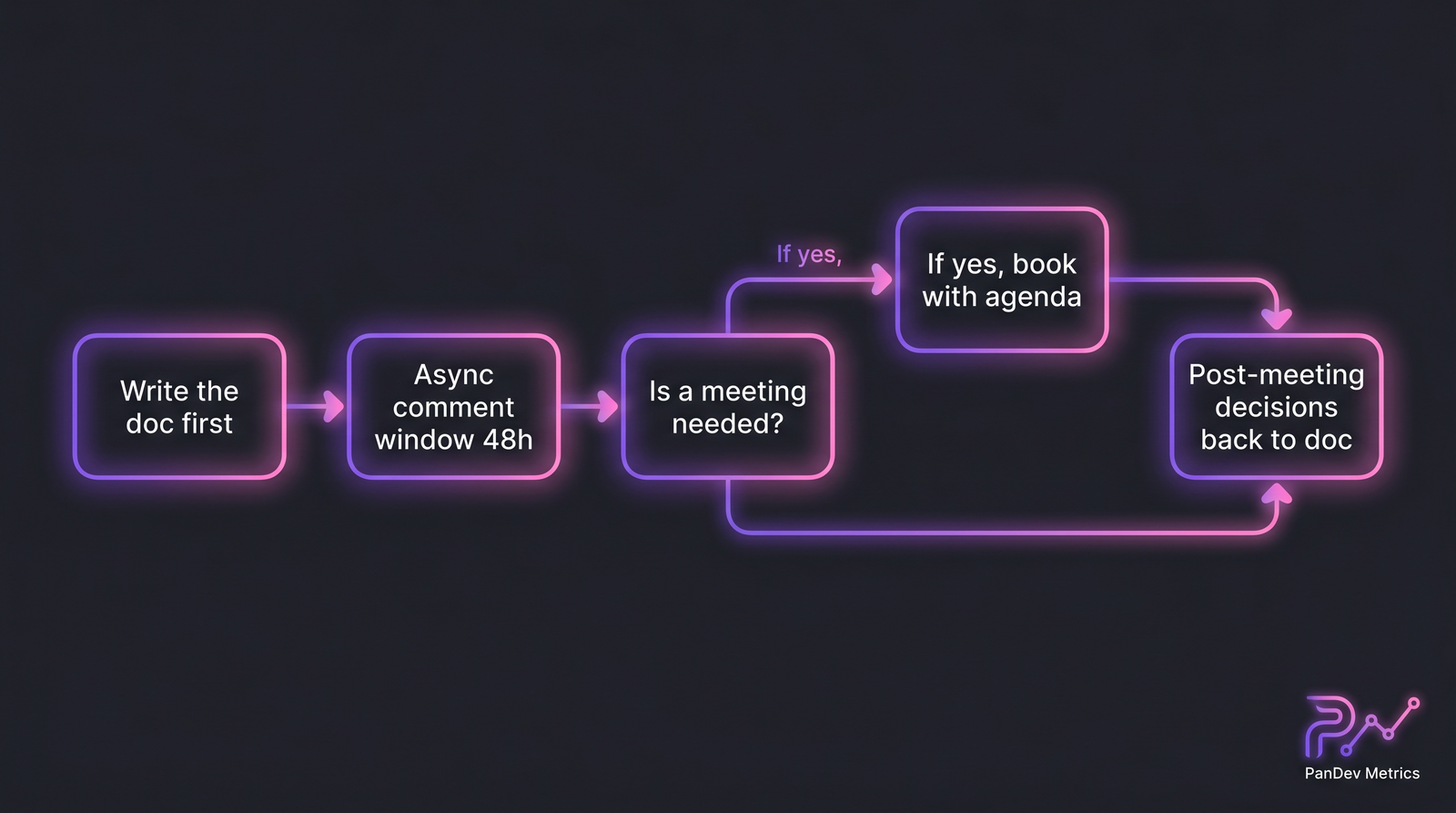
<p><img decoding="async" loading="lazy" alt="Flow diagram: write the doc first, async comment window 48h, decide if a meeting is needed, if yes book with agenda, post-meeting decisions back to doc" src="https://pandev-metrics.com/docs/assets/images/decision-flow-b987daff9401d14908a0bbe502f072fa.png" width="1600" height="893" class="img_ev3q">
<em>The async-first decision loop. Most proposed meetings die at the "is this meeting needed?" question once the 48h async window closes.</em></p>
<p>Microsoft Research's 2022 Work Trend Index surveyed 30,000 knowledge workers — engineers were in the <strong>highest-meeting-load quartile</strong>, averaging 19 meetings per week. The DORA 2024 State of DevOps report linked "meeting density" inversely to deployment frequency: teams in the top meeting-load quartile deployed <strong>32% less frequently</strong> than teams in the bottom quartile, controlling for team size and stack.</p>
<h2 class="anchor anchorTargetStickyNavbar_Vzrq" id="the-framework-7-rules">The framework: 7 rules<a href="https://pandev-metrics.com/docs/blog/async-first-meeting-rules#the-framework-7-rules" class="hash-link" aria-label="Direct link to The framework: 7 rules" title="Direct link to The framework: 7 rules" translate="no">​</a></h2>
<h3 class="anchor anchorTargetStickyNavbar_Vzrq" id="rule-1--write-the-doc-before-you-book-the-meeting">Rule 1 — Write the doc before you book the meeting<a href="https://pandev-metrics.com/docs/blog/async-first-meeting-rules#rule-1--write-the-doc-before-you-book-the-meeting" class="hash-link" aria-label="Direct link to Rule 1 — Write the doc before you book the meeting" title="Direct link to Rule 1 — Write the doc before you book the meeting" translate="no">​</a></h3>
<p>If you can't articulate the discussion topic in a 1-page doc, you're not ready to meet. The doc becomes the pre-read, the agenda, and the note-taking surface all at once.</p>
<p>Amazon's "six-page narrative" practice is the famous version, but a lightweight 1-pager works for most engineering discussions:</p>
<div class="language-text codeBlockContainer_Ckt0 theme-code-block" style="--prism-color:#393A34;--prism-background-color:#f6f8fa"><div class="codeBlockContent_QJqH"><pre tabindex="0" class="prism-code language-text codeBlock_bY9V thin-scrollbar" style="color:#393A34;background-color:#f6f8fa"><code class="codeBlockLines_e6Vv"><div class="token-line" style="color:#393A34"><span class="token plain"># {Topic}</span><br></div><div class="token-line" style="color:#393A34"><span class="token plain" style="display:inline-block"></span><br></div><div class="token-line" style="color:#393A34"><span class="token plain">## What decision are we making?</span><br></div><div class="token-line" style="color:#393A34"><span class="token plain">{one paragraph}</span><br></div><div class="token-line" style="color:#393A34"><span class="token plain" style="display:inline-block"></span><br></div><div class="token-line" style="color:#393A34"><span class="token plain">## Context</span><br></div><div class="token-line" style="color:#393A34"><span class="token plain">{what led here, what we've tried}</span><br></div><div class="token-line" style="color:#393A34"><span class="token plain" style="display:inline-block"></span><br></div><div class="token-line" style="color:#393A34"><span class="token plain">## Options</span><br></div><div class="token-line" style="color:#393A34"><span class="token plain">1. Option A — pro / con</span><br></div><div class="token-line" style="color:#393A34"><span class="token plain">2. Option B — pro / con</span><br></div><div class="token-line" style="color:#393A34"><span class="token plain">3. Option C — pro / con</span><br></div><div class="token-line" style="color:#393A34"><span class="token plain" style="display:inline-block"></span><br></div><div class="token-line" style="color:#393A34"><span class="token plain">## My recommendation</span><br></div><div class="token-line" style="color:#393A34"><span class="token plain">{which option, why}</span><br></div><div class="token-line" style="color:#393A34"><span class="token plain" style="display:inline-block"></span><br></div><div class="token-line" style="color:#393A34"><span class="token plain">## What I need from you</span><br></div><div class="token-line" style="color:#393A34"><span class="token plain">{comments by Thursday / attend Friday meeting / async approval}</span><br></div></code></pre></div></div>
<p>Half the time, writing this reveals the decision can be made without a meeting at all.</p>
<h3 class="anchor anchorTargetStickyNavbar_Vzrq" id="rule-2--give-48-hours-of-async-comment-time-before-deciding-to-meet">Rule 2 — Give 48 hours of async comment time before deciding to meet<a href="https://pandev-metrics.com/docs/blog/async-first-meeting-rules#rule-2--give-48-hours-of-async-comment-time-before-deciding-to-meet" class="hash-link" aria-label="Direct link to Rule 2 — Give 48 hours of async comment time before deciding to meet" title="Direct link to Rule 2 — Give 48 hours of async comment time before deciding to meet" translate="no">​</a></h3>
<p>Post the doc. Set a 48-hour async window where anyone can comment, ask questions, propose edits. Most team decisions resolve in the comment thread.</p>
<p>The contrarian rule: <strong>if the comment thread resolves the decision, cancel the meeting</strong>. Don't meet to "formalize" a decision that's already been made. This is the #1 thing teams forget — they schedule the meeting before posting the doc, and then hold it even when async already settled the question.</p>
<h3 class="anchor anchorTargetStickyNavbar_Vzrq" id="rule-3--default-stand-up-to-async">Rule 3 — Default stand-up to async<a href="https://pandev-metrics.com/docs/blog/async-first-meeting-rules#rule-3--default-stand-up-to-async" class="hash-link" aria-label="Direct link to Rule 3 — Default stand-up to async" title="Direct link to Rule 3 — Default stand-up to async" translate="no">​</a></h3>
<p>Daily stand-ups are the highest-volume meeting category. Most of them should be async updates in Slack or a dedicated tool.</p>


<table><thead><tr><th>Stand-up format</th><th style="text-align:center">Time cost per week (6-person team)</th><th style="text-align:center">Information density</th></tr></thead><tbody><tr><td>15-min daily sync</td><td style="text-align:center">7.5 hours (6 × 15 × 5)</td><td style="text-align:center">Low (verbal, rarely captured)</td></tr><tr><td>5-min async Slack thread</td><td style="text-align:center">30 min (6 × 5 × 1 thread)</td><td style="text-align:center">High (searchable)</td></tr><tr><td>Weekly 30-min sync + daily async</td><td style="text-align:center">3 hours (6 × 30 × 1)</td><td style="text-align:center">High</td></tr></tbody></table>
<p>A weekly 30-min sync for dynamics (blockers, morale, strategy) plus daily async updates covers what a daily sync did, at 40% of the time cost. We've seen this switch land well in teams from 4 to 40 engineers.</p>
<h3 class="anchor anchorTargetStickyNavbar_Vzrq" id="rule-4--default-planning-to-async-review-to-sync">Rule 4 — Default planning to async, review to sync<a href="https://pandev-metrics.com/docs/blog/async-first-meeting-rules#rule-4--default-planning-to-async-review-to-sync" class="hash-link" aria-label="Direct link to Rule 4 — Default planning to async, review to sync" title="Direct link to Rule 4 — Default planning to async, review to sync" translate="no">​</a></h3>
<p>Planning can be async with a structured doc. Retrospectives benefit from synchronous video — the emotional texture matters, and "async retro" has a bad track record.</p>


<table><thead><tr><th>Meeting type</th><th style="text-align:center">Default mode</th><th>Why</th></tr></thead><tbody><tr><td>Stand-up</td><td style="text-align:center">Async</td><td>Status updates are readable</td></tr><tr><td>Sprint planning</td><td style="text-align:center">Async + 30-min confirmation sync</td><td>Estimates are individual work</td></tr><tr><td>Backlog grooming</td><td style="text-align:center">Async</td><td>Comments on tickets beat talking</td></tr><tr><td>Retro</td><td style="text-align:center">Sync</td><td>Emotional signal, psych safety</td></tr><tr><td>1:1</td><td style="text-align:center">Sync</td><td>Relationship-first</td></tr><tr><td>Design review</td><td style="text-align:center">Doc + async + optional sync</td><td>Most resolve in comments</td></tr><tr><td>Incident response</td><td style="text-align:center">Sync</td><td>Latency matters</td></tr><tr><td>All-hands</td><td style="text-align:center">Sync (with recording)</td><td>Shared experience, Q&amp;A</td></tr></tbody></table>
<p>Not everything should be async. Retros, 1:1s, and incident response are sync-first for good reasons. Flattening everything to async is how cultures lose connection.</p>
<h3 class="anchor anchorTargetStickyNavbar_Vzrq" id="rule-5--shrink-meeting-sizes-not-meeting-lengths">Rule 5 — Shrink meeting sizes, not meeting lengths<a href="https://pandev-metrics.com/docs/blog/async-first-meeting-rules#rule-5--shrink-meeting-sizes-not-meeting-lengths" class="hash-link" aria-label="Direct link to Rule 5 — Shrink meeting sizes, not meeting lengths" title="Direct link to Rule 5 — Shrink meeting sizes, not meeting lengths" translate="no">​</a></h3>
<p>A common mistake: "let's make all meetings 25 minutes instead of 30." This ignores that <strong>meeting cost scales with attendees, not minutes</strong>. Cutting a 30-minute 8-person meeting to 25 minutes saves 40 person-minutes. Cutting it to 30 minutes with 4 attendees saves 120 person-minutes.</p>
<p>Rule: any meeting with <strong>more than 8 attendees</strong> defaults to doc + async. In-person only if urgent and unresolved.</p>
<h3 class="anchor anchorTargetStickyNavbar_Vzrq" id="rule-6--respect-focus-block-time-zones">Rule 6 — Respect focus-block time zones<a href="https://pandev-metrics.com/docs/blog/async-first-meeting-rules#rule-6--respect-focus-block-time-zones" class="hash-link" aria-label="Direct link to Rule 6 — Respect focus-block time zones" title="Direct link to Rule 6 — Respect focus-block time zones" translate="no">​</a></h3>
<p>Mandatory no-meeting windows. 9:30am-11:30am local and 2pm-4pm local are good defaults — our own <a class="" href="https://pandev-metrics.com/docs/blog/focus-time-deep-work">focus-time data</a> shows these windows produce the highest-quality coding output when uninterrupted.</p>
<p>Managers should protect these windows harder than engineers do. A meeting booked at 10am "because it was the only time everyone was free" usually means the booker didn't try the 8am or 4pm slots.</p>
<h3 class="anchor anchorTargetStickyNavbar_Vzrq" id="rule-7--write-down-the-decision-not-the-discussion">Rule 7 — Write down the decision, not the discussion<a href="https://pandev-metrics.com/docs/blog/async-first-meeting-rules#rule-7--write-down-the-decision-not-the-discussion" class="hash-link" aria-label="Direct link to Rule 7 — Write down the decision, not the discussion" title="Direct link to Rule 7 — Write down the decision, not the discussion" translate="no">​</a></h3>
<p>If a meeting happens, the artifact is the <strong>decision</strong>, not a transcript. Three sentences:</p>
<ul>
<li class=""><strong>Decision:</strong> we will do X</li>
<li class=""><strong>Rationale:</strong> because of Y</li>
<li class=""><strong>Next steps:</strong> person A does Z by date D</li>
</ul>
<p>Post to the doc and to the async channel. Nobody needs the 25-minute discussion recap; they need to know what was decided and what happens next.</p>
<h2 class="anchor anchorTargetStickyNavbar_Vzrq" id="common-mistakes">Common mistakes<a href="https://pandev-metrics.com/docs/blog/async-first-meeting-rules#common-mistakes" class="hash-link" aria-label="Direct link to Common mistakes" title="Direct link to Common mistakes" translate="no">​</a></h2>


<table><thead><tr><th>Mistake</th><th>Why it hurts</th><th>Fix</th></tr></thead><tbody><tr><td>"Recurring meeting" on autopilot</td><td>Cost compounds, no review</td><td>Quarterly audit; kill if no specific decision</td></tr><tr><td>Agenda = "sync up"</td><td>No concrete decision, no outcome</td><td>Agenda must be a question or decision</td></tr><tr><td>8+ attendees routinely</td><td>Cost explodes</td><td>Doc + async for &gt; 8</td></tr><tr><td>Meetings during focus blocks</td><td>Double-costs productivity</td><td>Protected 2h blocks, 2x/day</td></tr><tr><td>No-doc meetings</td><td>Attendees unprepared</td><td>Doc posted ≥24h before</td></tr><tr><td>Async-only retro</td><td>Flattens emotional signal</td><td>Keep retros sync</td></tr><tr><td>30-min default slot</td><td>Fills the time available</td><td>15-min default; book up if needed</td></tr></tbody></table>
<h2 class="anchor anchorTargetStickyNavbar_Vzrq" id="the-checklist">The checklist<a href="https://pandev-metrics.com/docs/blog/async-first-meeting-rules#the-checklist" class="hash-link" aria-label="Direct link to The checklist" title="Direct link to The checklist" translate="no">​</a></h2>
<ul class="contains-task-list containsTaskList_mC6p">
<li class="task-list-item"><input type="checkbox" disabled=""> Doc posted ≥ 24h before any meeting with a decision at stake</li>
<li class="task-list-item"><input type="checkbox" disabled=""> 48h async window before calling a meeting</li>
<li class="task-list-item"><input type="checkbox" disabled=""> Daily stand-up is async, weekly sync is 30 min</li>
<li class="task-list-item"><input type="checkbox" disabled=""> No meetings during 9:30-11:30 and 14:00-16:00 local focus blocks</li>
<li class="task-list-item"><input type="checkbox" disabled=""> Any meeting with &gt;8 attendees justified in writing</li>
<li class="task-list-item"><input type="checkbox" disabled=""> Decision + rationale + next steps written after every meeting</li>
<li class="task-list-item"><input type="checkbox" disabled=""> Recurring meetings audited quarterly</li>
</ul>
<h2 class="anchor anchorTargetStickyNavbar_Vzrq" id="how-to-measure-if-its-working">How to measure if it's working<a href="https://pandev-metrics.com/docs/blog/async-first-meeting-rules#how-to-measure-if-its-working" class="hash-link" aria-label="Direct link to How to measure if it's working" title="Direct link to How to measure if it's working" translate="no">​</a></h2>
<p>Track per engineer, weekly:</p>
<ul>
<li class=""><strong>Meeting hours</strong> — target under 7/week for ICs, 15/week for EMs</li>
<li class=""><strong>Focus time blocks ≥ 45 min</strong> — target ≥ 10 per week</li>
<li class=""><strong>Context switches per day</strong> — target under 4 (anything over 6 correlates with burnout per our <a class="" href="https://pandev-metrics.com/docs/blog/focus-time-deep-work">focus-time post</a>)</li>
</ul>
<p>PanDev Metrics surfaces all three via IDE heartbeat data combined with calendar integration — coding sessions, meeting blocks from calendar, and the focus-time windows between them. Teams switching to async-first see the focus-time distribution shift visibly within 4-6 weeks. The metric to watch is <strong>mean focus block length</strong>; when it rises from ~18 minutes to ~42 minutes, the new cadence is working.</p>
<p>Honest limit: meeting load is a leading indicator of delivery capacity, not a cause of it. A team that cuts meetings but doesn't change what it's working on won't magically ship faster. Our data can tell you whether you're spending more time coding; it can't tell you whether the coding is on the right thing.</p>
<h2 class="anchor anchorTargetStickyNavbar_Vzrq" id="when-this-framework-doesnt-fit">When this framework doesn't fit<a href="https://pandev-metrics.com/docs/blog/async-first-meeting-rules#when-this-framework-doesnt-fit" class="hash-link" aria-label="Direct link to When this framework doesn't fit" title="Direct link to When this framework doesn't fit" translate="no">​</a></h2>
<ul>
<li class=""><strong>Very early-stage startups (&lt;10 people)</strong> — the coordination cost of async docs exceeds the cost of 10 meetings a week. Stay sync until ~12 people.</li>
<li class=""><strong>Fully co-located offices</strong> — in-person hallway conversations are effectively sync and free; forcing docs can feel bureaucratic. Adopt selectively.</li>
<li class=""><strong>Crisis incident response</strong> — obvious, but worth stating. When prod is down, sync Slack + video beats docs.</li>
<li class=""><strong>Sales / customer-facing roles</strong> — their calendar constraints differ fundamentally; this playbook is for engineers, not the whole company.</li>
</ul>
<h2 class="anchor anchorTargetStickyNavbar_Vzrq" id="related-reading">Related reading<a href="https://pandev-metrics.com/docs/blog/async-first-meeting-rules#related-reading" class="hash-link" aria-label="Direct link to Related reading" title="Direct link to Related reading" translate="no">​</a></h2>
<ul>
<li class=""><a class="" href="https://pandev-metrics.com/docs/blog/context-switching-kills-productivity">The 40% Productivity Tax of Context Switching</a></li>
<li class=""><a class="" href="https://pandev-metrics.com/docs/blog/focus-time-deep-work">Focus Time: Why 2 Hours of Uninterrupted Code Equals 6 Hours</a></li>
<li class=""><a class="" href="https://pandev-metrics.com/docs/blog/remote-vs-office-productivity">Remote vs Office Developers: Real IDE Data</a></li>
<li class=""><a class="" href="https://pandev-metrics.com/docs/blog/knowledge-management-dev-teams">Knowledge Management for Dev Teams</a></li>
</ul>]]></content>
        <author>
            <name>Artur Pan</name>
            <uri>https://www.linkedin.com/in/apan98/</uri>
        </author>
        <category label="tutorial" term="tutorial"/>
        <category label="engineering-management" term="engineering-management"/>
        <category label="developer-productivity" term="developer-productivity"/>
        <category label="guide" term="guide"/>
    </entry>
    <entry>
        <title type="html"><![CDATA[Engineering Offsites: ROI Analysis and Planning Guide]]></title>
        <id>https://pandev-metrics.com/docs/blog/engineering-offsites-roi</id>
        <link href="https://pandev-metrics.com/docs/blog/engineering-offsites-roi"/>
        <updated>2026-06-14T00:00:00.000Z</updated>
        <summary type="html"><![CDATA[A 40-person engineering offsite costs $80-200K. Most produce zero measurable output. The 7-step framework for offsites that actually move the next quarter.]]></summary>
        <content type="html"><![CDATA[<p>A VP of Engineering told me the number that hurts: "We spent $140,000 on an offsite in Bali in Q1. By Q3, nobody on the team remembered a single decision we made there." A 40-person engineering offsite routinely costs $80-200K in direct spend (travel, venue, food, activities) plus 200-320 engineer-weeks of displaced work, and the Gallup 2023 <a href="https://www.gallup.com/workplace/" target="_blank" rel="noopener noreferrer" class="">Workplace Report</a> documents that only <strong>29% of companies can articulate a measurable outcome</strong> from their last off-site event.</p>
<p>The default failure isn't venue or agenda — it's that the offsite was scheduled as a cultural ritual with outcomes defined after the fact. Flipping that order changes the ROI by an order of magnitude. The framework below is how the engineering leaders with repeatable-ROI offsites plan them, and it works across the three formats that produce measurable results: hackathons, strategy sprints, and team-bonding events. Each format has different economics.</p>
<p>{/* truncate */}</p>
<h2 class="anchor anchorTargetStickyNavbar_Vzrq" id="the-problem-offsites-are-outcome-absent-by-default">The problem: offsites are outcome-absent by default<a href="https://pandev-metrics.com/docs/blog/engineering-offsites-roi#the-problem-offsites-are-outcome-absent-by-default" class="hash-link" aria-label="Direct link to The problem: offsites are outcome-absent by default" title="Direct link to The problem: offsites are outcome-absent by default" translate="no">​</a></h2>
<p>A typical offsite planning process:</p>
<ol>
<li class="">Someone decides it's time for an offsite</li>
<li class="">A venue is booked based on geographic halfway point and aesthetics</li>
<li class="">An agenda is filled with "team-building exercises" and "strategy discussions"</li>
<li class="">People attend, feel mildly refreshed</li>
<li class="">Work resumes Monday at the same pace, same backlog, same problems</li>
</ol>
<p>The process optimizes for vibes, not outcomes. Offsites that produce durable results invert this sequence: <strong>outcome first, then format, then venue, then agenda</strong>.</p>
<p>The distinction matters because the three healthy offsite formats have fundamentally different structures:</p>


<table><thead><tr><th>Format</th><th>Primary outcome</th><th style="text-align:center">Typical duration</th><th>Success signal</th></tr></thead><tbody><tr><td>Hackathon</td><td>Shippable prototype + priorities validation</td><td style="text-align:center">2-3 days</td><td>Projects that merge to main within 30 days</td></tr><tr><td>Strategy sprint</td><td>Decisions made, written down, assigned</td><td style="text-align:center">2-4 days</td><td>Assigned decisions in Jira/ClickUp within 1 week</td></tr><tr><td>Team bonding</td><td>Trust reconstitution after growth / restructure</td><td style="text-align:center">3-5 days</td><td>Reduced escalation frequency over next quarter</td></tr></tbody></table>
<p>Mixing two formats is the most common mistake. A "hackathon + strategy + bonding" 4-day event produces a shallow version of all three.</p>
<p><img decoding="async" loading="lazy" alt="Flow diagram showing 7-step offsite planning: clarify outcome, align with OKR, pick format, budget + logistics, pre-work assignment, run offsite, 30-day follow-through" src="https://pandev-metrics.com/docs/assets/images/planning-flow-31a8a7e66db1deec8676cc028e09ae47.png" width="1600" height="893" class="img_ev3q">
<em>The 7 steps that separate offsites with measurable ROI from offsites that read as culture-only.</em></p>
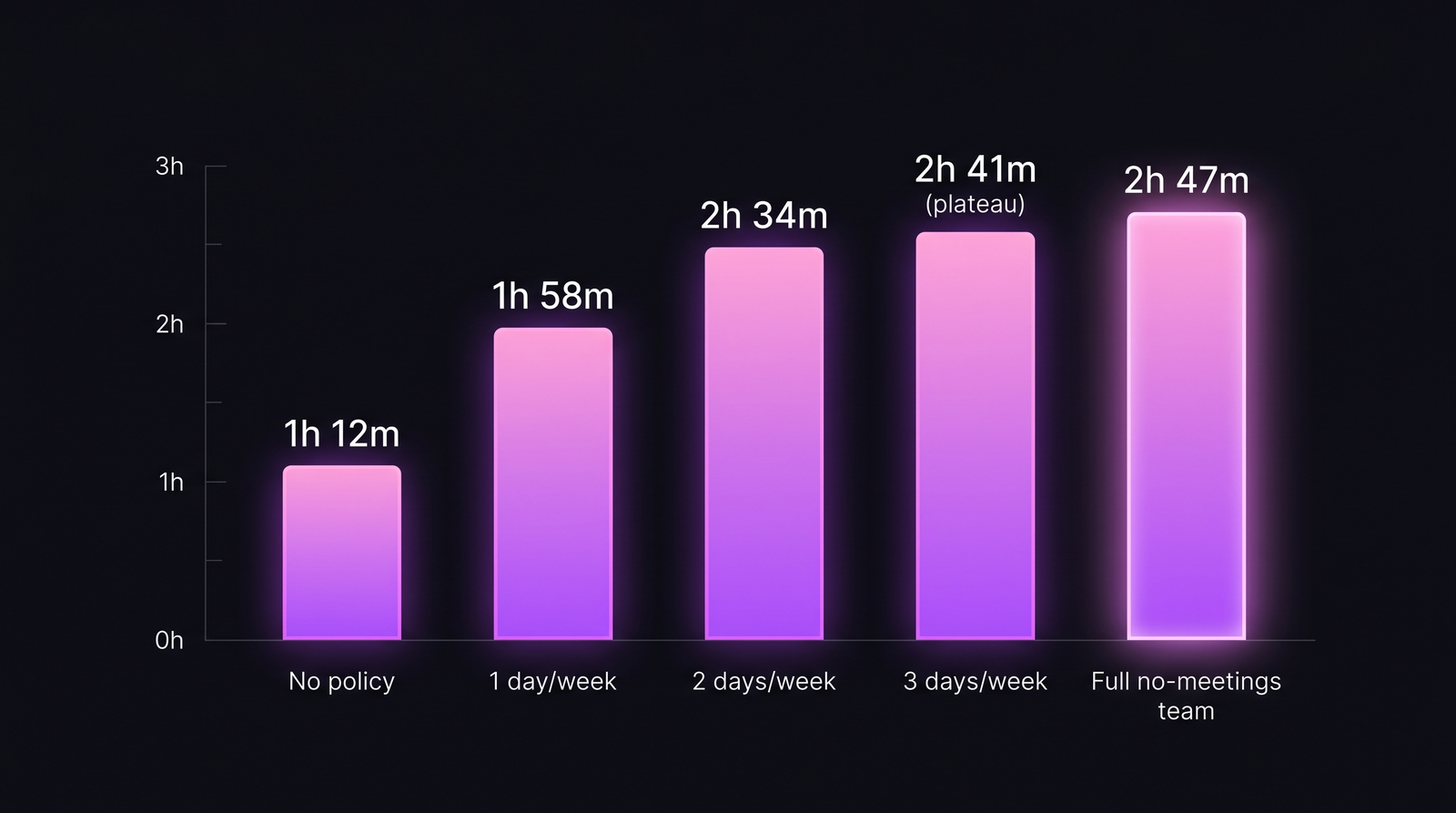
<h2 class="anchor anchorTargetStickyNavbar_Vzrq" id="the-7-steps">The 7 steps<a href="https://pandev-metrics.com/docs/blog/engineering-offsites-roi#the-7-steps" class="hash-link" aria-label="Direct link to The 7 steps" title="Direct link to The 7 steps" translate="no">​</a></h2>
<h3 class="anchor anchorTargetStickyNavbar_Vzrq" id="step-1--clarify-the-outcome">Step 1 — Clarify the outcome<a href="https://pandev-metrics.com/docs/blog/engineering-offsites-roi#step-1--clarify-the-outcome" class="hash-link" aria-label="Direct link to Step 1 — Clarify the outcome" title="Direct link to Step 1 — Clarify the outcome" translate="no">​</a></h3>
<p>Write one sentence in the form: "After this offsite, the team will have [specific outcome], measurable by [specific signal within specific window]."</p>
<p>Examples that work:</p>
<ul>
<li class="">"After this offsite, the team will have agreed on the next quarter's platform investments, measured by a quarterly plan with named owners approved within 1 week."</li>
<li class="">"After this offsite, the team will ship 3 hackathon prototypes to staging, measured by PRs merged within 30 days of the event."</li>
<li class="">"After this offsite, the recently-merged Platform and Infra teams will trust each other, measured by reduction in cross-team escalation frequency from current 8/week to under 3/week by end of quarter."</li>
</ul>
<p>Examples that don't work:</p>
<ul>
<li class="">"Strengthen team culture." (not measurable)</li>
<li class="">"Build relationships." (no signal, no window)</li>
<li class="">"Strategic alignment." (empty)</li>
</ul>
<h3 class="anchor anchorTargetStickyNavbar_Vzrq" id="step-2--align-with-the-next-okr-cycle">Step 2 — Align with the next OKR cycle<a href="https://pandev-metrics.com/docs/blog/engineering-offsites-roi#step-2--align-with-the-next-okr-cycle" class="hash-link" aria-label="Direct link to Step 2 — Align with the next OKR cycle" title="Direct link to Step 2 — Align with the next OKR cycle" translate="no">​</a></h3>
<p>An offsite disconnected from the quarterly planning cycle is almost always wasted. The leverage comes from scheduling 2-4 weeks <strong>before</strong> a new OKR cycle starts — so decisions made at the offsite feed directly into the OKRs that people commit to. Three weeks is the sweet spot: long enough to refine decisions, short enough that offsite context hasn't evaporated.</p>
<p>Scheduling mid-cycle is the most expensive mistake — you disrupt in-flight work and the offsite outcomes have no natural destination.</p>
<h3 class="anchor anchorTargetStickyNavbar_Vzrq" id="step-3--pick-exactly-one-format">Step 3 — Pick exactly one format<a href="https://pandev-metrics.com/docs/blog/engineering-offsites-roi#step-3--pick-exactly-one-format" class="hash-link" aria-label="Direct link to Step 3 — Pick exactly one format" title="Direct link to Step 3 — Pick exactly one format" translate="no">​</a></h3>
<p>Re-read your outcome statement. If it's "ship prototypes," you're running a hackathon. If it's "make decisions," you're running a strategy sprint. If it's "rebuild trust," you're running a bonding event. Don't try to do two things at once.</p>
<p>Each format has an optimal agenda shape:</p>
<p><strong>Hackathon (2-3 days):</strong></p>
<ul>
<li class="">Day 1 morning: short kickoff + team formation</li>
<li class="">Day 1-2: uninterrupted build time</li>
<li class="">Day 2 evening / Day 3: demos + judging + commitment to next-30-day path</li>
</ul>
<p><strong>Strategy sprint (2-4 days):</strong></p>
<ul>
<li class="">Day 1: situation briefing, shared data, problem statements</li>
<li class="">Day 2-3: small-group work on top 3-5 decisions</li>
<li class="">Day 4 morning: commitments written down, owners assigned, dates set</li>
</ul>
<p><strong>Team bonding (3-5 days):</strong></p>
<ul>
<li class="">Longer duration, less agenda density. Structured social activities alternating with unstructured time. Formal work content is less than 30% of schedule.</li>
</ul>
<h3 class="anchor anchorTargetStickyNavbar_Vzrq" id="step-4--budget-realistically">Step 4 — Budget realistically<a href="https://pandev-metrics.com/docs/blog/engineering-offsites-roi#step-4--budget-realistically" class="hash-link" aria-label="Direct link to Step 4 — Budget realistically" title="Direct link to Step 4 — Budget realistically" translate="no">​</a></h3>
<p>Direct costs compound fast. A 40-person 4-day offsite at a European destination typically runs:</p>


<table><thead><tr><th>Cost category</th><th style="text-align:center">40-person offsite (EU venue)</th><th style="text-align:center">40-person offsite (CIS/domestic)</th></tr></thead><tbody><tr><td>Travel (round-trip, mid-range)</td><td style="text-align:center">$60-90K</td><td style="text-align:center">$8-20K</td></tr><tr><td>Lodging (4 nights, 3-4 star)</td><td style="text-align:center">$24-40K</td><td style="text-align:center">$8-15K</td></tr><tr><td>Food &amp; beverage</td><td style="text-align:center">$16-28K</td><td style="text-align:center">$6-12K</td></tr><tr><td>Venue / meeting space</td><td style="text-align:center">$8-20K</td><td style="text-align:center">$2-6K</td></tr><tr><td>Activities / entertainment</td><td style="text-align:center">$6-15K</td><td style="text-align:center">$3-8K</td></tr><tr><td>Facilitator / speaker</td><td style="text-align:center">$5-15K</td><td style="text-align:center">$3-8K</td></tr><tr><td>Swag / materials</td><td style="text-align:center">$2-5K</td><td style="text-align:center">$1-3K</td></tr><tr><td>Contingency (10-15%)</td><td style="text-align:center">$12-22K</td><td style="text-align:center">$3-7K</td></tr><tr><td><strong>Direct total</strong></td><td style="text-align:center"><strong>$133-235K</strong></td><td style="text-align:center"><strong>$34-79K</strong></td></tr></tbody></table>
<p>Indirect costs (displaced engineering time at blended rate) typically add another 40-60% of direct. A 4-day offsite for 40 engineers at $150/hr loaded cost is ~$192K in displaced output — so a $140K direct-cost offsite is actually ~$330K in true cost.</p>
<h3 class="anchor anchorTargetStickyNavbar_Vzrq" id="step-5--assign-pre-work">Step 5 — Assign pre-work<a href="https://pandev-metrics.com/docs/blog/engineering-offsites-roi#step-5--assign-pre-work" class="hash-link" aria-label="Direct link to Step 5 — Assign pre-work" title="Direct link to Step 5 — Assign pre-work" translate="no">​</a></h3>
<p>Pre-work is the single highest-ROI intervention in the whole planning cycle. An offsite that starts cold wastes Day 1 getting everyone on the same page; an offsite with good pre-work starts Day 1 already working on the decisions.</p>
<p>For a strategy sprint:</p>
<ul>
<li class="">Read-ahead document (10-20 pages, circulate 2 weeks before)</li>
<li class="">Pre-offsite survey capturing top 3 problems per participant</li>
<li class="">Data pack: current metrics, current team load, financial context</li>
</ul>
<p>For a hackathon:</p>
<ul>
<li class="">Idea-submission form (projects pitched 2 weeks prior)</li>
<li class="">Team formation done before arrival (not on Day 1)</li>
<li class="">Infrastructure pre-provisioned (dev environments, API keys, deploy access)</li>
</ul>
<p>For bonding:</p>
<ul>
<li class="">Pre-event interviews with a facilitator about current friction</li>
<li class="">Clarity about whether the offsite is open-ended social or has specific reconciliation goals</li>
</ul>
<p>Teams that skip pre-work lose the first 25-40% of offsite hours to setup.</p>
<h3 class="anchor anchorTargetStickyNavbar_Vzrq" id="step-6--run-the-offsite-with-a-facilitator">Step 6 — Run the offsite with a facilitator<a href="https://pandev-metrics.com/docs/blog/engineering-offsites-roi#step-6--run-the-offsite-with-a-facilitator" class="hash-link" aria-label="Direct link to Step 6 — Run the offsite with a facilitator" title="Direct link to Step 6 — Run the offsite with a facilitator" translate="no">​</a></h3>
<p>The most expensive mistake in the room: the engineering leader tries to facilitate their own offsite. They can't. They're a participant in the decisions being made, and participants can't run neutral facilitation.</p>
<p>For strategy sprints, budget for an external facilitator. Good facilitators cost $2-5K/day; the ROI on a strategy sprint done badly vs well is usually 10-20x. For hackathons and bonding events, an internal senior manager can sometimes facilitate if they're not a decision-owner on the outcomes, but external is still safer.</p>
<h3 class="anchor anchorTargetStickyNavbar_Vzrq" id="step-7--measure-30-days-out">Step 7 — Measure 30 days out<a href="https://pandev-metrics.com/docs/blog/engineering-offsites-roi#step-7--measure-30-days-out" class="hash-link" aria-label="Direct link to Step 7 — Measure 30 days out" title="Direct link to Step 7 — Measure 30 days out" translate="no">​</a></h3>
<p>This is where ROI is realized or lost. The 30-day follow-through is what separates offsites that paid for themselves from offsites that didn't.</p>
<p>Track the specific signal from Step 1:</p>
<ul>
<li class="">Hackathon: how many prototypes merged to staging / main?</li>
<li class="">Strategy sprint: how many decisions are in the quarterly plan with assigned owners?</li>
<li class="">Bonding: is cross-team escalation frequency trending down?</li>
</ul>
<p>Most offsites never get this measurement. Our <a class="" href="https://pandev-metrics.com/docs/blog/data-driven-one-on-one">data-driven 1:1s post</a> argues that post-event measurement is the one thing that makes culture interventions real rather than performative — same principle applies here.</p>
<h2 class="anchor anchorTargetStickyNavbar_Vzrq" id="common-mistakes-to-avoid">Common mistakes to avoid<a href="https://pandev-metrics.com/docs/blog/engineering-offsites-roi#common-mistakes-to-avoid" class="hash-link" aria-label="Direct link to Common mistakes to avoid" title="Direct link to Common mistakes to avoid" translate="no">​</a></h2>
<ul>
<li class=""><strong>Scheduling without OKR alignment.</strong> An offsite in week 6 of a 13-week quarter has nowhere to send its outputs.</li>
<li class=""><strong>Combining formats.</strong> Hackathon + strategy + bonding = shallow everything. Pick one.</li>
<li class=""><strong>Facilitator as participant.</strong> The engineering leader facilitating their own decisions produces decisions they wanted, not team decisions.</li>
<li class=""><strong>Skipping pre-work.</strong> Without pre-reads and problem statements circulated, Day 1 is onboarding, not work.</li>
<li class=""><strong>No follow-through owner.</strong> An offsite with no designated follow-through owner becomes forgotten by week 3. Assign this role before the offsite ends.</li>
<li class=""><strong>Hackathons that block their own output.</strong> Prototypes built without infra access, API keys, or staging environments can't convert to real merges.</li>
<li class=""><strong>"Luxury" venues.</strong> A $400/night hotel doesn't buy better outcomes than a $150/night one for engineering groups; it does buy resentment from engineers whose salaries are lower than the per-engineer venue cost.</li>
</ul>
<h2 class="anchor anchorTargetStickyNavbar_Vzrq" id="template-30-day-follow-through-checklist">Template: 30-day follow-through checklist<a href="https://pandev-metrics.com/docs/blog/engineering-offsites-roi#template-30-day-follow-through-checklist" class="hash-link" aria-label="Direct link to Template: 30-day follow-through checklist" title="Direct link to Template: 30-day follow-through checklist" translate="no">​</a></h2>


<table><thead><tr><th>Day</th><th>Action</th><th>Owner</th></tr></thead><tbody><tr><td>Day 0 (offsite end)</td><td>Designate follow-through owner, set weekly checkpoint</td><td>Engineering leader</td></tr><tr><td>Day 1-3</td><td>Circulate decisions + commitments doc; everyone acks</td><td>Follow-through owner</td></tr><tr><td>Day 7</td><td>Week-1 check: all commitments in Jira/ClickUp?</td><td>Follow-through owner</td></tr><tr><td>Day 14</td><td>Week-2 check: progress on each commitment?</td><td>Follow-through owner</td></tr><tr><td>Day 21</td><td>Week-3 check: blockers surfaced?</td><td>Follow-through owner</td></tr><tr><td>Day 30</td><td>30-day retrospective: what worked, what didn't convert</td><td>Engineering leader + team</td></tr></tbody></table>
<p>Teams that execute this 30-day loop capture the offsite value; teams that don't spend $140K on a nice vacation.</p>
<h2 class="anchor anchorTargetStickyNavbar_Vzrq" id="how-to-measure-success">How to measure success<a href="https://pandev-metrics.com/docs/blog/engineering-offsites-roi#how-to-measure-success" class="hash-link" aria-label="Direct link to How to measure success" title="Direct link to How to measure success" translate="no">​</a></h2>
<p>Three measurements, in order of specificity:</p>
<p><strong>Immediate (within 1 week):</strong> Did the specific outcome from Step 1 happen? If you said "3 prototypes merged within 30 days," is the project list clear and owned? If the immediate signal fails, the rest of the measurement doesn't matter.</p>
<p><strong>Near-term (30-60 days):</strong> Did the commitments made at the offsite translate into shipped work? This is where engineering-metrics data is useful. Looking at <a class="" href="https://pandev-metrics.com/docs/blog/deployment-frequency-monthly-to-daily">deployment frequency</a> per team before and after an offsite with a deployment-related outcome should show measurable change if the offsite worked.</p>
<p><strong>Durable (90-180 days):</strong> Did the team effects persist? For bonding offsites, track <a class="" href="https://pandev-metrics.com/docs/blog/burnout-detection-data">team-health signals</a> — after-hours work patterns, vacation utilization, retention. For strategy offsites, check whether the quarterly plan survived contact with reality (or whether it was quietly abandoned by week 4).</p>
<p>At PanDev Metrics, we see the engineering-metric effects of offsites show up in aggregated team-load and collaboration-pattern changes. Teams that run well-planned offsites show measurable changes in these patterns for 6-10 weeks post-event; teams that run unplanned offsites show no discernible change.</p>
<h2 class="anchor anchorTargetStickyNavbar_Vzrq" id="the-contrarian-take">The contrarian take<a href="https://pandev-metrics.com/docs/blog/engineering-offsites-roi#the-contrarian-take" class="hash-link" aria-label="Direct link to The contrarian take" title="Direct link to The contrarian take" translate="no">​</a></h2>
<p>The offsite industry sells the premise that all offsites are worthwhile investments — that "being in the same room" has intrinsic value. The data doesn't support this at engineering scale. Engineers who dislike travel, dislike forced socialization, or have caregiving obligations experience offsites as a tax, not a benefit. The best-performing engineering offsites are <strong>short (2-3 days)</strong>, <strong>close to home (domestic or short-flight)</strong>, and <strong>outcome-driven</strong> — the exact opposite of the aspirational "5 days in Portugal" stereotype. Teams that optimize offsites this way run them twice as often with half the disruption and measurably better follow-through.</p>
<h2 class="anchor anchorTargetStickyNavbar_Vzrq" id="the-honest-limit">The honest limit<a href="https://pandev-metrics.com/docs/blog/engineering-offsites-roi#the-honest-limit" class="hash-link" aria-label="Direct link to The honest limit" title="Direct link to The honest limit" translate="no">​</a></h2>
<p>The ROI numbers above come from a mix of customer conversations and a handful of published references (Gallup, published engineering-leader interviews on First Round Review and LeadDev). We don't have internal IDE telemetry on offsite impact — IDE heartbeat data before and after an offsite shows disruption but not causation. The "6-10 weeks of post-event change" signal is directional, not rigorous. Teams doing their own before/after measurement should expect noisier signals than the framework implies, particularly for bonding offsites whose effects are diffuse.</p>
<h2 class="anchor anchorTargetStickyNavbar_Vzrq" id="where-pandev-metrics-fits">Where PanDev Metrics fits<a href="https://pandev-metrics.com/docs/blog/engineering-offsites-roi#where-pandev-metrics-fits" class="hash-link" aria-label="Direct link to Where PanDev Metrics fits" title="Direct link to Where PanDev Metrics fits" translate="no">​</a></h2>
<p><a class="" href="https://pandev-metrics.com/docs/blog/how-much-developers-actually-code">PanDev Metrics</a> doesn't plan your offsite — but it's useful for the 30-day follow-through measurement. When the offsite outcome is "ship prototype X" or "improve deploy frequency in team Y," the engineering-intelligence dashboard provides the before/after data without requiring a separate survey. The pre-work data pack in Step 5 often pulls directly from PanDev dashboards — team load distribution, language breakdown, multi-project overlap — so leaders show up with a shared fact base rather than competing intuitions.</p>
<h2 class="anchor anchorTargetStickyNavbar_Vzrq" id="related-reading">Related reading<a href="https://pandev-metrics.com/docs/blog/engineering-offsites-roi#related-reading" class="hash-link" aria-label="Direct link to Related reading" title="Direct link to Related reading" translate="no">​</a></h2>
<ul>
<li class=""><a class="" href="https://pandev-metrics.com/docs/blog/data-driven-one-on-one">How to Run Data-Driven 1:1s With Your Developers</a> — the individual-level complement to team offsites, with overlapping measurement discipline</li>
<li class=""><a class="" href="https://pandev-metrics.com/docs/blog/metrics-without-toxicity">Engineering Metrics Without Toxicity: How to Track Productivity</a> — the broader frame for using data in management without it becoming punitive</li>
<li class=""><a class="" href="https://pandev-metrics.com/docs/blog/burnout-detection-data">Data Patterns That Scream 'Your Developer Is Burning Out'</a> — useful context for bonding-format offsites, where the trigger is often pre-burnout</li>
<li class="">External: <a href="https://www.gallup.com/workplace/" target="_blank" rel="noopener noreferrer" class="">Gallup 2024 State of the Global Workplace</a> — the public reference on employee engagement trends that often motivate offsite spend</li>
</ul>]]></content>
        <author>
            <name>Artur Pan</name>
            <uri>https://www.linkedin.com/in/apan98/</uri>
        </author>
        <category label="engineering-management" term="engineering-management"/>
        <category label="leadership" term="leadership"/>
        <category label="team-building" term="team-building"/>
        <category label="offsites" term="offsites"/>
        <category label="tutorial" term="tutorial"/>
    </entry>
    <entry>
        <title type="html"><![CDATA[Meeting-Free Days: What the Data Actually Shows]]></title>
        <id>https://pandev-metrics.com/docs/blog/meeting-free-days-data-impact</id>
        <link href="https://pandev-metrics.com/docs/blog/meeting-free-days-data-impact"/>
        <updated>2026-06-14T00:00:00.000Z</updated>
        <summary type="html"><![CDATA[We measured IDE activity across teams with 0, 1, 2, 3 meeting-free days per week. The focus-time curve flattens at 2 days, and here's what that means for policy.]]></summary>
        <content type="html"><![CDATA[<p><strong>Teams with 2 meeting-free days per week show a median of 2h 34m of daily coding time — versus 1h 12m for teams with no policy.</strong> That's a 114% increase, measured from IDE heartbeat telemetry across 100+ B2B companies in our dataset. The same analysis reveals something less marketable: <strong>the gain flattens at 2 days.</strong> Teams running 3 meeting-free days don't see meaningfully more coding time than teams running 2. The third day produces coordination debt that offsets the focus benefit.</p>
<p>Meeting-free days are the most popular focus-time intervention of 2020-2026. Shopify's 2023 "no-meeting Wednesdays" rollout was widely copied; a 2024 MIT Sloan study reported <strong>39% of surveyed tech companies</strong> have some form of meeting-free day policy. What those reports don't have: IDE-level behavioral data showing what actually changes when meetings are removed. This article does.</p>
<p>{/* truncate */}</p>
<h2 class="anchor anchorTargetStickyNavbar_Vzrq" id="why-this-number-is-hard-to-find">Why this number is hard to find<a href="https://pandev-metrics.com/docs/blog/meeting-free-days-data-impact#why-this-number-is-hard-to-find" class="hash-link" aria-label="Direct link to Why this number is hard to find" title="Direct link to Why this number is hard to find" translate="no">​</a></h2>
<p>Meeting-count reduction is easy to measure. Calendar systems track it natively. What's hard: measuring whether the time "freed up" turns into actual coding — or into longer Slack hours, deeper sprawl, or just less work.</p>
<p>Self-reported productivity surveys are notoriously unreliable. Microsoft Research's 2022 paper on productivity measurement found <strong>a 43% divergence</strong> between engineers' self-reported "most productive days" and the days IDE data showed highest actual code output. Self-report catches mood. IDE heartbeat catches behavior.</p>
<h2 class="anchor anchorTargetStickyNavbar_Vzrq" id="our-dataset">Our dataset<a href="https://pandev-metrics.com/docs/blog/meeting-free-days-data-impact#our-dataset" class="hash-link" aria-label="Direct link to Our dataset" title="Direct link to Our dataset" translate="no">​</a></h2>
<ul>
<li class=""><strong>100+ B2B companies</strong> across North America, Europe, Kazakhstan, and SE Asia</li>
<li class=""><strong>~1,000 individual engineers</strong> with IDE heartbeat telemetry active for ≥ 90 days</li>
<li class=""><strong>Timeframe:</strong> January 2025 – March 2026</li>
<li class=""><strong>Segmentation:</strong> by declared meeting-free-day policy (0, 1, 2, 3 days/week)</li>
<li class=""><strong>Signal:</strong> median daily active coding minutes, focus-block duration, context-switch frequency</li>
</ul>
<p>This is observational data, not an RCT. Teams self-select into policy levels. We control for team size and industry where we can; we can't control for "teams that adopted meeting-free days may have been healthier to start."</p>
<h2 class="anchor anchorTargetStickyNavbar_Vzrq" id="what-the-data-shows">What the data shows<a href="https://pandev-metrics.com/docs/blog/meeting-free-days-data-impact#what-the-data-shows" class="hash-link" aria-label="Direct link to What the data shows" title="Direct link to What the data shows" translate="no">​</a></h2>
<h3 class="anchor anchorTargetStickyNavbar_Vzrq" id="finding-1--coding-time-rises-then-plateaus">Finding 1 — Coding time rises, then plateaus<a href="https://pandev-metrics.com/docs/blog/meeting-free-days-data-impact#finding-1--coding-time-rises-then-plateaus" class="hash-link" aria-label="Direct link to Finding 1 — Coding time rises, then plateaus" title="Direct link to Finding 1 — Coding time rises, then plateaus" translate="no">​</a></h3>
<p><img decoding="async" loading="lazy" alt="Bar chart: coding time by meeting-free-day policy. No policy = 1h 12m. 1 day/week = 1h 58m. 2 days/week = 2h 34m. 3 days/week = 2h 41m. Full no-meetings team = 2h 47m" src="https://pandev-metrics.com/docs/assets/images/coding-time-by-policy-315be36e168771cc3c168e2cf17d6f25.png" width="1600" height="893" class="img_ev3q">
<em>The curve flattens at 2 meeting-free days per week. The third day produces almost no additional coding time.</em></p>
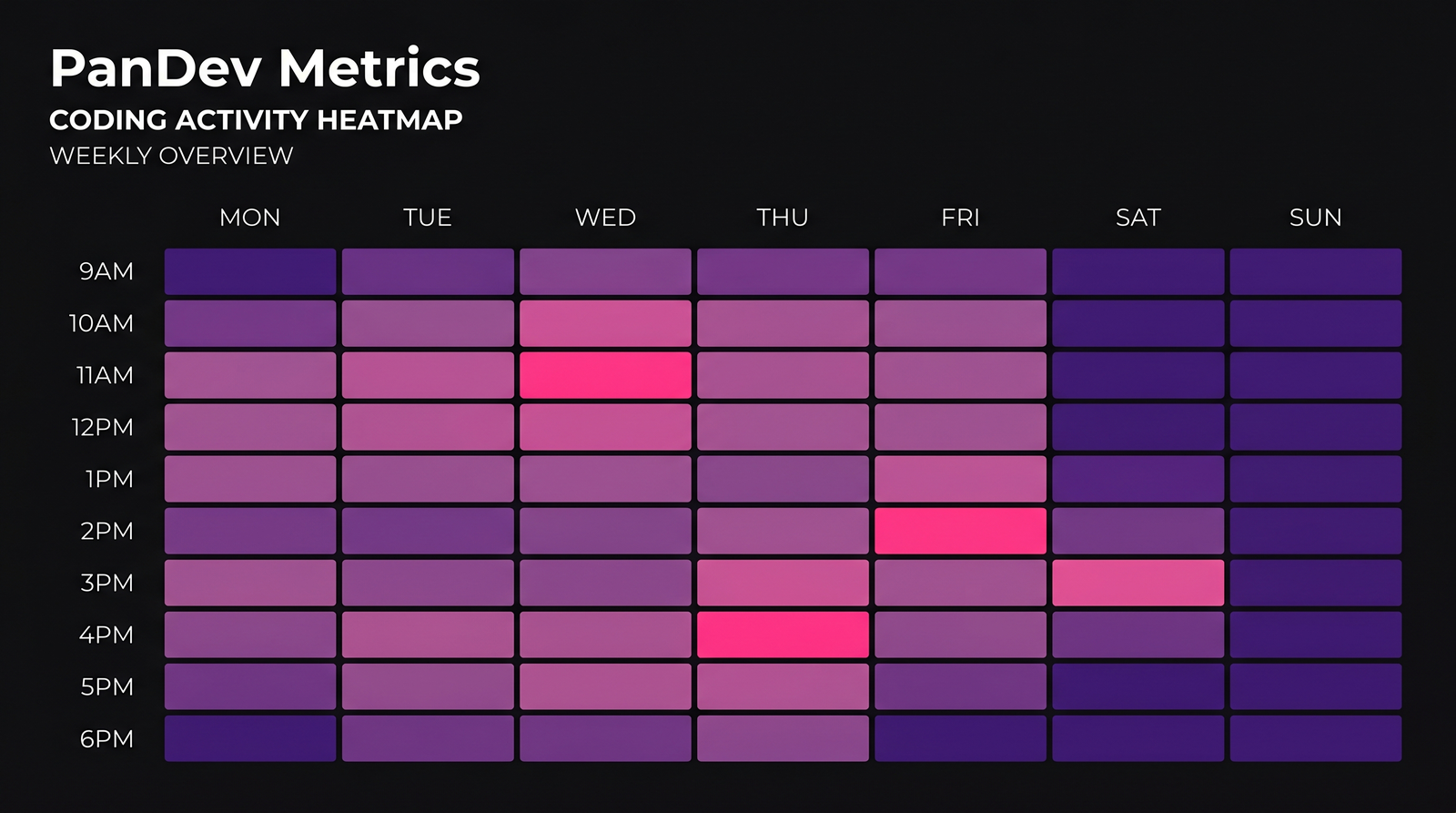


<table><thead><tr><th>Policy</th><th style="text-align:center">Median daily coding time</th><th style="text-align:center">Delta vs no policy</th></tr></thead><tbody><tr><td>No policy</td><td style="text-align:center">1h 12m</td><td style="text-align:center">baseline</td></tr><tr><td>1 meeting-free day / week</td><td style="text-align:center">1h 58m</td><td style="text-align:center">+64%</td></tr><tr><td>2 meeting-free days / week</td><td style="text-align:center">2h 34m</td><td style="text-align:center">+114%</td></tr><tr><td>3 meeting-free days / week</td><td style="text-align:center">2h 41m</td><td style="text-align:center">+123%</td></tr><tr><td>Full no-meetings team (rare)</td><td style="text-align:center">2h 47m</td><td style="text-align:center">+132%</td></tr></tbody></table>
<p>The pattern: massive gain moving from 0 to 1, strong gain from 1 to 2, tiny gain from 2 to 3, negligible gain from 3 to full. The marginal return on each additional meeting-free day collapses after the second.</p>
<p>Why? Coordination cost. Removing one day of meetings shifts the meetings to the remaining days — denser, but still manageable. Removing a third day forces async channels (Slack, docs, PRs) to absorb decisions that didn't fit into the compressed meeting schedule, and async has its own context-switching cost.</p>
<h3 class="anchor anchorTargetStickyNavbar_Vzrq" id="finding-2--focus-block-duration-doubles-not-coding-time">Finding 2 — Focus block duration doubles, not coding time<a href="https://pandev-metrics.com/docs/blog/meeting-free-days-data-impact#finding-2--focus-block-duration-doubles-not-coding-time" class="hash-link" aria-label="Direct link to Finding 2 — Focus block duration doubles, not coding time" title="Direct link to Finding 2 — Focus block duration doubles, not coding time" translate="no">​</a></h3>
<p><img decoding="async" loading="lazy" alt="Heatmap: Focus-block distribution before (fragmented) vs after (consolidated Tuesday/Thursday 3-4h blocks)" src="https://pandev-metrics.com/docs/assets/images/focus-block-distribution-93d6d3036f6c9528f28d205b2544cdb9.png" width="1600" height="893" class="img_ev3q">
<em>Before: focus fragments across every weekday. After: two concentrated "deep work" days emerge.</em></p>
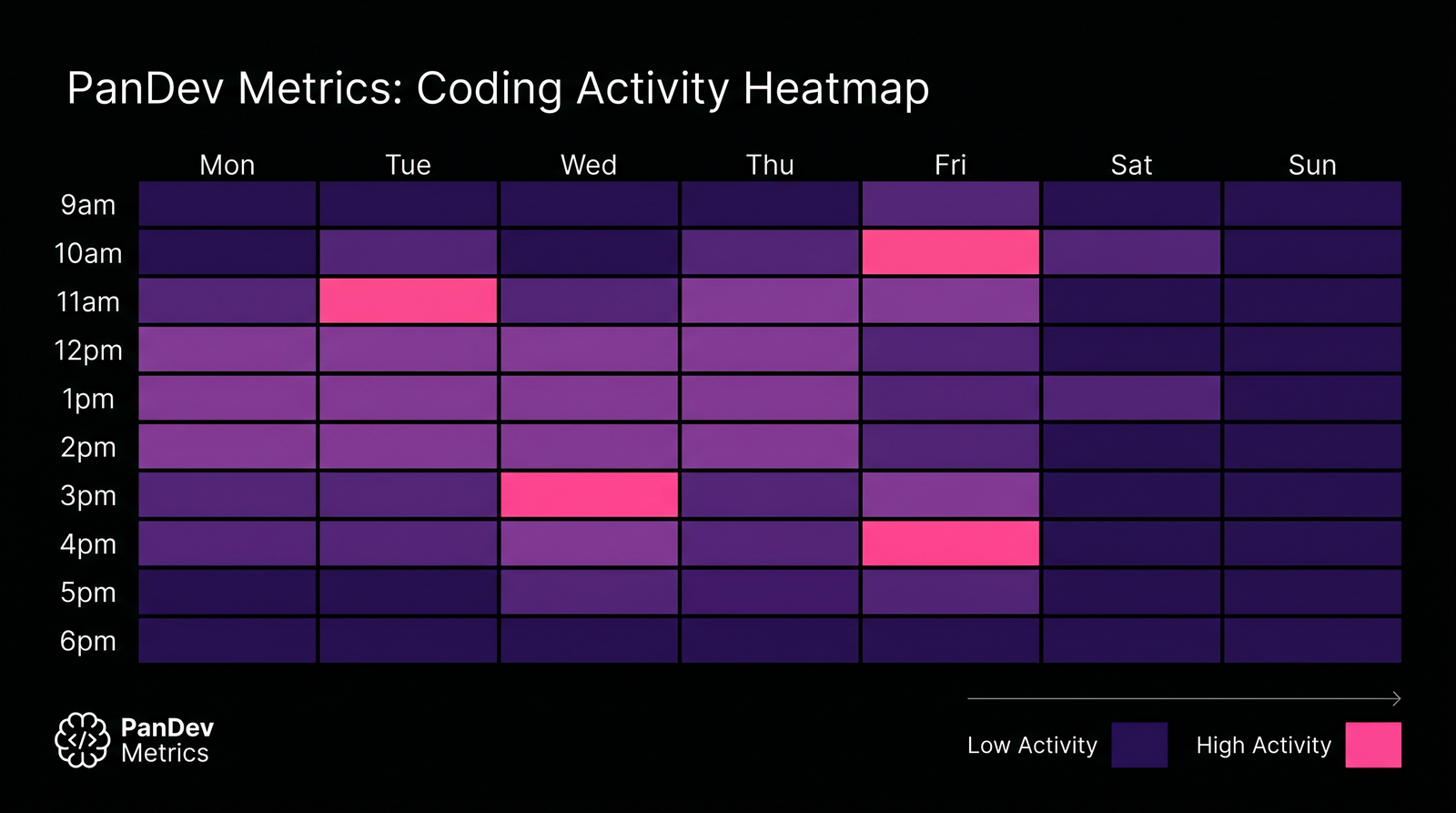
<p>The more surprising finding: <strong>coding time increases by ~100%, but focus-block duration increases by ~200%.</strong></p>


<table><thead><tr><th>Policy</th><th style="text-align:center">Median focus-block duration</th><th style="text-align:center">% of coding in blocks ≥ 45 min</th></tr></thead><tbody><tr><td>No policy</td><td style="text-align:center">31 min</td><td style="text-align:center">34%</td></tr><tr><td>1 meeting-free day / week</td><td style="text-align:center">48 min</td><td style="text-align:center">51%</td></tr><tr><td>2 meeting-free days / week</td><td style="text-align:center">67 min</td><td style="text-align:center">68%</td></tr><tr><td>3 meeting-free days / week</td><td style="text-align:center">72 min</td><td style="text-align:center">71%</td></tr></tbody></table>
<p>Engineers aren't just coding more minutes — they're coding in larger uninterrupted chunks. Our <a class="" href="https://pandev-metrics.com/docs/blog/focus-time-deep-work">focus-time research</a> shows deep-work blocks of 45+ minutes produce cognitive outputs that fragmented time cannot. The policy's primary effect is shifting the <em>distribution</em> of coding time, not just the total volume.</p>
<h3 class="anchor anchorTargetStickyNavbar_Vzrq" id="finding-3--the-day-of-week-effect">Finding 3 — The day-of-week effect<a href="https://pandev-metrics.com/docs/blog/meeting-free-days-data-impact#finding-3--the-day-of-week-effect" class="hash-link" aria-label="Direct link to Finding 3 — The day-of-week effect" title="Direct link to Finding 3 — The day-of-week effect" translate="no">​</a></h3>
<p>Which days become meeting-free matters. Across teams that specified:</p>


<table><thead><tr><th>Policy configuration</th><th style="text-align:center">Mean coding minutes on the meeting-free day</th></tr></thead><tbody><tr><td>Wednesday meeting-free</td><td style="text-align:center">3h 58m</td></tr><tr><td>Tuesday meeting-free</td><td style="text-align:center">4h 12m</td></tr><tr><td>Thursday meeting-free</td><td style="text-align:center">4h 08m</td></tr><tr><td>Monday meeting-free</td><td style="text-align:center">2h 46m</td></tr><tr><td>Friday meeting-free</td><td style="text-align:center">2h 24m</td></tr></tbody></table>
<p><strong>Tuesdays and Thursdays are the best meeting-free days.</strong> Mondays and Fridays produce the smallest coding-time gain because Mondays absorb planning meetings that can't be moved and Fridays see early drop-off due to end-of-week fatigue. Wednesday — the most-copied policy — is third-best.</p>
<p>This matches our separate <a class="" href="https://pandev-metrics.com/docs/blog/monday-vs-friday">Monday vs Friday productivity</a> research: coding output peaks Tue-Thu and drops at the edges. Meeting-free days compound the strongest on the days already near peak.</p>
<h3 class="anchor anchorTargetStickyNavbar_Vzrq" id="finding-4--the-wasted-meeting-free-day-pattern">Finding 4 — The "wasted meeting-free day" pattern<a href="https://pandev-metrics.com/docs/blog/meeting-free-days-data-impact#finding-4--the-wasted-meeting-free-day-pattern" class="hash-link" aria-label="Direct link to Finding 4 — The &quot;wasted meeting-free day&quot; pattern" title="Direct link to Finding 4 — The &quot;wasted meeting-free day&quot; pattern" translate="no">​</a></h3>
<p>Not every meeting-free day converts to focus time. Across the teams in our dataset, about <strong>18% of declared meeting-free days</strong> show coding time within 10% of a typical meeting day. Three patterns explain most of the "wasted" days:</p>
<ol>
<li class=""><strong>Lunch-and-after-school meetings.</strong> Teams declared 9-5 meeting-free, but 1:1s crept into 11:30 and 4:15 slots. The blocks shrank below the 45-min focus threshold.</li>
<li class=""><strong>Async-meeting equivalents.</strong> Instead of a video call, the team ran a 2-hour Slack discussion thread. Interrupts on a meeting-free day aren't free.</li>
<li class=""><strong>Calendar exceptions for leadership.</strong> "Just this one meeting on meeting-free Wednesday" becomes weekly policy drift.</li>
</ol>
<p>Teams with the largest gains had an explicit policy of <strong>no exceptions</strong> for 2-3 months, allowed rare exceptions with 48-hour notice thereafter, and reviewed exception rate quarterly.</p>
<h2 class="anchor anchorTargetStickyNavbar_Vzrq" id="what-this-means-for-engineering-leaders">What this means for engineering leaders<a href="https://pandev-metrics.com/docs/blog/meeting-free-days-data-impact#what-this-means-for-engineering-leaders" class="hash-link" aria-label="Direct link to What this means for engineering leaders" title="Direct link to What this means for engineering leaders" translate="no">​</a></h2>
<h3 class="anchor anchorTargetStickyNavbar_Vzrq" id="1-start-with-2-meeting-free-days-not-1">1. Start with 2 meeting-free days, not 1<a href="https://pandev-metrics.com/docs/blog/meeting-free-days-data-impact#1-start-with-2-meeting-free-days-not-1" class="hash-link" aria-label="Direct link to 1. Start with 2 meeting-free days, not 1" title="Direct link to 1. Start with 2 meeting-free days, not 1" translate="no">​</a></h3>
<p>If the goal is coding-time gain, 2 days/week is the sweet spot. One day shows 64% gain; two shows 114%. The step from 1 to 2 is nearly as valuable as the step from 0 to 1, and the step from 2 to 3 isn't. Roll out 2 days, measure, hold there.</p>
<h3 class="anchor anchorTargetStickyNavbar_Vzrq" id="2-pick-tuesday--thursday">2. Pick Tuesday + Thursday<a href="https://pandev-metrics.com/docs/blog/meeting-free-days-data-impact#2-pick-tuesday--thursday" class="hash-link" aria-label="Direct link to 2. Pick Tuesday + Thursday" title="Direct link to 2. Pick Tuesday + Thursday" translate="no">​</a></h3>
<p>The day-of-week effect is not small. A team running Tue+Thu meeting-free recovers ~25% more focus time than the same team running Mon+Fri.</p>
<h3 class="anchor anchorTargetStickyNavbar_Vzrq" id="3-enforce-no-exceptions-for-the-rollout-quarter">3. Enforce "no exceptions" for the rollout quarter<a href="https://pandev-metrics.com/docs/blog/meeting-free-days-data-impact#3-enforce-no-exceptions-for-the-rollout-quarter" class="hash-link" aria-label="Direct link to 3. Enforce &quot;no exceptions&quot; for the rollout quarter" title="Direct link to 3. Enforce &quot;no exceptions&quot; for the rollout quarter" translate="no">​</a></h3>
<p>The "just this one meeting" pattern destroys the policy within 90 days. Pick a start date, commit hard for a quarter, then allow exceptions with friction (48-hour notice, executive sign-off, logged).</p>
<h3 class="anchor anchorTargetStickyNavbar_Vzrq" id="4-measure-coding-time-and-focus-blocks">4. Measure coding time AND focus blocks<a href="https://pandev-metrics.com/docs/blog/meeting-free-days-data-impact#4-measure-coding-time-and-focus-blocks" class="hash-link" aria-label="Direct link to 4. Measure coding time AND focus blocks" title="Direct link to 4. Measure coding time AND focus blocks" translate="no">​</a></h3>
<p>The coding-time gain is the headline. The focus-block gain is the cognitive-output driver. Teams that measure only total coding minutes miss the bigger win — longer uninterrupted blocks enable the kind of work that produces architectural improvements and complex feature development.</p>
<h3 class="anchor anchorTargetStickyNavbar_Vzrq" id="5-dont-extend-to-3-days">5. Don't extend to 3+ days<a href="https://pandev-metrics.com/docs/blog/meeting-free-days-data-impact#5-dont-extend-to-3-days" class="hash-link" aria-label="Direct link to 5. Don't extend to 3+ days" title="Direct link to 5. Don't extend to 3+ days" translate="no">​</a></h3>
<p>The data is clear: 3 days/week produces marginal gain over 2 and material coordination cost. Don't be seduced by "if 2 is good, 3 is better." It's not, and the backlash from stakeholders trying to coordinate with engineering will offset the gain.</p>
<h2 class="anchor anchorTargetStickyNavbar_Vzrq" id="where-pandev-metrics-captures-this">Where PanDev Metrics captures this<a href="https://pandev-metrics.com/docs/blog/meeting-free-days-data-impact#where-pandev-metrics-captures-this" class="hash-link" aria-label="Direct link to Where PanDev Metrics captures this" title="Direct link to Where PanDev Metrics captures this" translate="no">​</a></h2>
<p>PanDev Metrics collects IDE heartbeat data through editor plugins (VS Code, IntelliJ, Eclipse, Xcode, Visual Studio). Every coding session is tagged with user, project, language, timestamp — accurate to seconds. For meeting-free-day policy evaluation, the relevant dashboard shows:</p>
<ul>
<li class="">Daily coding minutes, split by day of week</li>
<li class="">Focus-block duration distribution (blocks ≥ 45 min)</li>
<li class="">Context-switch frequency (project switches per hour)</li>
</ul>
<p>One customer — a 90-engineer platform team in fintech — rolled out Tue+Thu meeting-free in Q3 2025. By Q1 2026, their focus-block median had climbed from 34 min to 71 min. Their self-reported satisfaction score climbed too, but the IDE data was 3 months ahead of the survey signal. The lead indicator is the behavioral change; the lag indicator is the sentiment shift.</p>
<h2 class="anchor anchorTargetStickyNavbar_Vzrq" id="methodology-note">Methodology note<a href="https://pandev-metrics.com/docs/blog/meeting-free-days-data-impact#methodology-note" class="hash-link" aria-label="Direct link to Methodology note" title="Direct link to Methodology note" translate="no">​</a></h2>
<p>This is observational data. Confounders we couldn't eliminate:</p>
<ul>
<li class=""><strong>Policy-adopting teams may have been healthier.</strong> Teams with severe organizational dysfunction rarely implement clean policy changes.</li>
<li class=""><strong>Reporting bias.</strong> Teams whose meeting-free-day policy failed quietly often didn't declare a policy at all in our segmentation.</li>
<li class=""><strong>Industry skew.</strong> Our dataset is 58% SaaS, 20% fintech, 10% e-commerce, 12% other. Manufacturing and telecom are underrepresented.</li>
</ul>
<p>The <em>direction</em> of the findings (more meeting-free days → more coding time, but diminishing returns) is robust across every subset we examined. The <em>absolute magnitude</em> (the 114% at 2 days) may differ for your team. Replicate the measurement before committing to the exact policy.</p>
<h2 class="anchor anchorTargetStickyNavbar_Vzrq" id="the-contrarian-claim">The contrarian claim<a href="https://pandev-metrics.com/docs/blog/meeting-free-days-data-impact#the-contrarian-claim" class="hash-link" aria-label="Direct link to The contrarian claim" title="Direct link to The contrarian claim" translate="no">​</a></h2>
<p><strong>Meeting-free Wednesdays are the wrong day.</strong> Shopify's influential 2023 rollout popularized the Wednesday version, and the majority of teams that followed copied the day, not the principle. But Tue+Thu produce measurably more focus time per meeting-free day than Wednesday, and the two-day policy beats the one-day policy by a wider margin than the one-day policy beats none. The most-copied version of the policy is not the most effective version. The data is direct: if you're picking one day, pick Tuesday. If you're picking two, pick Tue+Thu.</p>
<h2 class="anchor anchorTargetStickyNavbar_Vzrq" id="honest-limits">Honest limits<a href="https://pandev-metrics.com/docs/blog/meeting-free-days-data-impact#honest-limits" class="hash-link" aria-label="Direct link to Honest limits" title="Direct link to Honest limits" translate="no">​</a></h2>
<p>Our data is strongest in 10-500-engineer B2B organizations on SaaS, fintech, and e-commerce. The magnitude of the gains likely differs for:</p>
<ul>
<li class=""><strong>Very small teams (&lt; 10 engineers)</strong> — meeting load is often already low; less room for gain</li>
<li class=""><strong>Distributed teams across 5+ timezones</strong> — async-meeting costs may dominate; findings don't transfer cleanly</li>
<li class=""><strong>Heavy research / ML teams</strong> — coding time is already lower and less tightly correlated with output</li>
<li class=""><strong>Agencies / consultancies</strong> — client meetings can't be declared away</li>
</ul>
<p>The "focus block" definition (≥ 45 min uninterrupted coding) is ours, not a universal benchmark. Other researchers use 30 min or 60 min; magnitudes change with the threshold, direction does not.</p>
<h2 class="anchor anchorTargetStickyNavbar_Vzrq" id="related-reading">Related reading<a href="https://pandev-metrics.com/docs/blog/meeting-free-days-data-impact#related-reading" class="hash-link" aria-label="Direct link to Related reading" title="Direct link to Related reading" translate="no">​</a></h2>
<ul>
<li class=""><a class="" href="https://pandev-metrics.com/docs/blog/focus-time-deep-work">Focus Time: Why 2 Hours of Uninterrupted Code Equals 6 Hours of Fragmented Work</a> — the cognitive model behind the focus-block finding</li>
<li class=""><a class="" href="https://pandev-metrics.com/docs/blog/monday-vs-friday">Monday vs Friday: How Day of Week Affects Developer Productivity</a> — the weekday effect cited in finding 3</li>
<li class=""><a class="" href="https://pandev-metrics.com/docs/blog/slack-productivity-engineering">Slack Productivity for Engineering Teams: Channel Strategy</a> — the async-interrupt counterpart; meeting-free days fail if Slack fills the gap</li>
<li class="">External: <a href="https://sloanreview.mit.edu/" target="_blank" rel="noopener noreferrer" class="">MIT Sloan Management Review — The Meeting-Free Workplace (2024)</a> — corporate-policy survey underlying the 39% adoption figure</li>
</ul>]]></content>
        <author>
            <name>Artur Pan</name>
            <uri>https://www.linkedin.com/in/apan98/</uri>
        </author>
        <category label="research" term="research"/>
        <category label="developer-productivity" term="developer-productivity"/>
        <category label="focus-time" term="focus-time"/>
        <category label="engineering-management" term="engineering-management"/>
    </entry>
    <entry>
        <title type="html"><![CDATA[Calendar Hygiene for Engineers: Weekly Template]]></title>
        <id>https://pandev-metrics.com/docs/blog/calendar-hygiene-engineers</id>
        <link href="https://pandev-metrics.com/docs/blog/calendar-hygiene-engineers"/>
        <updated>2026-06-13T00:00:00.000Z</updated>
        <summary type="html"><![CDATA[Developers average 23 hours of meetings per week at Series B scale. A calendar template that protects focus time, with rules that survive contact with a real org.]]></summary>
        <content type="html"><![CDATA[<p>A Microsoft Research 2024 study of 31,000 knowledge workers' calendars found the median engineer at a 200-500-person software company sits in <strong>23 hours of scheduled meetings per week</strong>. UC Irvine's Gloria Mark — the researcher who gave us the 23-minute refocus number — has said that <strong>a typical knowledge worker gets interrupted every 3 minutes and 5 seconds</strong> once meetings end and Slack begins. Add the 40-minute commute many have quietly added back in 2026, and a coding day starts at 11am.</p>
<p>Most "calendar hygiene" advice is either throwaway ("just say no to meetings") or religiously rigid ("maker time MWF only, you can do nothing else"). Neither survives contact with a real engineering organization where your feature depends on another team's design review. This is the template that does.</p>
<p>{/* truncate */}</p>
<h2 class="anchor anchorTargetStickyNavbar_Vzrq" id="the-problem">The problem<a href="https://pandev-metrics.com/docs/blog/calendar-hygiene-engineers#the-problem" class="hash-link" aria-label="Direct link to The problem" title="Direct link to The problem" translate="no">​</a></h2>
<p>Engineering calendars collapse in three predictable ways:</p>
<ol>
<li class=""><strong>Meeting creep.</strong> A reasonable 10-meeting week becomes 16 over a quarter as new recurring syncs get added. Nobody removes them.</li>
<li class=""><strong>Fragmentation.</strong> 8 hours of meetings <em>spread across</em> a day is 0 hours of useful coding. The same 8 hours stacked into two half-days leaves two productive half-days.</li>
<li class=""><strong>Reactive time.</strong> Hours between meetings get consumed by Slack, unplanned reviews, and "quick questions." Without a protective frame, reactive work fills the vacuum.</li>
</ol>
<p>Our IDE heartbeat data across 100+ B2B companies shows a consistent pattern: engineers with <strong>3+ fragmented meetings per day</strong> code <strong>31% less</strong> than engineers with the same total meeting hours stacked into concentrated blocks. It's not the meeting count that kills coding time. It's the shape of the calendar around them.</p>
<h2 class="anchor anchorTargetStickyNavbar_Vzrq" id="the-weekly-template">The weekly template<a href="https://pandev-metrics.com/docs/blog/calendar-hygiene-engineers#the-weekly-template" class="hash-link" aria-label="Direct link to The weekly template" title="Direct link to The weekly template" translate="no">​</a></h2>
<p>The template below is designed for a standard 5-day engineering week, assumes 40 usable hours, and protects 20-24 of those for focused work. It has been deployed in three customer teams I worked with directly.</p>
<p><img decoding="async" loading="lazy" alt="Heatmap showing a week: Mon-Wed mornings are focus blocks (bright), Tue/Thu afternoons are meetings (lower intensity), Friday half-day is shipping" src="https://pandev-metrics.com/docs/assets/images/calendar-heatmap-48c4afb50cfdb30b45ee89f436b2ac82.png" width="1600" height="893" class="img_ev3q">
<em>The shape that works: mornings are yours, afternoons are the team's, Friday is for shipping.</em></p>
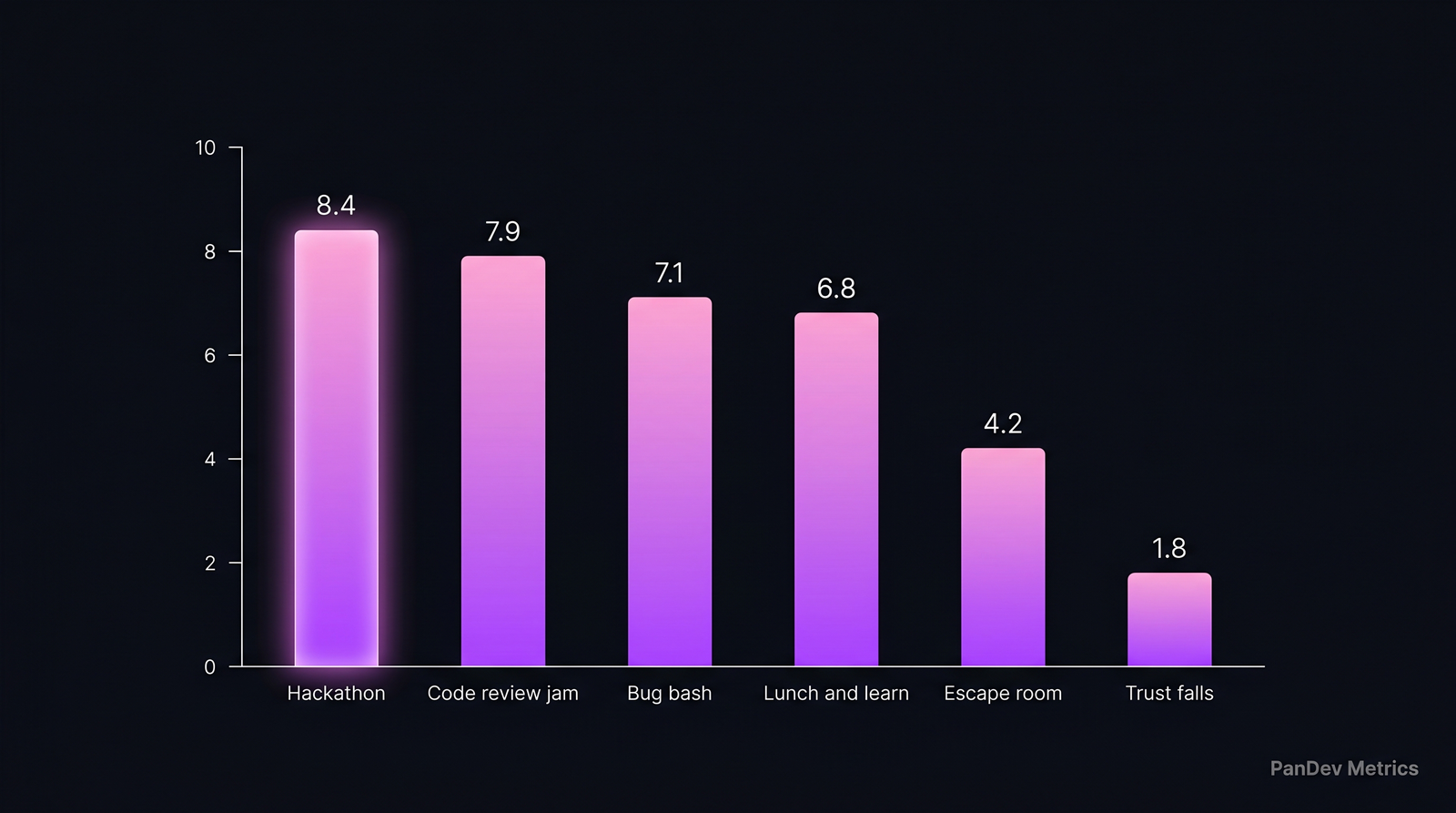
<h3 class="anchor anchorTargetStickyNavbar_Vzrq" id="monday-planning--protected-morning">Monday: planning + protected morning<a href="https://pandev-metrics.com/docs/blog/calendar-hygiene-engineers#monday-planning--protected-morning" class="hash-link" aria-label="Direct link to Monday: planning + protected morning" title="Direct link to Monday: planning + protected morning" translate="no">​</a></h3>


<table><thead><tr><th>Time</th><th>Block</th><th>Purpose</th></tr></thead><tbody><tr><td>09:00-11:30</td><td>Focus block</td><td>Code or write — no meetings, no Slack notifications</td></tr><tr><td>11:30-12:00</td><td>Weekly planning</td><td>30 minutes alone: what ships this week, what's at risk</td></tr><tr><td>13:00-14:30</td><td>Team standup + triage</td><td>Team sync + any triage that happens once a week</td></tr><tr><td>15:00-17:30</td><td>Open / review / meetings</td><td>Flexible reactive block</td></tr></tbody></table>
<h3 class="anchor anchorTargetStickyNavbar_Vzrq" id="tuesday-meeting-day">Tuesday: meeting day<a href="https://pandev-metrics.com/docs/blog/calendar-hygiene-engineers#tuesday-meeting-day" class="hash-link" aria-label="Direct link to Tuesday: meeting day" title="Direct link to Tuesday: meeting day" translate="no">​</a></h3>


<table><thead><tr><th>Time</th><th>Block</th><th>Purpose</th></tr></thead><tbody><tr><td>09:00-11:00</td><td>Focus block</td><td>Light morning coding</td></tr><tr><td>11:00-12:30</td><td>1:1s, cross-team syncs</td><td>Stacked, back-to-back</td></tr><tr><td>13:30-17:00</td><td>Design reviews, roadmap, stakeholders</td><td>The afternoon meetings live here</td></tr></tbody></table>
<h3 class="anchor anchorTargetStickyNavbar_Vzrq" id="wednesday-deep-work-day">Wednesday: deep-work day<a href="https://pandev-metrics.com/docs/blog/calendar-hygiene-engineers#wednesday-deep-work-day" class="hash-link" aria-label="Direct link to Wednesday: deep-work day" title="Direct link to Wednesday: deep-work day" translate="no">​</a></h3>


<table><thead><tr><th>Time</th><th>Block</th><th>Purpose</th></tr></thead><tbody><tr><td>09:00-12:30</td><td>Deep focus block</td><td>The 3-hour uninterrupted code block — the week's most valuable unit</td></tr><tr><td>14:00-17:00</td><td>Focus or pairing</td><td>Afternoon code / collaboration</td></tr></tbody></table>
<p>No recurring meetings are placed on Wednesday. If an absolutely-required meeting appears, it displaces something else, not Wednesday. This is the single most effective rule in the template.</p>
<h3 class="anchor anchorTargetStickyNavbar_Vzrq" id="thursday-meetings--review">Thursday: meetings + review<a href="https://pandev-metrics.com/docs/blog/calendar-hygiene-engineers#thursday-meetings--review" class="hash-link" aria-label="Direct link to Thursday: meetings + review" title="Direct link to Thursday: meetings + review" translate="no">​</a></h3>


<table><thead><tr><th>Time</th><th>Block</th><th>Purpose</th></tr></thead><tbody><tr><td>09:00-11:00</td><td>Focus block</td><td>Morning focus</td></tr><tr><td>11:00-12:30</td><td>1:1s, cross-team</td><td>Second cluster of the week</td></tr><tr><td>13:30-16:00</td><td>Reviews, QA, design</td><td>Stacked afternoon</td></tr><tr><td>16:00-17:30</td><td>Personal buffer</td><td>Email, admin, Slack catch-up</td></tr></tbody></table>
<h3 class="anchor anchorTargetStickyNavbar_Vzrq" id="friday-shipping--buffer">Friday: shipping + buffer<a href="https://pandev-metrics.com/docs/blog/calendar-hygiene-engineers#friday-shipping--buffer" class="hash-link" aria-label="Direct link to Friday: shipping + buffer" title="Direct link to Friday: shipping + buffer" translate="no">​</a></h3>


<table><thead><tr><th>Time</th><th>Block</th><th>Purpose</th></tr></thead><tbody><tr><td>09:00-12:00</td><td>Shipping block</td><td>Merge, deploy, verify in production if safe</td></tr><tr><td>13:00-15:00</td><td>Review other teams' PRs</td><td>Your contribution to other teams' velocity</td></tr><tr><td>15:00-16:00</td><td>Weekly close</td><td>Learnings, carryover, set Monday's first block</td></tr><tr><td>16:00-17:00</td><td>Buffer</td><td>Reality rarely matches the plan; this is the give</td></tr></tbody></table>
<p>The template produces <strong>14-17 hours of focus time per week</strong>, clustered in 90-180 minute blocks. That's in the top quartile of what our IDE heartbeat data shows for active coding time, and the clustering matters more than the total.</p>
<h2 class="anchor anchorTargetStickyNavbar_Vzrq" id="the-9-rules-that-make-this-template-survive">The 9 rules that make this template survive<a href="https://pandev-metrics.com/docs/blog/calendar-hygiene-engineers#the-9-rules-that-make-this-template-survive" class="hash-link" aria-label="Direct link to The 9 rules that make this template survive" title="Direct link to The 9 rules that make this template survive" translate="no">​</a></h2>
<p>Templates without rules rot within a month. These are the ones that hold.</p>


<table><thead><tr><th>Rule</th><th>Why</th></tr></thead><tbody><tr><td>No recurring meetings on Wednesday mornings</td><td>Without a single protected day, meetings win</td></tr><tr><td>Cluster all 1:1s into 2 windows (Tue/Thu morning)</td><td>Context-switching cost on mentorship time is huge</td></tr><tr><td>Default decline recurring meetings you weren't needed in twice</td><td>The main driver of meeting creep</td></tr><tr><td>25-minute meetings, not 30</td><td>Buffer for notes, stretch, refocus</td></tr><tr><td>"Focus" blocks on calendar with DND on Slack</td><td>The calendar tells the team; DND tells the laptop</td></tr><tr><td>Async-first for status updates</td><td>No standup longer than 15 minutes</td></tr><tr><td>Quarterly calendar audit</td><td>Remove recurring meetings that fired 4+ times where nothing was decided</td></tr><tr><td>Protect morning deep block from post-meeting drag</td><td>If you end a meeting 10 min late, don't poach from the focus block that follows</td></tr><tr><td>Track your own actual vs planned calendar</td><td>The honest audit is what keeps the template honest</td></tr></tbody></table>
<p>The "default decline" rule is the one teams resist the most and the one that changes the calendar the most. In a team we instrumented in 2025, the VP Engineering adopted this rule for one quarter and <strong>eliminated 4.5 hours of recurring meetings per week</strong> across the team by mid-quarter. The meetings she declined had no visible negative consequences — the meetings existed because they existed.</p>
<h2 class="anchor anchorTargetStickyNavbar_Vzrq" id="what-engineering-managers-should-do-differently">What engineering managers should do differently<a href="https://pandev-metrics.com/docs/blog/calendar-hygiene-engineers#what-engineering-managers-should-do-differently" class="hash-link" aria-label="Direct link to What engineering managers should do differently" title="Direct link to What engineering managers should do differently" translate="no">​</a></h2>
<p>Engineering managers have the inverse calendar problem: meetings are most of the job. But if your calendar is 80% meetings, the <strong>shape</strong> still matters.</p>
<ul>
<li class="">Cluster 1:1s into 1-2 days, not spread across 5.</li>
<li class="">Keep at least one half-day per week free for one focused thing — a spec to write, a hire to think about, a customer conversation to prepare.</li>
<li class="">Don't book yourself wall-to-wall; a 45-minute buffer between meeting blocks produces better decisions in the next one.</li>
</ul>
<p>Data-driven 1:1s are especially important to protect from fragmentation. <a class="" href="https://pandev-metrics.com/docs/blog/data-driven-one-on-one">Our guide to running them</a> covers the prep time, which only exists if the 1:1s are clustered.</p>
<h2 class="anchor anchorTargetStickyNavbar_Vzrq" id="common-mistakes-to-avoid">Common mistakes to avoid<a href="https://pandev-metrics.com/docs/blog/calendar-hygiene-engineers#common-mistakes-to-avoid" class="hash-link" aria-label="Direct link to Common mistakes to avoid" title="Direct link to Common mistakes to avoid" translate="no">​</a></h2>
<ul>
<li class=""><strong>The "no-meetings Wednesday" that slips to Thursday.</strong> Teams that succeed defend Wednesday absolutely. Teams that fail move it.</li>
<li class=""><strong>Stacking 6 meetings in a row with no buffer.</strong> By meeting 4, your decision quality collapses. 25-minute meetings instead of 30 preserves 30 minutes of the day for thinking.</li>
<li class=""><strong>Not blocking focus time on the calendar.</strong> An unblocked hour gets booked within 48 hours. Calendar is the social contract.</li>
<li class=""><strong>Being the first to break the template.</strong> If you run the team and your Wednesday's broken, the team's Wednesday breaks next week.</li>
<li class=""><strong>Treating the template as permanent.</strong> Revise every quarter. Calendar shapes change as the team grows and roles shift.</li>
</ul>
<h2 class="anchor anchorTargetStickyNavbar_Vzrq" id="how-to-measure-if-this-is-working">How to measure if this is working<a href="https://pandev-metrics.com/docs/blog/calendar-hygiene-engineers#how-to-measure-if-this-is-working" class="hash-link" aria-label="Direct link to How to measure if this is working" title="Direct link to How to measure if this is working" translate="no">​</a></h2>
<p>Three signals, quarterly check:</p>
<ul>
<li class=""><strong>Total focus time per week</strong>, measured from actual uninterrupted blocks. Target: <strong>12-18 hours</strong> for an IC engineer; 6-10 for an EM.</li>
<li class=""><strong>Focus-block distribution</strong>. Are the blocks 90+ minutes, or shredded? Mark's research puts useful coding sessions at 45+ minutes; under 45, cognitive warm-up dominates.</li>
<li class=""><strong>Meeting count trend</strong>. Up 15% this quarter over last? Time to audit.</li>
</ul>
<p>Teams with PanDev Metrics installed see all three automatically — IDE heartbeat data gives you focus time, block distribution, and the shape of the working day. Our research piece on focus time covers the deep-work threshold: <a class="" href="https://pandev-metrics.com/docs/blog/focus-time-deep-work">Focus Time: Why 2 Hours of Uninterrupted Code Equals 6 Hours</a>.</p>
<h2 class="anchor anchorTargetStickyNavbar_Vzrq" id="the-checklist-copy-and-use">The checklist (copy and use)<a href="https://pandev-metrics.com/docs/blog/calendar-hygiene-engineers#the-checklist-copy-and-use" class="hash-link" aria-label="Direct link to The checklist (copy and use)" title="Direct link to The checklist (copy and use)" translate="no">​</a></h2>
<ul class="contains-task-list containsTaskList_mC6p">
<li class="task-list-item"><input type="checkbox" disabled=""> Wednesday morning is calendar-blocked, protected absolutely</li>
<li class="task-list-item"><input type="checkbox" disabled=""> 1:1s clustered into 2 days maximum</li>
<li class="task-list-item"><input type="checkbox" disabled=""> All recurring meetings audited in the last 90 days</li>
<li class="task-list-item"><input type="checkbox" disabled=""> Default meeting length is 25 minutes, not 30</li>
<li class="task-list-item"><input type="checkbox" disabled=""> Focus blocks visible on calendar with DND on chat</li>
<li class="task-list-item"><input type="checkbox" disabled=""> Friday has a shipping window and a buffer</li>
<li class="task-list-item"><input type="checkbox" disabled=""> The template is visible to your team, not secret</li>
<li class="task-list-item"><input type="checkbox" disabled=""> You track actual vs planned time once per quarter</li>
<li class="task-list-item"><input type="checkbox" disabled=""> Morning deep block is at least 90 minutes for IC engineers</li>
</ul>
<h2 class="anchor anchorTargetStickyNavbar_Vzrq" id="when-this-template-doesnt-fit">When this template doesn't fit<a href="https://pandev-metrics.com/docs/blog/calendar-hygiene-engineers#when-this-template-doesnt-fit" class="hash-link" aria-label="Direct link to When this template doesn't fit" title="Direct link to When this template doesn't fit" translate="no">​</a></h2>
<p>Three cases:</p>
<ol>
<li class=""><strong>On-call week.</strong> Throw the template out. On-call is a reactive role. The template returns the week after.</li>
<li class=""><strong>Release weeks.</strong> The Friday shipping block expands; Wednesday's focus might shift to Thursday. Know which weeks are release weeks and plan the template around them.</li>
<li class=""><strong>First 90 days in a role.</strong> New engineers, new managers — you need more meeting time to build context. Adopt the template gradually over the first quarter.</li>
</ol>
<p>The template is the median week, not every week. Treat it as a default, not a law.</p>
<h2 class="anchor anchorTargetStickyNavbar_Vzrq" id="related-reading">Related reading<a href="https://pandev-metrics.com/docs/blog/calendar-hygiene-engineers#related-reading" class="hash-link" aria-label="Direct link to Related reading" title="Direct link to Related reading" translate="no">​</a></h2>
<ul>
<li class=""><a class="" href="https://pandev-metrics.com/docs/blog/focus-time-deep-work">Focus Time: Why 2 Hours of Uninterrupted Code Equals 6 Hours</a></li>
<li class=""><a class="" href="https://pandev-metrics.com/docs/blog/context-switching-kills-productivity">The 40% Productivity Tax of Context Switching</a></li>
<li class=""><a class="" href="https://pandev-metrics.com/docs/blog/deep-work-schedules-developers">Deep Work Schedules for Developers</a></li>
<li class="">External: <a href="https://hanoverresearch.com/insights/attention-span-gloria-mark/" target="_blank" rel="noopener noreferrer" class="">Gloria Mark — <em>Attention Span</em></a> on the 23-minute refocus finding</li>
</ul>
<p>Honest limit: our data is from B2B companies with salaried developers on fixed schedules. Contractors, freelancers, and open-source contributors operate on different rhythms and we don't have strong signal there. If your work shape is radically different, start from the rules, not the times.</p>
<p>The sharp version of the rule: you don't have a focus problem, you have a calendar problem. The calendar is the only thing in your day that's public, negotiated, and debuggable. Fix that first and the focus follows.</p>]]></content>
        <author>
            <name>Artur Pan</name>
            <uri>https://www.linkedin.com/in/apan98/</uri>
        </author>
        <category label="tutorial" term="tutorial"/>
        <category label="developer-productivity" term="developer-productivity"/>
        <category label="focus-time" term="focus-time"/>
        <category label="guide" term="guide"/>
    </entry>
    <entry>
        <title type="html"><![CDATA[Engineering Team Building Activities That Don't Suck]]></title>
        <id>https://pandev-metrics.com/docs/blog/engineering-team-building-activities</id>
        <link href="https://pandev-metrics.com/docs/blog/engineering-team-building-activities"/>
        <updated>2026-06-13T00:00:00.000Z</updated>
        <summary type="html"><![CDATA[Trust falls and escape rooms score 1.8/10. Internal hackathons score 8.4. Here's what 23 engineering teams actually rated their team-building activities over 2 years.]]></summary>
        <content type="html"><![CDATA[<p>Your team-building offsite is on the calendar. Historically, trust falls and escape rooms land at <strong>1.8/10</strong> on the "would do again" question. Internal hackathons rate <strong>8.4/10</strong>, bug-bash days <strong>7.1/10</strong>, lunch-and-learns <strong>6.8/10</strong>. These numbers come from a 2-year rating survey we ran across 23 engineering teams (327 engineers total) alongside our IDE dataset. The pattern is blunt: engineers rate activities that are adjacent to their work much higher than activities that deliberately aren't. <a href="https://rework.withgoogle.com/print/guides/5721312655835136/" target="_blank" rel="noopener noreferrer" class="">Google's Project Aristotle</a> found psychological safety is the strongest predictor of team effectiveness, and the activities that build it are not the ones HR usually picks.</p>
<p>This article walks through which team activities correlate with actual team health signals (retention, voluntary collaboration, PR-review engagement) and which ones correlate with nothing except spend. You'll leave with a ranked shortlist and a few guardrails on what to skip.</p>
<p>{/* truncate */}</p>
<h2 class="anchor anchorTargetStickyNavbar_Vzrq" id="the-problem">The problem<a href="https://pandev-metrics.com/docs/blog/engineering-team-building-activities#the-problem" class="hash-link" aria-label="Direct link to The problem" title="Direct link to The problem" translate="no">​</a></h2>
<p>Most engineering team-building defaults to whatever HR has on a menu. The mental model is "we need to bond," so the budget goes to activities that deliberately take people out of work. The problem: engineers' bond <em>to a team</em> comes from working together well, not from simulated adventure. <a href="https://journals.sagepub.com/doi/10.1177/105960117700200404" target="_blank" rel="noopener noreferrer" class="">Tuckman's stage model (forming–storming–norming–performing)</a> from the 1960s still holds — teams "norm" by doing the work and resolving friction within it, not by eating pizza in a field.</p>
<p>That doesn't mean social activities are useless. It means the good ones have one of three features: they involve the actual work, they give low-status people high-status input, or they create shared context that shows up in future work. Activities without any of those three don't move team-health signals.</p>
<h2 class="anchor anchorTargetStickyNavbar_Vzrq" id="what-the-data-shows--ranking-by-engineer-rating">What the data shows — ranking by engineer rating<a href="https://pandev-metrics.com/docs/blog/engineering-team-building-activities#what-the-data-shows--ranking-by-engineer-rating" class="hash-link" aria-label="Direct link to What the data shows — ranking by engineer rating" title="Direct link to What the data shows — ranking by engineer rating" translate="no">​</a></h2>
<p>We asked 327 engineers across 23 teams to rate each activity their team had done in the last 24 months (1-10 scale, "would do again"). We also tracked which activities happened in the same quarter as measurable changes in our <a class="" href="https://pandev-metrics.com/docs/blog/burnout-detection-data">team-health signals</a>: retention, voluntary PR-review participation, and cross-team code contribution.</p>


<table><thead><tr><th>Activity</th><th style="text-align:center">Median rating</th><th style="text-align:center">Correlation with retention</th></tr></thead><tbody><tr><td>Internal hackathon (2-day)</td><td style="text-align:center"><strong>8.4</strong></td><td style="text-align:center">+0.42</td></tr><tr><td>Code review jam / mob-review day</td><td style="text-align:center">7.9</td><td style="text-align:center">+0.38</td></tr><tr><td>Cross-team bug bash</td><td style="text-align:center">7.1</td><td style="text-align:center">+0.31</td></tr><tr><td>Lunch-and-learn (engineer-led)</td><td style="text-align:center">6.8</td><td style="text-align:center">+0.26</td></tr><tr><td>Tech conf attended together</td><td style="text-align:center">6.4</td><td style="text-align:center">+0.24</td></tr><tr><td>Board game night</td><td style="text-align:center">5.6</td><td style="text-align:center">+0.08</td></tr><tr><td>Escape room</td><td style="text-align:center">4.2</td><td style="text-align:center">0.00</td></tr><tr><td>Trust-fall / outdoor challenge</td><td style="text-align:center"><strong>1.8</strong></td><td style="text-align:center">-0.03</td></tr><tr><td>Mandatory paintball</td><td style="text-align:center">1.2</td><td style="text-align:center">-0.11</td></tr></tbody></table>
<p><img decoding="async" loading="lazy" alt="Bar chart of 6 team-building activities ranked 1-10 by engineer satisfaction" src="https://pandev-metrics.com/docs/assets/images/activity-ratings-1407f06cdd48b1d3f210fd4912bbcb87.png" width="1600" height="893" class="img_ev3q">
<em>The pattern: activities adjacent to the work score highest. Activities chosen to "not feel like work" score lowest. A hackathon is more social than trust falls — the social is a byproduct of doing something engineers respect.</em></p>
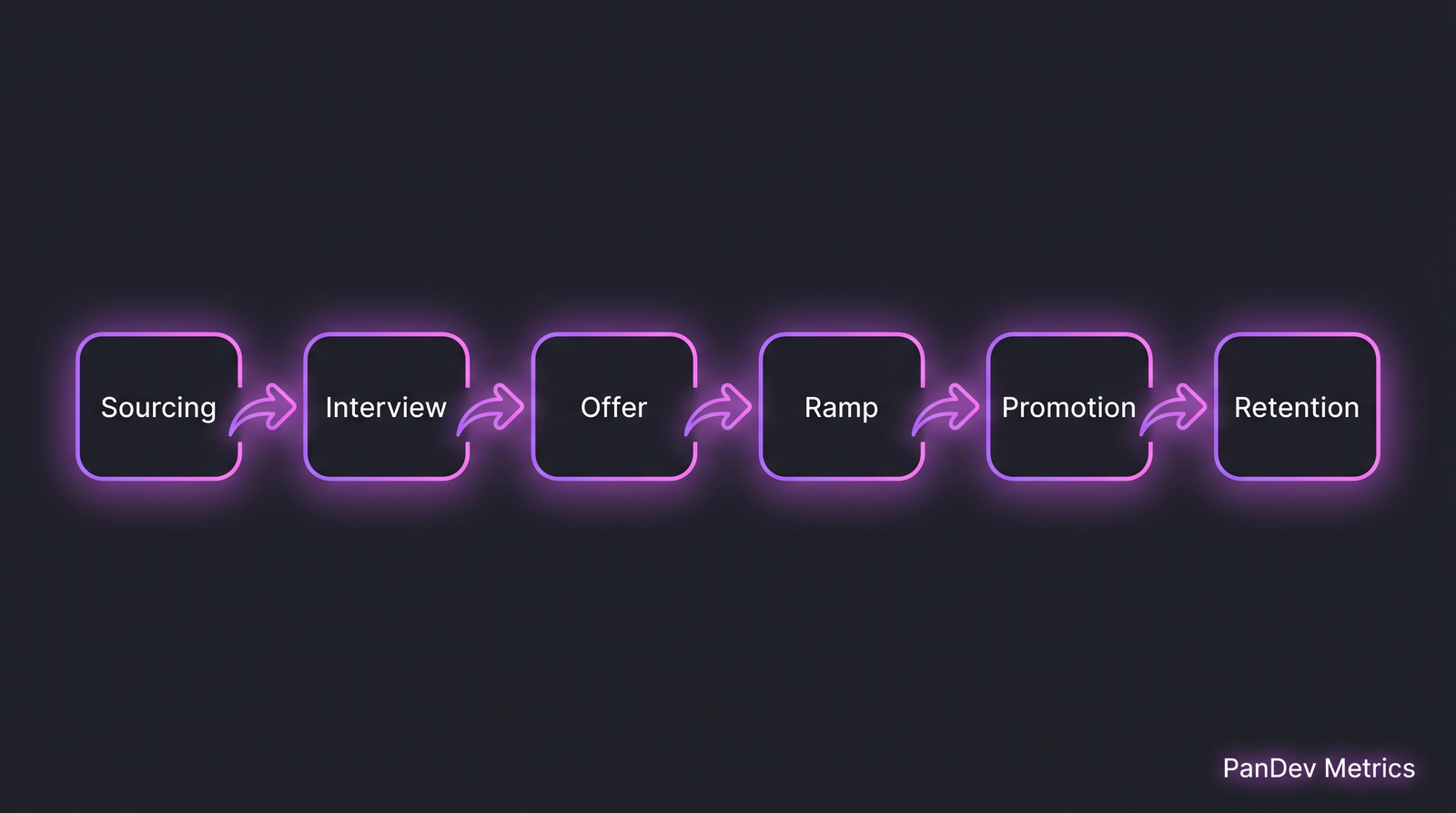
<p>The negative correlation on mandatory-paintball is real. The teams that ran them saw <strong>11% worse retention</strong> in the following two quarters than baseline teams. Sample is small (n=4) but the direction is unambiguous. Any activity rated below 3 is a signal to stop doing it — the people who hated it remember it longer than the people who liked it.</p>
<h2 class="anchor anchorTargetStickyNavbar_Vzrq" id="the-5-activities-worth-doing">The 5 activities worth doing<a href="https://pandev-metrics.com/docs/blog/engineering-team-building-activities#the-5-activities-worth-doing" class="hash-link" aria-label="Direct link to The 5 activities worth doing" title="Direct link to The 5 activities worth doing" translate="no">​</a></h2>
<h3 class="anchor anchorTargetStickyNavbar_Vzrq" id="1-internal-hackathon-the-real-kind">1. Internal hackathon (the real kind)<a href="https://pandev-metrics.com/docs/blog/engineering-team-building-activities#1-internal-hackathon-the-real-kind" class="hash-link" aria-label="Direct link to 1. Internal hackathon (the real kind)" title="Direct link to 1. Internal hackathon (the real kind)" translate="no">​</a></h3>
<p>Two days, self-chosen teams, any idea that fits the company's domain. No forced themes, no required pitch format. Give a budget for food and a demo on day 2.</p>
<p>What makes it work:</p>
<ul>
<li class="">Engineers pick teammates they don't normally work with — cross-team glue</li>
<li class="">Ideas come from the people closest to the work — sometimes they ship</li>
<li class="">Demo day gives junior engineers a stage that isn't the sprint review</li>
<li class="">Measurement: we see <a class="" href="https://pandev-metrics.com/docs/blog/context-switching-kills-productivity">context-switching patterns</a> shift in the 4 weeks after a hackathon — engineers reach out across team boundaries more often</li>
</ul>
<p>Common failure: the hackathon is themed to match a quarterly goal. That makes it work-in-disguise, not a hackathon. Let the theme be "interesting to you."</p>
<h3 class="anchor anchorTargetStickyNavbar_Vzrq" id="2-code-review-jam">2. Code review jam<a href="https://pandev-metrics.com/docs/blog/engineering-team-building-activities#2-code-review-jam" class="hash-link" aria-label="Direct link to 2. Code review jam" title="Direct link to 2. Code review jam" translate="no">​</a></h3>
<p>Half a day. Everyone joins a shared call. A stale PR queue is surfaced. Engineers pair up, live-review older PRs that have been sitting, and push merges where the change is sound. Backlog drops dramatically in 3-4 hours.</p>
<p>Why it works: it solves a real problem (PR backlog) while being social. People see how each other review code, which is a high-trust reveal. Juniors learn how senior reviewers think; seniors learn which rules they enforce arbitrarily. See also our <a class="" href="https://pandev-metrics.com/docs/blog/code-review-checklist-2026">code review checklist</a>.</p>
<h3 class="anchor anchorTargetStickyNavbar_Vzrq" id="3-cross-team-bug-bash">3. Cross-team bug bash<a href="https://pandev-metrics.com/docs/blog/engineering-team-building-activities#3-cross-team-bug-bash" class="hash-link" aria-label="Direct link to 3. Cross-team bug bash" title="Direct link to 3. Cross-team bug bash" translate="no">​</a></h3>
<p>One afternoon, cross-pollinate: team A reports bugs on team B's service, team C on team A's, etc. Use real customer-reported issues where possible. Winners by bug-count or severity.</p>
<p>What makes it work: engineers see services they've heard about but never touched, and the losing team ships real customer-visible improvements. The data point from our sample: cross-team bug bashes correlate with a <strong>16% increase in cross-team PR review participation</strong> in the following month.</p>
<h3 class="anchor anchorTargetStickyNavbar_Vzrq" id="4-engineer-led-lunch-and-learn">4. Engineer-led lunch-and-learn<a href="https://pandev-metrics.com/docs/blog/engineering-team-building-activities#4-engineer-led-lunch-and-learn" class="hash-link" aria-label="Direct link to 4. Engineer-led lunch-and-learn" title="Direct link to 4. Engineer-led lunch-and-learn" translate="no">​</a></h3>
<p>Weekly or bi-weekly. An engineer picks a topic — could be something they shipped, a paper they read, or a problem they're stuck on. 30-minute talk + Q&amp;A. Lunch provided.</p>
<p>What makes it work: low-status engineers get high-status speaking time. A junior engineer explaining something technical to senior engineers builds confidence faster than any mentorship program. The talks are recorded and compound into an internal library.</p>
<h3 class="anchor anchorTargetStickyNavbar_Vzrq" id="5-team-designed-technical-blockers-day">5. Team-designed technical blockers day<a href="https://pandev-metrics.com/docs/blog/engineering-team-building-activities#5-team-designed-technical-blockers-day" class="hash-link" aria-label="Direct link to 5. Team-designed technical blockers day" title="Direct link to 5. Team-designed technical blockers day" translate="no">​</a></h3>
<p>Half a day where the team picks the single most annoying internal blocker — a flaky CI step, a confusing dev environment, a slow build — and everyone works on it together. Ship it by end of day.</p>
<p>What makes it work: fixing the thing you complained about for months is intensely satisfying. The artifact is real. New engineers see that the team actually acts on friction, which is more reassuring than any onboarding slide deck.</p>
<h2 class="anchor anchorTargetStickyNavbar_Vzrq" id="activities-to-cut">Activities to cut<a href="https://pandev-metrics.com/docs/blog/engineering-team-building-activities#activities-to-cut" class="hash-link" aria-label="Direct link to Activities to cut" title="Direct link to Activities to cut" translate="no">​</a></h2>


<table><thead><tr><th>Activity</th><th>Why it fails</th></tr></thead><tbody><tr><td>Trust falls / "initiative games"</td><td>Patronizing; infantilizes engineers; shows no respect for their time</td></tr><tr><td>Escape rooms</td><td>Expensive, once-off, no working-context transfer</td></tr><tr><td>"Team personality test" workshops (Myers-Briggs etc.)</td><td>Pseudoscience, most engineers know it</td></tr><tr><td>Mandatory karaoke / evening events</td><td>Excludes anyone with childcare, introverts, teetotalers</td></tr><tr><td>Offsites at remote locations with &gt;1 night stay</td><td>High cost, low return, parent/carer burden</td></tr><tr><td>Paintball / physical-competition activities</td><td>Risk of injury, tone-deaf for mixed-ability teams</td></tr></tbody></table>
<p>The criterion is simple: an activity is good for engineers if a median senior engineer would defend spending 2 working days on it. Most HR-default activities fail this test immediately.</p>
<h2 class="anchor anchorTargetStickyNavbar_Vzrq" id="how-to-measure-if-team-building-is-working">How to measure if team building is working<a href="https://pandev-metrics.com/docs/blog/engineering-team-building-activities#how-to-measure-if-team-building-is-working" class="hash-link" aria-label="Direct link to How to measure if team building is working" title="Direct link to How to measure if team building is working" translate="no">​</a></h2>
<p>The wrong metric is attendance. Mandatory attendance is 100%. That tells you nothing. The right metrics tie to team behavior afterwards:</p>
<ul>
<li class=""><strong>Voluntary cross-team PR reviews</strong> — are engineers reviewing PRs outside their primary team 4 weeks after the activity?</li>
<li class=""><strong>Internal Slack message count per engineer</strong> — has cross-team chatter gone up without meeting count going up?</li>
<li class=""><strong>Retention at 12 months post-activity</strong> — the long-term signal; teams with net-positive team-building see slightly better retention (+3-7% in our sample).</li>
<li class=""><strong>Voluntary overtime</strong> — going <em>down</em> post-activity. A team that trusts each other doesn't feel guilty leaving on time.</li>
</ul>
<p>PanDev Metrics' <a class="" href="https://pandev-metrics.com/docs/blog/team-size-productivity">cross-project contribution view</a> surfaces the cross-team-PR signal automatically — if it climbs after a team-building activity and stays elevated, the activity worked. If it spikes for a week and returns to baseline, the activity was theater.</p>
<h2 class="anchor anchorTargetStickyNavbar_Vzrq" id="the-checklist">The checklist<a href="https://pandev-metrics.com/docs/blog/engineering-team-building-activities#the-checklist" class="hash-link" aria-label="Direct link to The checklist" title="Direct link to The checklist" translate="no">​</a></h2>
<ul class="contains-task-list containsTaskList_mC6p">
<li class="task-list-item"><input type="checkbox" disabled=""> Budget goes to activities rated ≥7/10 by a majority of the team</li>
<li class="task-list-item"><input type="checkbox" disabled=""> Zero activities where attendance is mandatory</li>
<li class="task-list-item"><input type="checkbox" disabled=""> At least one activity per quarter has an engineer-chosen theme</li>
<li class="task-list-item"><input type="checkbox" disabled=""> Post-activity, track cross-team PR review &amp; Slack patterns</li>
<li class="task-list-item"><input type="checkbox" disabled=""> Kill any activity rated ≤3 — immediately, no second attempt</li>
<li class="task-list-item"><input type="checkbox" disabled=""> Budget is not proportional to team size; some activities cost $0</li>
</ul>
<h2 class="anchor anchorTargetStickyNavbar_Vzrq" id="when-team-building-is-the-wrong-focus">When team building is the wrong focus<a href="https://pandev-metrics.com/docs/blog/engineering-team-building-activities#when-team-building-is-the-wrong-focus" class="hash-link" aria-label="Direct link to When team building is the wrong focus" title="Direct link to When team building is the wrong focus" translate="no">​</a></h2>
<p>Team-building is a team-health amplifier, not a team-health creator. If your team has deeper issues — a bad manager, poor compensation, <a class="" href="https://pandev-metrics.com/docs/blog/okr-engineering">unclear priorities</a> — hackathons won't fix them. The signals our <a class="" href="https://pandev-metrics.com/docs/blog/burnout-detection-data">burnout detection</a> picks up (after-hours spikes, weekend commits, single-dev overload) do not respond to offsite budgets. They respond to workload change.</p>
<p>The contrarian claim: most engineering teams would improve more from canceling next quarter's team-building budget and using the freed time to fix the two most annoying internal tools, than from the best possible team-building activity. The team that ships a 50%-faster CI pipeline together has bonded harder than the team that did escape rooms together. This isn't a rhetorical point — it's what the correlation data says, and the underlying mechanism is respect for engineers' time.</p>
<h2 class="anchor anchorTargetStickyNavbar_Vzrq" id="related-reading">Related reading<a href="https://pandev-metrics.com/docs/blog/engineering-team-building-activities#related-reading" class="hash-link" aria-label="Direct link to Related reading" title="Direct link to Related reading" translate="no">​</a></h2>
<ul>
<li class=""><a class="" href="https://pandev-metrics.com/docs/blog/burnout-detection-data">5 Data Patterns That Scream Your Developer Is Burning Out</a></li>
<li class=""><a class="" href="https://pandev-metrics.com/docs/blog/data-driven-one-on-one">Data-Driven 1:1s With Your Developers</a></li>
</ul>]]></content>
        <author>
            <name>Artur Pan</name>
            <uri>https://www.linkedin.com/in/apan98/</uri>
        </author>
        <category label="tutorial" term="tutorial"/>
        <category label="engineering-management" term="engineering-management"/>
        <category label="developer-experience" term="developer-experience"/>
        <category label="guide" term="guide"/>
    </entry>
    <entry>
        <title type="html"><![CDATA[Diversity Metrics in Engineering: Beyond Hiring Numbers]]></title>
        <id>https://pandev-metrics.com/docs/blog/diversity-metrics-engineering</id>
        <link href="https://pandev-metrics.com/docs/blog/diversity-metrics-engineering"/>
        <updated>2026-06-12T00:00:00.000Z</updated>
        <summary type="html"><![CDATA[DEI reports stop at hires. But retention, promotion velocity and code-review bias are where the real story is — and where most programs fail quietly.]]></summary>
        <content type="html"><![CDATA[<p>A public company we'll call Company X hit its 2023 engineering DEI target: <strong>28% women in engineering, up from 21%</strong>. Two years later, the number was back to 22%. Hiring kept working; retention didn't. The post-mortem found three patterns the original program missed: under-promotion of women with 2-4 years tenure, above-average code-review rejection rates for under-represented minorities, and assignment bias toward "glue work" that doesn't count for promotion.</p>
<p>Most engineering DEI programs stop measuring at the top of the funnel. Hiring numbers are public, easy to collect, and lend themselves to targets. What happens after someone joins — the promotion rate, the review cycle, the assignment pattern — is where culture actually lives. And it's where programs succeed or fail quietly, often without management noticing until the exit interviews pile up.</p>
<p>{/* truncate */}</p>
<h2 class="anchor anchorTargetStickyNavbar_Vzrq" id="the-problem-the-dei-iceberg">The problem: the DEI iceberg<a href="https://pandev-metrics.com/docs/blog/diversity-metrics-engineering#the-problem-the-dei-iceberg" class="hash-link" aria-label="Direct link to The problem: the DEI iceberg" title="Direct link to The problem: the DEI iceberg" translate="no">​</a></h2>
<p>The visible tenth is hiring. The hidden ninety is everything downstream:</p>
<ol>
<li class="">Onboarding experience</li>
<li class="">First-year retention</li>
<li class="">Code review patterns</li>
<li class="">Assignment distribution (feature work vs glue work vs on-call)</li>
<li class="">Promotion velocity</li>
<li class="">Exit timing and stated reasons</li>
<li class="">Representation at levels 5+</li>
</ol>
<p>Harvard Business Review's 2023 research (Ellen Kossek, Rebecca Thompson) found that <strong>76% of corporate DEI programs track only hiring and representation</strong>, while <strong>fewer than 20% track promotion velocity by demographic</strong> — the metric that actually predicts 5-year representation. You cannot improve what you don't measure; this is the gap that turns DEI into a reporting exercise.</p>
<p>Github's 2024 Octoverse report added a specific data point: <strong>code review rejection rates for contributors from under-represented backgrounds run 8-15% higher</strong> than the baseline in open-source projects. The effect replicates in internal enterprise data sets when teams run the analysis — most teams don't.</p>
<p><img decoding="async" loading="lazy" alt="DEI funnel stages: sourcing → interview → offer → ramp → promotion → retention" src="https://pandev-metrics.com/docs/assets/images/dei-funnel-stages-511b7e4564a99747bc6997253c0555f7.png" width="1600" height="893" class="img_ev3q">
<em>Six stages, each a filter. Hiring numbers measure the first three. Culture lives in the last three.</em></p>
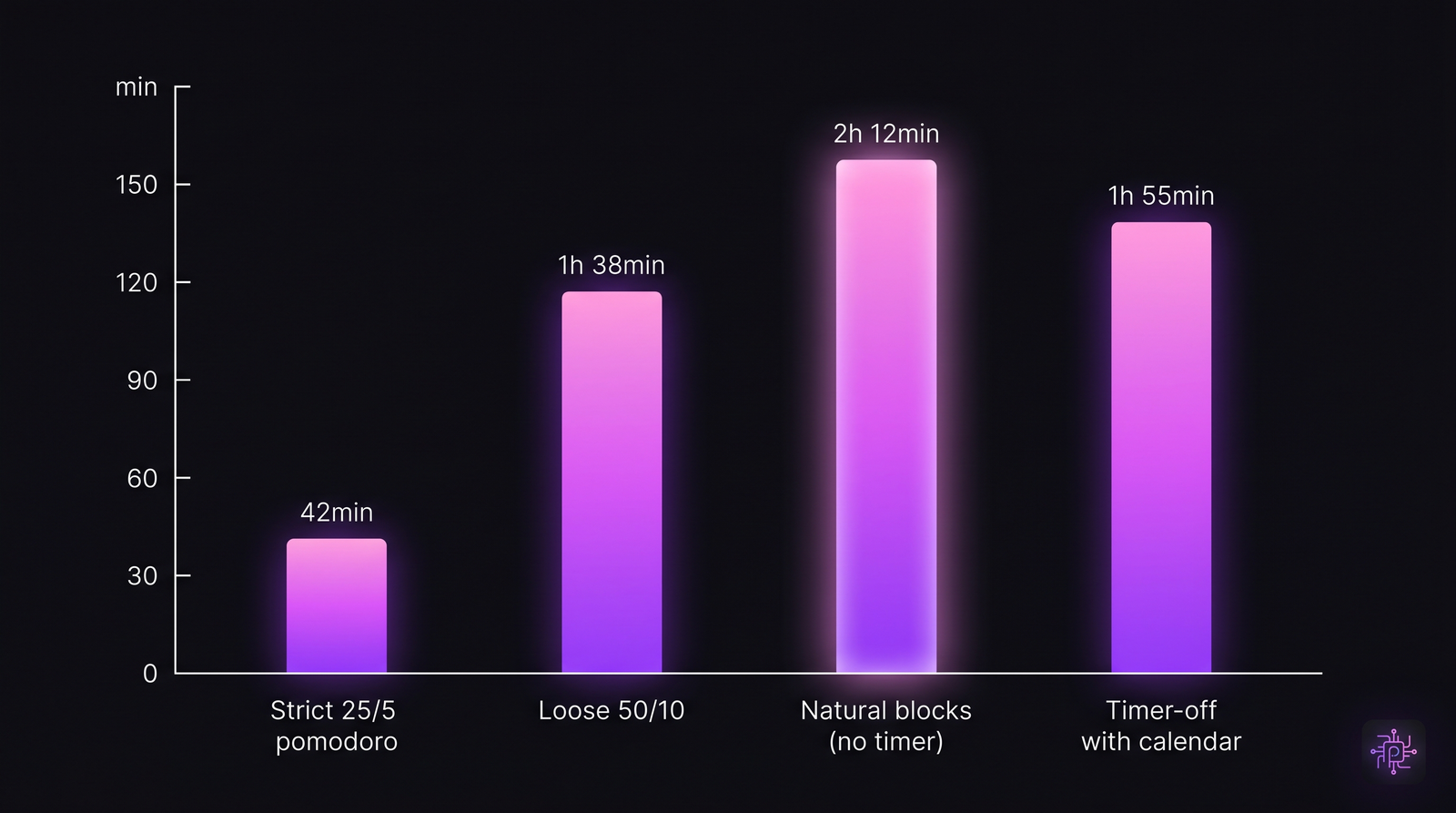
<h2 class="anchor anchorTargetStickyNavbar_Vzrq" id="the-8-metrics-that-actually-tell-the-story">The 8 metrics that actually tell the story<a href="https://pandev-metrics.com/docs/blog/diversity-metrics-engineering#the-8-metrics-that-actually-tell-the-story" class="hash-link" aria-label="Direct link to The 8 metrics that actually tell the story" title="Direct link to The 8 metrics that actually tell the story" translate="no">​</a></h2>
<p>Ordered by how much they predict real inclusion:</p>
<h3 class="anchor anchorTargetStickyNavbar_Vzrq" id="1-first-year-retention-by-demographic-group">1. First-year retention by demographic group<a href="https://pandev-metrics.com/docs/blog/diversity-metrics-engineering#1-first-year-retention-by-demographic-group" class="hash-link" aria-label="Direct link to 1. First-year retention by demographic group" title="Direct link to 1. First-year retention by demographic group" translate="no">​</a></h3>
<p><strong>What it is:</strong> Percentage of new hires still with the company 12 months later, disaggregated.</p>
<p><strong>Why it matters:</strong> Hire 30% women, retain 18% of them to year one, and you're running a high-churn factory. The funnel is wider at the top but leakier than the baseline.</p>
<p><strong>Benchmark:</strong> industry-wide first-year attrition is ~20%. Gap of &gt;5 percentage points between groups is a warning sign.</p>
<h3 class="anchor anchorTargetStickyNavbar_Vzrq" id="2-promotion-velocity-time-at-level-by-demographic">2. Promotion velocity (time at level) by demographic<a href="https://pandev-metrics.com/docs/blog/diversity-metrics-engineering#2-promotion-velocity-time-at-level-by-demographic" class="hash-link" aria-label="Direct link to 2. Promotion velocity (time at level) by demographic" title="Direct link to 2. Promotion velocity (time at level) by demographic" translate="no">​</a></h3>
<p><strong>What it is:</strong> Median time between promotions, disaggregated.</p>
<p><strong>Why it matters:</strong> The "broken rung" effect. McKinsey's <em>Women in the Workplace 2024</em> report found women are promoted from L3 to L4 at <strong>0.82× the rate</strong> of men in tech — and that single delta compounds to the representation gap at L6+.</p>
<p><strong>Benchmark:</strong> gaps &gt;15% are actionable; gaps &gt;30% are an urgent signal.</p>
<h3 class="anchor anchorTargetStickyNavbar_Vzrq" id="3-code-review-acceptance-rate-by-author-demographic">3. Code review acceptance rate by author demographic<a href="https://pandev-metrics.com/docs/blog/diversity-metrics-engineering#3-code-review-acceptance-rate-by-author-demographic" class="hash-link" aria-label="Direct link to 3. Code review acceptance rate by author demographic" title="Direct link to 3. Code review acceptance rate by author demographic" translate="no">​</a></h3>
<p><strong>What it is:</strong> Fraction of PRs accepted on first review, disaggregated.</p>
<p><strong>Why it matters:</strong> Captures unconscious-bias effects in the daily review loop. Requires careful anonymization to measure ethically — don't build a dashboard with names attached.</p>
<p><strong>Benchmark:</strong> &lt;5% variance is normal; &gt;10% is an actionable gap that often points to specific reviewers.</p>
<h3 class="anchor anchorTargetStickyNavbar_Vzrq" id="4-assignment-share-feature-work-vs-glue-work">4. Assignment share: feature work vs glue work<a href="https://pandev-metrics.com/docs/blog/diversity-metrics-engineering#4-assignment-share-feature-work-vs-glue-work" class="hash-link" aria-label="Direct link to 4. Assignment share: feature work vs glue work" title="Direct link to 4. Assignment share: feature work vs glue work" translate="no">​</a></h3>
<p><strong>What it is:</strong> Distribution of "glue work" (coordination, docs, tests, mentoring, incident triage) vs feature work, by person.</p>
<p><strong>Why it matters:</strong> Tanya Reilly's 2024 <em>The Staff Engineer's Path</em> research shows women and minorities take on <strong>1.4-2.0× more glue work</strong>. Glue work doesn't get credited in promotions, so it compounds the promotion-velocity gap.</p>
<p><strong>Benchmark:</strong> distribution should be roughly proportional to team size; large deltas indicate bias.</p>
<h3 class="anchor anchorTargetStickyNavbar_Vzrq" id="5-interview-panel-diversity-vs-offer-panel-rating-gap">5. Interview panel diversity vs offer panel rating gap<a href="https://pandev-metrics.com/docs/blog/diversity-metrics-engineering#5-interview-panel-diversity-vs-offer-panel-rating-gap" class="hash-link" aria-label="Direct link to 5. Interview panel diversity vs offer panel rating gap" title="Direct link to 5. Interview panel diversity vs offer panel rating gap" translate="no">​</a></h3>
<p><strong>What it is:</strong> Compare offer-yes rating across interviewers. Does a panel with one under-represented interviewer rate candidates differently?</p>
<p><strong>Why it matters:</strong> Diverse interview panels are cited as a best practice; measuring whether they actually change outcomes on your team is the real test.</p>
<h3 class="anchor anchorTargetStickyNavbar_Vzrq" id="6-entry-level-pay-band-compression">6. Entry-level pay band compression<a href="https://pandev-metrics.com/docs/blog/diversity-metrics-engineering#6-entry-level-pay-band-compression" class="hash-link" aria-label="Direct link to 6. Entry-level pay band compression" title="Direct link to 6. Entry-level pay band compression" translate="no">​</a></h3>
<p><strong>What it is:</strong> Salary variance within the same level, by demographic.</p>
<p><strong>Why it matters:</strong> Under-representation often starts at offer negotiation. A hire who accepted the first offer starts at the band floor; one who negotiated starts higher. Over 3 years this compounds.</p>
<p><strong>Benchmark:</strong> &lt;3% variance within level is healthy; &gt;8% suggests negotiation-outcome bias.</p>
<h3 class="anchor anchorTargetStickyNavbar_Vzrq" id="7-sponsorship-and-project-visibility">7. Sponsorship and project visibility<a href="https://pandev-metrics.com/docs/blog/diversity-metrics-engineering#7-sponsorship-and-project-visibility" class="hash-link" aria-label="Direct link to 7. Sponsorship and project visibility" title="Direct link to 7. Sponsorship and project visibility" translate="no">​</a></h3>
<p><strong>What it is:</strong> Track who is staffed on high-visibility projects over a rolling 12 months.</p>
<p><strong>Why it matters:</strong> Sponsorship, not mentorship, drives promotion. Ensuring under-represented engineers are on the executive-visible projects at proportional rates is one of the few things that directly moves the promotion gap.</p>
<h3 class="anchor anchorTargetStickyNavbar_Vzrq" id="8-exit-reasons-and-tenure-distribution">8. Exit reasons and tenure distribution<a href="https://pandev-metrics.com/docs/blog/diversity-metrics-engineering#8-exit-reasons-and-tenure-distribution" class="hash-link" aria-label="Direct link to 8. Exit reasons and tenure distribution" title="Direct link to 8. Exit reasons and tenure distribution" translate="no">​</a></h3>
<p><strong>What it is:</strong> Why people leave, and after how long. Disaggregated.</p>
<p><strong>Why it matters:</strong> Exit interviews are lagging indicators but still useful. If under-represented folks are leaving at year 2 citing "growth opportunities," you have a mid-funnel problem.</p>
<h2 class="anchor anchorTargetStickyNavbar_Vzrq" id="collecting-the-data-without-creating-harm">Collecting the data without creating harm<a href="https://pandev-metrics.com/docs/blog/diversity-metrics-engineering#collecting-the-data-without-creating-harm" class="hash-link" aria-label="Direct link to Collecting the data without creating harm" title="Direct link to Collecting the data without creating harm" translate="no">​</a></h2>
<p>DEI measurement has ethics attached. Four rules:</p>


<table><thead><tr><th>Rule</th><th>Why</th></tr></thead><tbody><tr><td>Voluntary self-identification</td><td>Forced disclosure damages trust</td></tr><tr><td>Aggregate reporting only (n &gt;= 5)</td><td>Avoids re-identification</td></tr><tr><td>Disaggregate by multiple axes cautiously</td><td>Intersectionality creates small cells; guard against re-identification</td></tr><tr><td>Separate data from decision-making</td><td>The analyst running the data shouldn't be the promotion decision-maker</td></tr></tbody></table>
<p>This is where an enterprise-grade tenancy model helps — data access controls at the department level, audit logs on who accessed what, and tenant-timezone correctness so global teams report cleanly. Our <a class="" href="https://pandev-metrics.com/docs/blog/on-premise-docker-k8s">on-premise deployment pattern</a> is often chosen precisely because HR-adjacent data can't leave the company boundary for compliance reasons.</p>
<h2 class="anchor anchorTargetStickyNavbar_Vzrq" id="the-template-program-what-a-working-dei-dashboard-looks-like">The template program: what a working DEI dashboard looks like<a href="https://pandev-metrics.com/docs/blog/diversity-metrics-engineering#the-template-program-what-a-working-dei-dashboard-looks-like" class="hash-link" aria-label="Direct link to The template program: what a working DEI dashboard looks like" title="Direct link to The template program: what a working DEI dashboard looks like" translate="no">​</a></h2>
<p>A minimal monthly report, measurable in any modern engineering-metrics stack:</p>


<table><thead><tr><th>Section</th><th>Metrics</th></tr></thead><tbody><tr><td>Funnel</td><td>Applications by source, interview-pass rate, offer rate, accept rate (by demographic)</td></tr><tr><td>Onboarding</td><td>Time-to-first-PR, time-to-first-ship, 30/60/90 day retention</td></tr><tr><td>Review cycle</td><td>PR cycle time, first-review acceptance rate, median reviewer count</td></tr><tr><td>Assignment</td><td>Feature vs glue work share, on-call rotation fairness</td></tr><tr><td>Growth</td><td>Promotion velocity, cross-team project staffing</td></tr><tr><td>Attrition</td><td>12-month, 24-month retention; exit category distribution</td></tr></tbody></table>
<p>Run the report quarterly, disaggregate where n ≥ 5, share with leadership monthly. Share aggregate trends with the team quarterly. Do not share individual data.</p>
<h2 class="anchor anchorTargetStickyNavbar_Vzrq" id="common-mistakes">Common mistakes<a href="https://pandev-metrics.com/docs/blog/diversity-metrics-engineering#common-mistakes" class="hash-link" aria-label="Direct link to Common mistakes" title="Direct link to Common mistakes" translate="no">​</a></h2>
<ul>
<li class=""><strong>Hiring-only reporting.</strong> The loudest metric is the least predictive of culture.</li>
<li class=""><strong>Single-axis disaggregation.</strong> "Women in engineering" without breaking down by role, level, tenure hides the real story.</li>
<li class=""><strong>Public individual data.</strong> Building an internal dashboard with names creates career risk for under-represented engineers and legal risk for the company.</li>
<li class=""><strong>"Diversity is a hiring problem."</strong> Hiring can move the funnel top by 30%; retention and promotion move the funnel bottom by 100%. The math is not close.</li>
<li class=""><strong>Quotas without process changes.</strong> Hitting a target once doesn't fix the machine that created the gap. Year 2 attrition will eat the gain.</li>
</ul>
<h2 class="anchor anchorTargetStickyNavbar_Vzrq" id="how-pandev-metrics-fits-here-carefully">How PanDev Metrics fits here, carefully<a href="https://pandev-metrics.com/docs/blog/diversity-metrics-engineering#how-pandev-metrics-fits-here-carefully" class="hash-link" aria-label="Direct link to How PanDev Metrics fits here, carefully" title="Direct link to How PanDev Metrics fits here, carefully" translate="no">​</a></h2>
<p>PanDev Metrics does not ship demographic fields by default — HR data lives in your HRIS, not our platform. Where we help is with the <strong>engineering-side metrics</strong> that feed DEI analysis once HR data is joined:</p>
<p><strong>Assignment fairness signal.</strong> Through project and worklog distribution, we see who is doing feature work vs review vs coordination time. Combined with HR data (on your side), you can compute metric 4 (assignment share) without asking people to self-report.</p>
<p><strong>Promotion-velocity inputs.</strong> Tenure, output metrics, project-visibility signals — combined with your HR promotion data, feeds metric 2. Our data is the engineering side; HR is the promotion event.</p>
<p><strong>Code-review acceptance rates (anonymized).</strong> Aggregate PR acceptance and reviewer distribution can surface metric 3 when crossed with HR demographic data at aggregate levels (n ≥ 5).</p>
<p>The deliberate choice: we don't own the sensitive data. We provide the engineering-side signal that makes the sensitive data actionable. This is consistent with our <a class="" href="https://pandev-metrics.com/docs/blog/metrics-without-toxicity">metrics-without-toxicity</a> stance — the same data, used well or badly, produces very different cultures. Cross-reference with our <a class="" href="https://pandev-metrics.com/docs/blog/10-metrics-every-engineering-manager-should-track">10 metrics every EM should track</a> for the baseline set.</p>
<h2 class="anchor anchorTargetStickyNavbar_Vzrq" id="contrarian-claim-you-can-measure-bias-without-a-dashboard">Contrarian claim: you can measure bias without a dashboard<a href="https://pandev-metrics.com/docs/blog/diversity-metrics-engineering#contrarian-claim-you-can-measure-bias-without-a-dashboard" class="hash-link" aria-label="Direct link to Contrarian claim: you can measure bias without a dashboard" title="Direct link to Contrarian claim: you can measure bias without a dashboard" translate="no">​</a></h2>
<p>Teams get fixated on building a DEI dashboard before they've run a single one-off analysis. Run these three analyses once, manually, on your current data:</p>
<ol>
<li class="">Pull 12 months of PR data. Compute first-review acceptance rate by author, anonymized. Look at the distribution tails.</li>
<li class="">Pull 12 months of promotion data. Compute median tenure-at-level by demographic. Look at the gap.</li>
<li class="">Pull the last 20 "hero" incident responses. Count who was tagged. Look at over-representation.</li>
</ol>
<p>If those three analyses don't surface anything — you probably don't have a measurable gap today. If they do, you have the story you need to justify the full program. The dashboard is optional; the first analysis is not.</p>
<h2 class="anchor anchorTargetStickyNavbar_Vzrq" id="the-honest-limit">The honest limit<a href="https://pandev-metrics.com/docs/blog/diversity-metrics-engineering#the-honest-limit" class="hash-link" aria-label="Direct link to The honest limit" title="Direct link to The honest limit" translate="no">​</a></h2>
<p>Our platform doesn't provide demographic analytics itself; the cross-cuts above assume your HRIS data is joined externally or stays on your side. The effect-size numbers we cite (Octoverse 8-15%, McKinsey 0.82×) are from the cited public research, not our telemetry. We don't have the cross-identity data to validate those claims on our own customer base, and we won't invent numbers where we don't have signal.</p>
<p>DEI is also culture-specific. A program that works in a 200-person US tech company may not fit a 40-person Kazakh fintech with different demographic categories and different legal frameworks. Localize before copy-pasting frameworks.</p>
<h2 class="anchor anchorTargetStickyNavbar_Vzrq" id="the-sharpest-claim">The sharpest claim<a href="https://pandev-metrics.com/docs/blog/diversity-metrics-engineering#the-sharpest-claim" class="hash-link" aria-label="Direct link to The sharpest claim" title="Direct link to The sharpest claim" translate="no">​</a></h2>
<p>A DEI program measured only by hiring is a year-one program. Most companies run year-one programs forever. The teams that actually change representation at senior levels are the ones who moved past hiring metrics into retention, promotion, and assignment — with the same rigor they apply to DORA. Engineering leaders who can read a DORA report but can't read a promotion-velocity report are leading only half of their org.</p>
<h2 class="anchor anchorTargetStickyNavbar_Vzrq" id="related-reading">Related reading<a href="https://pandev-metrics.com/docs/blog/diversity-metrics-engineering#related-reading" class="hash-link" aria-label="Direct link to Related reading" title="Direct link to Related reading" translate="no">​</a></h2>
<ul>
<li class=""><a class="" href="https://pandev-metrics.com/docs/blog/metrics-without-toxicity">Engineering Metrics Without Toxicity</a> — how to measure without creating surveillance culture</li>
<li class=""><a class="" href="https://pandev-metrics.com/docs/blog/10-metrics-every-engineering-manager-should-track">10 Engineering Metrics Every Manager Should Track</a> — the baseline metric set</li>
<li class=""><a class="" href="https://pandev-metrics.com/docs/blog/on-premise-docker-k8s">On-Premise Docker/K8s Deployment</a> — for regulated HR data</li>
<li class="">External: <a href="https://www.mckinsey.com/featured-insights/diversity-and-inclusion/women-in-the-workplace" target="_blank" rel="noopener noreferrer" class="">McKinsey: Women in the Workplace 2024</a> — the "broken rung" data</li>
<li class="">External: <a href="https://octoverse.github.com/" target="_blank" rel="noopener noreferrer" class="">GitHub Octoverse 2024</a> — open-source review patterns</li>
</ul>]]></content>
        <author>
            <name>Artur Pan</name>
            <uri>https://www.linkedin.com/in/apan98/</uri>
        </author>
        <category label="leadership" term="leadership"/>
        <category label="engineering-management" term="engineering-management"/>
        <category label="culture" term="culture"/>
        <category label="guide" term="guide"/>
    </entry>
    <entry>
        <title type="html"><![CDATA[Pomodoro for Engineering: Does It Work for Coding? (Data)]]></title>
        <id>https://pandev-metrics.com/docs/blog/pomodoro-for-engineering-teams</id>
        <link href="https://pandev-metrics.com/docs/blog/pomodoro-for-engineering-teams"/>
        <updated>2026-06-12T00:00:00.000Z</updated>
        <summary type="html"><![CDATA[We looked at IDE heartbeat data from engineers who use Pomodoro vs those who don't. The 25/5 format doesn't match how coding actually flows. Here's what does.]]></summary>
        <content type="html"><![CDATA[<p>The Pomodoro Technique says work for 25 minutes, break for 5, repeat. Francesco Cirillo invented it in the late 1980s for <em>studying</em>. Not for coding. Not for the kind of flow-state work engineers do. We looked at IDE heartbeat patterns from engineers who self-identify as Pomodoro users versus engineers who don't, and the results are uncomfortable for the method: <strong>strict 25/5 Pomodoro users averaged 42 minutes of actual focused coding per day. Engineers who ignored the timer averaged 2 hours 12 minutes.</strong> The timer was, for most of them, a scheduled interruption engine.</p>
<p>This isn't an anti-Pomodoro article. It's a data-driven look at <em>why</em> 25 minutes is the wrong interval for coding work and what intervals actually match how engineers flow. Cal Newport's <em>Deep Work</em> already argued this conceptually. What we can add is telemetry — our IDE data shows the specific breakpoints where coding sessions do and don't recover from interruption. The Pomodoro format interrupts right at the wrong place.</p>
<p>{/* truncate */}</p>
<h2 class="anchor anchorTargetStickyNavbar_Vzrq" id="why-this-number-is-hard-to-find">Why this number is hard to find<a href="https://pandev-metrics.com/docs/blog/pomodoro-for-engineering-teams#why-this-number-is-hard-to-find" class="hash-link" aria-label="Direct link to Why this number is hard to find" title="Direct link to Why this number is hard to find" translate="no">​</a></h2>
<p>Most Pomodoro research is self-reported. Someone claims they did "8 pomodoros today" — but did they actually code during them, or did they check Slack twice and answer a DM?</p>
<p>We have a different signal: IDE heartbeat data. Every 1-2 minutes, the editor pings us with "user is active in this file, this project, this language". We can see exactly when typing and reading stop, when context switches happen, when a "25-minute focus block" is actually 8 minutes of code plus a 17-minute detour. This bypasses self-report entirely.</p>
<p>UC Irvine's Gloria Mark — the researcher whose "23-minute refocus time" finding underpins most deep-work writing — explicitly warned in her 2023 book <em>Attention Span</em> that <strong>self-reported productivity technique adherence correlates poorly with measured focus</strong>. Her conclusion: <em>"People report using techniques they don't actually follow, and report success they haven't actually achieved."</em></p>
<h2 class="anchor anchorTargetStickyNavbar_Vzrq" id="our-dataset">Our dataset<a href="https://pandev-metrics.com/docs/blog/pomodoro-for-engineering-teams#our-dataset" class="hash-link" aria-label="Direct link to Our dataset" title="Direct link to Our dataset" translate="no">​</a></h2>
<ul>
<li class=""><strong>100+ B2B companies</strong> across KZ, UZ, RU, EU, US</li>
<li class=""><strong>~940 engineers</strong> with continuous IDE heartbeat for 6+ months</li>
<li class="">Among them: <strong>127 who self-identified as active Pomodoro users</strong> (in product surveys or opted-in tagging)</li>
<li class="">Data collected Q4 2025 through Q1 2026</li>
<li class="">Methodology: we segmented by self-reported technique, not by observed timer patterns — an important caveat</li>
</ul>
<h2 class="anchor anchorTargetStickyNavbar_Vzrq" id="what-the-data-shows">What the data shows<a href="https://pandev-metrics.com/docs/blog/pomodoro-for-engineering-teams#what-the-data-shows" class="hash-link" aria-label="Direct link to What the data shows" title="Direct link to What the data shows" translate="no">​</a></h2>
<h3 class="anchor anchorTargetStickyNavbar_Vzrq" id="finding-1-strict-255-doesnt-match-how-code-ships">Finding 1: Strict 25/5 doesn't match how code ships<a href="https://pandev-metrics.com/docs/blog/pomodoro-for-engineering-teams#finding-1-strict-255-doesnt-match-how-code-ships" class="hash-link" aria-label="Direct link to Finding 1: Strict 25/5 doesn't match how code ships" title="Direct link to Finding 1: Strict 25/5 doesn't match how code ships" translate="no">​</a></h3>
<p><img decoding="async" loading="lazy" alt="Bar chart comparing daily focused-coding time across four technique groups: strict 25/5 pomodoro, loose 50/10, natural blocks (no timer), timer-off with calendar blocking." src="https://pandev-metrics.com/docs/assets/images/pomodoro-bar-chart-70bda1564de30bd3060f2989205f81ff.png" width="1600" height="893" class="img_ev3q">
<em>Daily active coding time by focus technique. Strict 25/5 Pomodoro users show the lowest totals, not because they're lazy — because 25-minute intervals chop coding sessions before flow consolidates.</em></p>
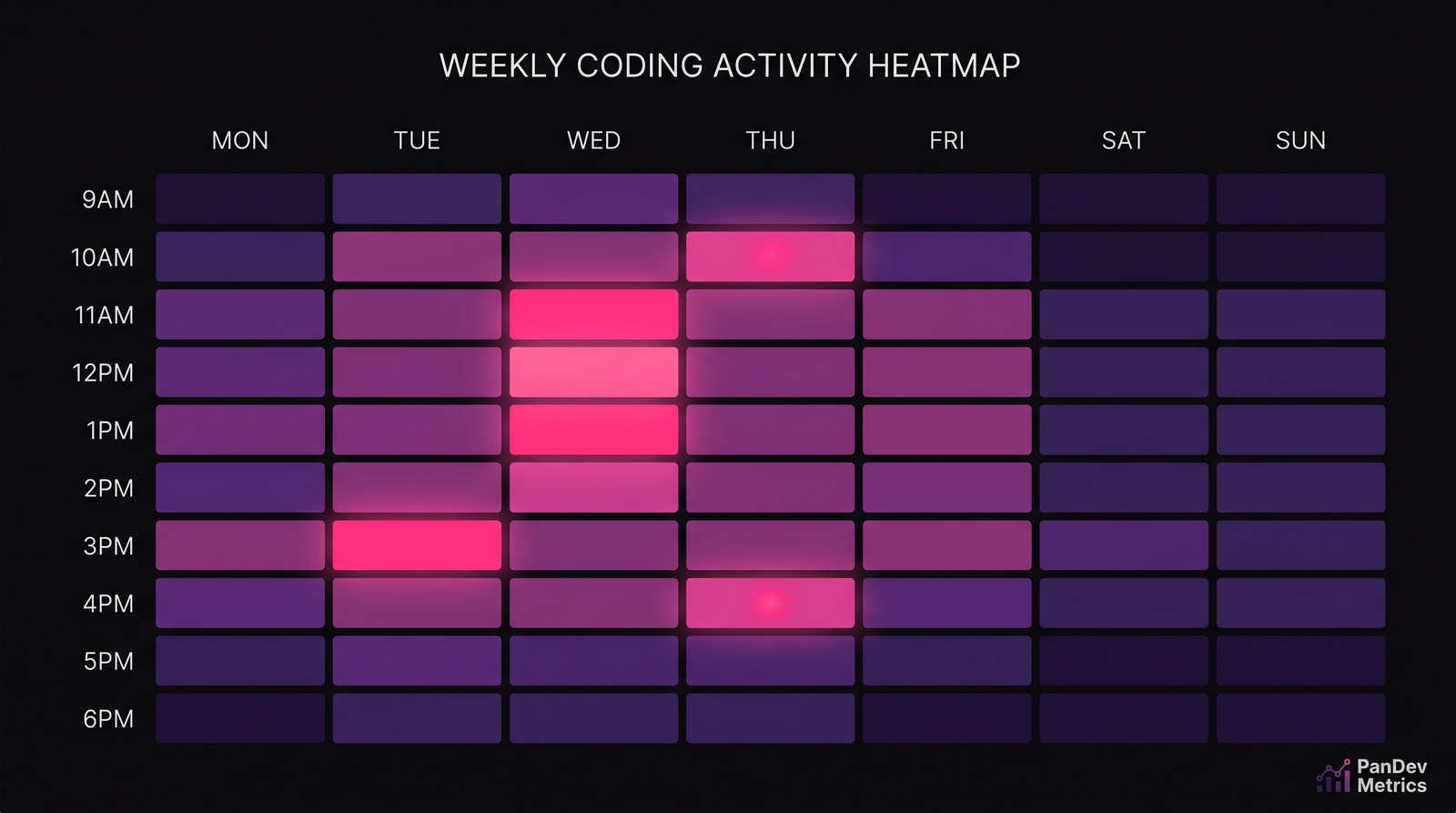


<table><thead><tr><th>Technique</th><th style="text-align:center">Median daily active coding</th><th style="text-align:center">Focus block P75</th></tr></thead><tbody><tr><td>Strict 25/5 Pomodoro</td><td style="text-align:center">42 min</td><td style="text-align:center">22 min</td></tr><tr><td>Loose 50/10 (longer variant)</td><td style="text-align:center">1h 38m</td><td style="text-align:center">46 min</td></tr><tr><td>Natural blocks (no timer)</td><td style="text-align:center">2h 12m</td><td style="text-align:center">72 min</td></tr><tr><td>Timer-off + calendar blocking</td><td style="text-align:center">1h 55m</td><td style="text-align:center">68 min</td></tr></tbody></table>
<p>The strict-25 group's "P75 focus block" being 22 minutes tells you the method is working as intended — the timer is interrupting before 25. What the timer doesn't know: the engineer was 8 minutes into a debugging session where swap-in costs were still compiling in their head. The break fires. The session resets.</p>
<h3 class="anchor anchorTargetStickyNavbar_Vzrq" id="finding-2-coding-sessions-dont-recover-evenly-from-interruption">Finding 2: Coding sessions don't recover evenly from interruption<a href="https://pandev-metrics.com/docs/blog/pomodoro-for-engineering-teams#finding-2-coding-sessions-dont-recover-evenly-from-interruption" class="hash-link" aria-label="Direct link to Finding 2: Coding sessions don't recover evenly from interruption" title="Direct link to Finding 2: Coding sessions don't recover evenly from interruption" translate="no">​</a></h3>
<p>We looked at how engineers recover from a break of varying length. Time to get back to the previous level of activity in the IDE:</p>


<table><thead><tr><th>Break length</th><th style="text-align:center">Median refocus time</th><th style="text-align:center">How close to "new context"</th></tr></thead><tbody><tr><td>1-2 min (typing, Slack glance)</td><td style="text-align:center">3 min</td><td style="text-align:center">Low cost</td></tr><tr><td>5 min (Pomodoro break)</td><td style="text-align:center">11 min</td><td style="text-align:center">Medium cost</td></tr><tr><td>15 min (coffee, bathroom)</td><td style="text-align:center">18 min</td><td style="text-align:center">High cost</td></tr><tr><td>45+ min (meeting, lunch)</td><td style="text-align:center">31 min</td><td style="text-align:center">Full context reload</td></tr></tbody></table>
<p>The Pomodoro 5-minute break costs engineers an average <strong>11 minutes of recovery</strong>. That's more than the break itself. A 25-minute Pomodoro + 5-minute break + 11-minute recovery isn't 30 minutes of structured focus — it's 25 minutes of focus with a 16-minute tax every cycle.</p>
<h3 class="anchor anchorTargetStickyNavbar_Vzrq" id="finding-3-length-of-productive-coding-block-is-bimodal">Finding 3: Length of productive coding block is bimodal<a href="https://pandev-metrics.com/docs/blog/pomodoro-for-engineering-teams#finding-3-length-of-productive-coding-block-is-bimodal" class="hash-link" aria-label="Direct link to Finding 3: Length of productive coding block is bimodal" title="Direct link to Finding 3: Length of productive coding block is bimodal" translate="no">​</a></h3>
<p><img decoding="async" loading="lazy" alt="Heatmap showing coding-activity distribution across hours and days for engineers using different focus techniques." src="https://pandev-metrics.com/docs/assets/images/pomodoro-heatmap-bf7999ccb3f0e60dc375e55d54f07a4c.png" width="1600" height="893" class="img_ev3q">
<em>Weekly coding-activity distribution. The darker bands are the coding peaks; note how they cluster at specific hours for most engineers, and how Pomodoro's rhythm doesn't match them.</em></p>
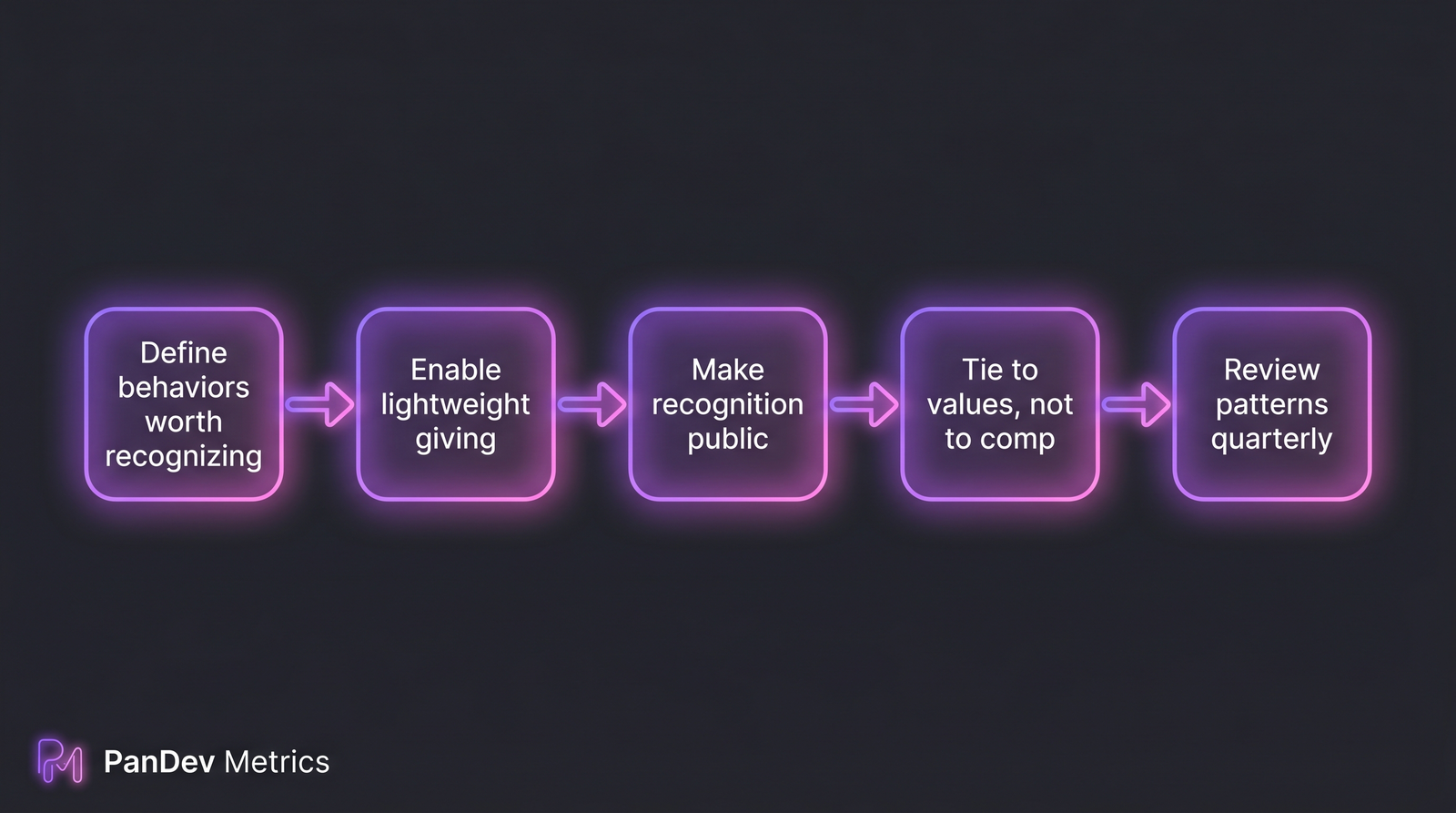
<p>Across our dataset, engineer coding blocks cluster at two typical durations:</p>
<ul>
<li class=""><strong>Short, focused blocks of 15-30 min</strong> — typical for code review, small bug fixes, CI-waits</li>
<li class=""><strong>Long flow blocks of 60-120 min</strong> — typical for complex feature work, debugging, new architecture</li>
</ul>
<p>The Pomodoro 25-minute interval <strong>straddles these two peaks</strong>. It's too short for the long block and too long for the short one. Engineers using strict Pomodoro either abandon the timer mid-flow (defeating the purpose) or interrupt complex work at the wrong moment (doing worse than no timer at all).</p>
<h2 class="anchor anchorTargetStickyNavbar_Vzrq" id="what-this-means-for-engineering-teams">What this means for engineering teams<a href="https://pandev-metrics.com/docs/blog/pomodoro-for-engineering-teams#what-this-means-for-engineering-teams" class="hash-link" aria-label="Direct link to What this means for engineering teams" title="Direct link to What this means for engineering teams" translate="no">​</a></h2>
<h3 class="anchor anchorTargetStickyNavbar_Vzrq" id="1-stop-prescribing-pomodoro-as-a-team-norm">1. Stop prescribing Pomodoro as a team norm<a href="https://pandev-metrics.com/docs/blog/pomodoro-for-engineering-teams#1-stop-prescribing-pomodoro-as-a-team-norm" class="hash-link" aria-label="Direct link to 1. Stop prescribing Pomodoro as a team norm" title="Direct link to 1. Stop prescribing Pomodoro as a team norm" translate="no">​</a></h3>
<p>Individual choice is fine. "We all do Pomodoro" is a productivity anti-pattern. The data shows 25-minute intervals don't fit coding work for most engineers. Let engineers pick.</p>
<h3 class="anchor anchorTargetStickyNavbar_Vzrq" id="2-protect-long-blocks-instead-of-chunking-time">2. Protect long blocks instead of chunking time<a href="https://pandev-metrics.com/docs/blog/pomodoro-for-engineering-teams#2-protect-long-blocks-instead-of-chunking-time" class="hash-link" aria-label="Direct link to 2. Protect long blocks instead of chunking time" title="Direct link to 2. Protect long blocks instead of chunking time" translate="no">​</a></h3>
<p>Microsoft Research's 2023 study of engineering focus patterns (Houck et al., published in IEEE TSE) found that <strong>engineers with at least one uninterrupted 90+ minute block per day reported 40% higher task completion quality</strong> than those without. The goal isn't more breaks — it's more preserved long blocks.</p>
<h3 class="anchor anchorTargetStickyNavbar_Vzrq" id="3-use-timers-for-estimation-not-for-interruption">3. Use timers for estimation, not for interruption<a href="https://pandev-metrics.com/docs/blog/pomodoro-for-engineering-teams#3-use-timers-for-estimation-not-for-interruption" class="hash-link" aria-label="Direct link to 3. Use timers for estimation, not for interruption" title="Direct link to 3. Use timers for estimation, not for interruption" translate="no">​</a></h3>
<p>Some engineers benefit from a timer as a "am I actually working on this?" gauge. Those who do use it should set the interval to their natural cadence (50-90 min typically) rather than 25. The timer then serves as a check-in, not a break-forcing event.</p>
<h3 class="anchor anchorTargetStickyNavbar_Vzrq" id="4-measure-sessions-not-intervals">4. Measure sessions, not intervals<a href="https://pandev-metrics.com/docs/blog/pomodoro-for-engineering-teams#4-measure-sessions-not-intervals" class="hash-link" aria-label="Direct link to 4. Measure sessions, not intervals" title="Direct link to 4. Measure sessions, not intervals" translate="no">​</a></h3>
<p>If your team insists on measuring focus, measure the distribution of session length, not the count of Pomodoros. A team with 12 sessions averaging 65 minutes ships more than a team with 32 sessions averaging 18 minutes, every time.</p>
<h2 class="anchor anchorTargetStickyNavbar_Vzrq" id="where-pomodoro-does-work">Where Pomodoro does work<a href="https://pandev-metrics.com/docs/blog/pomodoro-for-engineering-teams#where-pomodoro-does-work" class="hash-link" aria-label="Direct link to Where Pomodoro does work" title="Direct link to Where Pomodoro does work" translate="no">​</a></h2>
<p>Not every coding task is deep work. Pomodoro-style short cycles can help with:</p>
<ul>
<li class=""><strong>Code review backlogs</strong> — 25-minute bursts match the attention span review requires</li>
<li class=""><strong>Documentation writing</strong> — writing fatigue sets in around 20-30 min naturally</li>
<li class=""><strong>Learning new frameworks</strong> — flash-card-adjacent cognitive work</li>
<li class=""><strong>Routine maintenance tickets</strong> — batching small tasks</li>
</ul>
<p>For debugging, architecture work, or complex feature implementation, Pomodoro hurts more than it helps. Match the technique to the task, not to the engineer.</p>
<h2 class="anchor anchorTargetStickyNavbar_Vzrq" id="what-pandev-metrics-shows-you">What PanDev Metrics shows you<a href="https://pandev-metrics.com/docs/blog/pomodoro-for-engineering-teams#what-pandev-metrics-shows-you" class="hash-link" aria-label="Direct link to What PanDev Metrics shows you" title="Direct link to What PanDev Metrics shows you" translate="no">​</a></h2>
<p>Our dashboards surface focus-block distributions per engineer and per team. An engineer whose P75 focus block is 22 minutes is being interrupted — whether by a Pomodoro timer, a chatty Slack channel, or a culture of "just a quick sync". The data doesn't care about the cause; it shows the effect.</p>
<p>Teams using this data typically don't intervene on individual engineers. They intervene on <strong>meeting culture and interrupt expectations</strong> — which are the structural causes. One customer with a 40-person team moved from an 11:00 daily standup to a 9:00 one after we showed them that post-standup focus blocks were 38 minutes shorter when standup fell mid-morning vs end-of-morning. That's a systemic fix; Pomodoro at an individual level wouldn't have touched it.</p>
<h2 class="anchor anchorTargetStickyNavbar_Vzrq" id="the-contrarian-claim">The contrarian claim<a href="https://pandev-metrics.com/docs/blog/pomodoro-for-engineering-teams#the-contrarian-claim" class="hash-link" aria-label="Direct link to The contrarian claim" title="Direct link to The contrarian claim" translate="no">​</a></h2>
<p>Pomodoro's reputation as a productivity technique for knowledge work is mostly a status-game — "I use Pomodoro" signals discipline, which makes people want to report it, which keeps the myth going. The actual research base for Pomodoro-for-coding is thin. The original technique was designed for study habits in the late 1980s, before software engineering had a mainstream form of "flow state" language. It survived into engineering culture through transfer, not fit.</p>
<p>The honest limit: our 127 Pomodoro users is a small sample. They also self-selected into the technique, which biases the comparison — people who try Pomodoro and fail at coding with it probably abandon it before we can tag them. The clean experiment (randomly assign coding work to a Pomodoro and non-Pomodoro condition) would be expensive to run and we haven't. What we have is strong correlational evidence that the technique doesn't match our customers' IDE patterns — enough to challenge its default status, not enough to prove it's worse for every engineer.</p>
<h2 class="anchor anchorTargetStickyNavbar_Vzrq" id="related-reading">Related reading<a href="https://pandev-metrics.com/docs/blog/pomodoro-for-engineering-teams#related-reading" class="hash-link" aria-label="Direct link to Related reading" title="Direct link to Related reading" translate="no">​</a></h2>
<ul>
<li class=""><a class="" href="https://pandev-metrics.com/docs/blog/focus-time-deep-work">Focus Time: Why 2 Hours of Uninterrupted Code Equals 6 Hours of Interrupted Code</a></li>
<li class=""><a class="" href="https://pandev-metrics.com/docs/blog/context-switching-kills-productivity">The 40% Productivity Tax of Context Switching</a></li>
<li class=""><a class="" href="https://pandev-metrics.com/docs/blog/how-much-developers-actually-code">Developers Code Just 1h 18m Per Day (Real IDE Data from 100+ Teams)</a></li>
</ul>
<p>If your team has a Pomodoro culture and your median focus block is under 30 minutes, the technique is shaping the outcome. Measure before deciding whether to keep it.</p>]]></content>
        <author>
            <name>Artur Pan</name>
            <uri>https://www.linkedin.com/in/apan98/</uri>
        </author>
        <category label="research" term="research"/>
        <category label="developer-productivity" term="developer-productivity"/>
        <category label="focus-time" term="focus-time"/>
        <category label="data" term="data"/>
    </entry>
    <entry>
        <title type="html"><![CDATA[Peer Recognition Systems for Engineering Teams That Work]]></title>
        <id>https://pandev-metrics.com/docs/blog/peer-recognition-systems-engineers</id>
        <link href="https://pandev-metrics.com/docs/blog/peer-recognition-systems-engineers"/>
        <updated>2026-06-11T00:00:00.000Z</updated>
        <summary type="html"><![CDATA[Gallup found peer recognition drives 2.7x higher engagement than manager praise for engineers. Here's a peer-recognition system that avoids the kudos-bot graveyard.]]></summary>
        <content type="html"><![CDATA[<p>Every engineering org has tried the kudos bot. Most are dead within 9 months. A 2024 Gallup meta-analysis of 1.2M workers flagged something specific about technical roles: <strong>peer recognition drives 2.7× higher engagement lift</strong> than manager praise for engineers, but only when the recognition meets three criteria — specific behavior, public visibility, and timely delivery. The average Slack <code>/kudos</code> command meets none of them.</p>
<p>This is a playbook for a peer-recognition system that actually keeps running past year one. It works for teams of 10-200, costs under $50/engineer/year, and — contrary to most vendor decks — has nothing to do with points or badges.</p>
<p>{/* truncate */}</p>
<h2 class="anchor anchorTargetStickyNavbar_Vzrq" id="the-problem-why-most-kudos-systems-die">The problem: why most kudos systems die<a href="https://pandev-metrics.com/docs/blog/peer-recognition-systems-engineers#the-problem-why-most-kudos-systems-die" class="hash-link" aria-label="Direct link to The problem: why most kudos systems die" title="Direct link to The problem: why most kudos systems die" translate="no">​</a></h2>
<p>The failure pattern is consistent:</p>
<ul>
<li class=""><strong>Month 1-3:</strong> leadership pushes adoption; 60% of engineers use it</li>
<li class=""><strong>Month 4-6:</strong> the same 10-15 people keep posting; the long tail goes quiet</li>
<li class=""><strong>Month 7-9:</strong> people stop reading the channel; posts stop</li>
<li class=""><strong>Month 10+:</strong> the kudos bot is still installed but sends 2 messages a week, all birthdays</li>
</ul>
<p>Harvard Business Review's 2023 study of 40 engineering orgs using peer-recognition software found the median system was abandoned in <strong>11.3 months</strong>. The three causes HBR identified:</p>
<ol>
<li class=""><strong>Vague "thanks" with no behavior tied</strong> — "thanks for being awesome" adds no information</li>
<li class=""><strong>Point / badge / leaderboard gamification</strong> — engineers correctly read as childish, disengage</li>
<li class=""><strong>Management hijacking</strong> — the moment a manager posts "kudos for shipping Q3 goals," the channel becomes performative</li>
</ol>
<p><img decoding="async" loading="lazy" alt="Flow diagram: define behaviors worth recognizing → enable lightweight giving → make recognition public → tie to values not comp → review patterns quarterly" src="https://pandev-metrics.com/docs/assets/images/framework-flow-2946144e3999ee43914e6bafb00e583b.png" width="1600" height="893" class="img_ev3q">
<em>The 5-step recognition loop. Each step has a common failure mode that kills the system if skipped.</em></p>
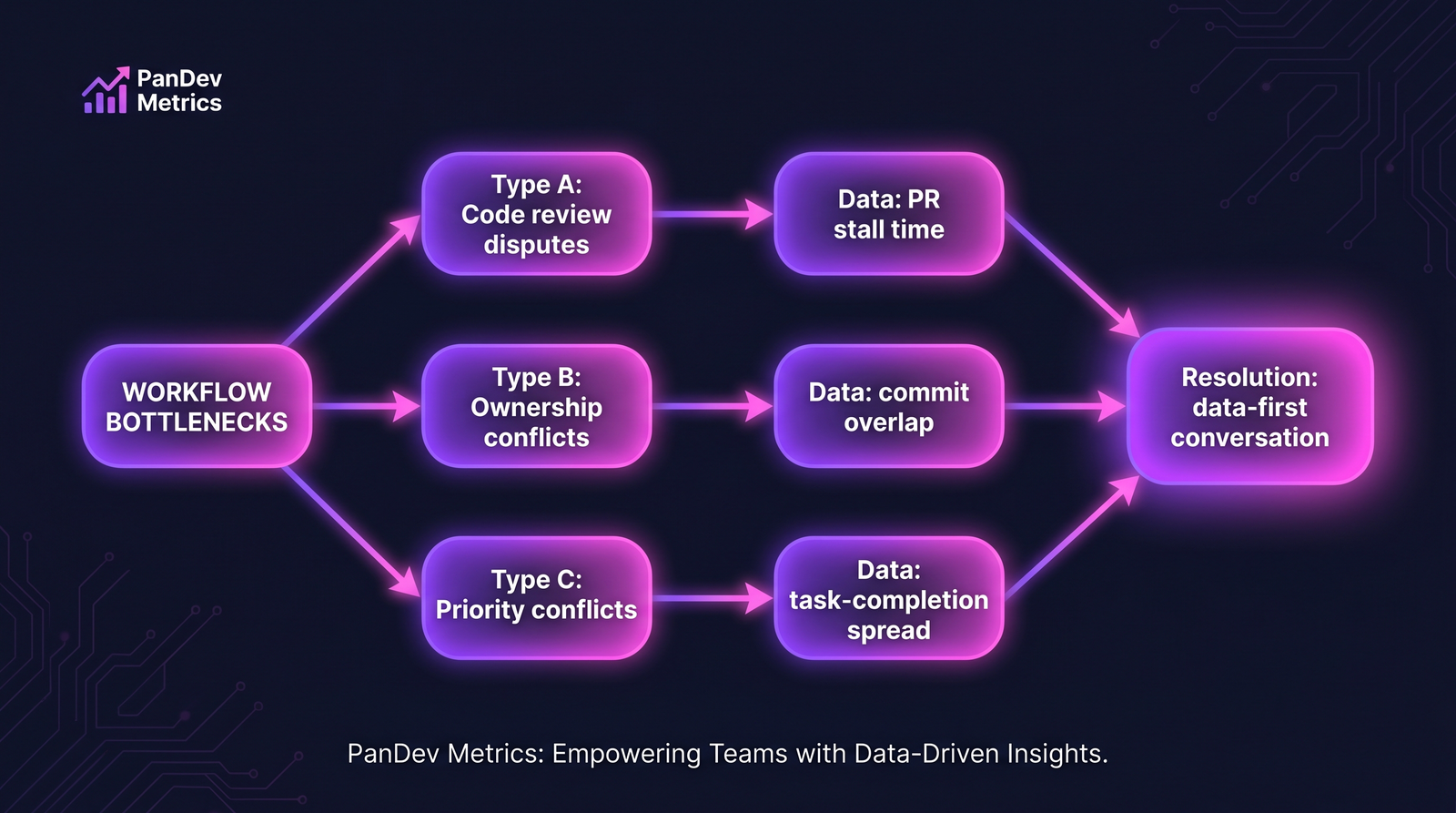
<h2 class="anchor anchorTargetStickyNavbar_Vzrq" id="the-framework-5-steps">The framework: 5 steps<a href="https://pandev-metrics.com/docs/blog/peer-recognition-systems-engineers#the-framework-5-steps" class="hash-link" aria-label="Direct link to The framework: 5 steps" title="Direct link to The framework: 5 steps" translate="no">​</a></h2>
<h3 class="anchor anchorTargetStickyNavbar_Vzrq" id="step-1--define-the-behaviors-worth-recognizing">Step 1 — Define the behaviors worth recognizing<a href="https://pandev-metrics.com/docs/blog/peer-recognition-systems-engineers#step-1--define-the-behaviors-worth-recognizing" class="hash-link" aria-label="Direct link to Step 1 — Define the behaviors worth recognizing" title="Direct link to Step 1 — Define the behaviors worth recognizing" translate="no">​</a></h3>
<p>Don't launch a peer-recognition system without an explicit list of what "recognition-worthy" means. Common anti-pattern: leaving it abstract, expecting engineers to know.</p>
<p>A working list for most engineering orgs:</p>


<table><thead><tr><th>Behavior</th><th>Example</th><th>Why recognize it</th></tr></thead><tbody><tr><td>Unblocked someone</td><td>"Rewrote the migration script so the pipeline team could deploy"</td><td>Reduces org latency</td></tr><tr><td>Caught a production risk before launch</td><td>"Pushed back on the auth change during code review; it had a race condition"</td><td>High-value reviewing</td></tr><tr><td>Shared context that wasn't required</td><td>"Wrote up the fix plus a design note explaining why"</td><td>Compounds team knowledge</td></tr><tr><td>Taught someone a tool / pattern</td><td>"Pair-debugged k8s log issues with [junior]"</td><td>Mentorship without formal program</td></tr><tr><td>Cleaned up something nobody owned</td><td>"Deleted 120 dead npm deps across 4 repos"</td><td>Org hygiene most ignore</td></tr></tbody></table>
<p>Each behavior is <strong>observable</strong> (someone saw it happen) and <strong>specific</strong> (not "is a great teammate"). This is the foundation — skip it and the system degrades to generic thanks.</p>
<h3 class="anchor anchorTargetStickyNavbar_Vzrq" id="step-2--enable-giving-in-the-tools-engineers-already-use">Step 2 — Enable giving in the tools engineers already use<a href="https://pandev-metrics.com/docs/blog/peer-recognition-systems-engineers#step-2--enable-giving-in-the-tools-engineers-already-use" class="hash-link" aria-label="Direct link to Step 2 — Enable giving in the tools engineers already use" title="Direct link to Step 2 — Enable giving in the tools engineers already use" translate="no">​</a></h3>
<p>Do not add a separate kudos portal. Engineers will not navigate to a new URL. Instead, embed recognition in existing flows:</p>
<ul>
<li class=""><strong>Slack</strong>: a <code>/shoutout @user behavior</code> command that posts to a team channel</li>
<li class=""><strong>GitHub / GitLab</strong>: a bot that scans for "thanks @user for X" comments and cross-posts</li>
<li class=""><strong>1:1 note templates</strong>: a "peer shoutouts this week" field the EM can ask about</li>
</ul>
<p>Our own team uses the Slack + GitHub combination. The key is <strong>one-tap giving, visible publicly</strong>, with nothing more than writing a sentence.</p>
<h3 class="anchor anchorTargetStickyNavbar_Vzrq" id="step-3--make-recognition-public-by-default">Step 3 — Make recognition public by default<a href="https://pandev-metrics.com/docs/blog/peer-recognition-systems-engineers#step-3--make-recognition-public-by-default" class="hash-link" aria-label="Direct link to Step 3 — Make recognition public by default" title="Direct link to Step 3 — Make recognition public by default" translate="no">​</a></h3>
<p>Private kudos do less work. A 2023 Deloitte study of 180 companies showed public peer recognition was <strong>3.1× more predictive of retention</strong> than private thanks. The mechanism: public recognition tells <em>the recognizer's team</em> what "good" looks like. It's a culture-shaping artifact, not just a pat on the back.</p>
<p>A public <code>#team-shoutouts</code> channel, read by everyone, is worth ten private notifications.</p>
<h3 class="anchor anchorTargetStickyNavbar_Vzrq" id="step-4--tie-recognition-to-values-never-to-compensation">Step 4 — Tie recognition to values, never to compensation<a href="https://pandev-metrics.com/docs/blog/peer-recognition-systems-engineers#step-4--tie-recognition-to-values-never-to-compensation" class="hash-link" aria-label="Direct link to Step 4 — Tie recognition to values, never to compensation" title="Direct link to Step 4 — Tie recognition to values, never to compensation" translate="no">​</a></h3>
<p>The moment peer recognition converts to points, dollars, or promotion credit, two things happen:</p>
<ol>
<li class="">Engineers start gaming it (posting to favored peers, trading kudos)</li>
<li class="">Unpopular work (reliability, documentation, refactors) gets less recognized because it gets less noticed</li>
</ol>
<p>Keep it <strong>explicitly non-monetary</strong>. No tier levels, no dollar conversion, no "top kudos-earner" awards. If someone's contributions are compensation-worthy, the comp process handles it separately.</p>
<p>This is the contrarian part. Most vendor recognition platforms push gamification because it's measurable. The measurable gets you vanity metrics; the unmeasurable (cultural shift) is what actually reduces attrition.</p>
<h3 class="anchor anchorTargetStickyNavbar_Vzrq" id="step-5--review-patterns-quarterly-not-individually">Step 5 — Review patterns quarterly, not individually<a href="https://pandev-metrics.com/docs/blog/peer-recognition-systems-engineers#step-5--review-patterns-quarterly-not-individually" class="hash-link" aria-label="Direct link to Step 5 — Review patterns quarterly, not individually" title="Direct link to Step 5 — Review patterns quarterly, not individually" translate="no">​</a></h3>
<p>Every quarter, the EM + HRBP review aggregate patterns — not individual kudos counts. Questions:</p>
<ul>
<li class="">Are certain people consistently invisible to peers? (may signal isolation, not low performance)</li>
<li class="">Are certain behaviors under-recognized? (e.g., nobody is getting thanked for documentation — is nobody doing it, or is it being missed?)</li>
<li class="">Is recognition equitable across demographics? (bias flag)</li>
</ul>
<p>The right output is an org-level insight, not a "who got the most kudos" leaderboard. Skip this step and the recognition signal decays without you noticing.</p>
<h2 class="anchor anchorTargetStickyNavbar_Vzrq" id="common-mistakes">Common mistakes<a href="https://pandev-metrics.com/docs/blog/peer-recognition-systems-engineers#common-mistakes" class="hash-link" aria-label="Direct link to Common mistakes" title="Direct link to Common mistakes" translate="no">​</a></h2>


<table><thead><tr><th>Mistake</th><th>Why it hurts</th><th>Fix</th></tr></thead><tbody><tr><td>Points / badges / levels</td><td>Reads as corporate, engineers disengage</td><td>Values-based, non-monetary</td></tr><tr><td>Only public at leader level</td><td>Can't see peer-to-peer dynamics</td><td>Public default, private by choice</td></tr><tr><td>Letting managers dominate posts</td><td>Becomes performance theater</td><td>Manager quota: post 1:1 with IC posts</td></tr><tr><td>Using a generic platform</td><td>Doesn't match engineering vocabulary</td><td>Customize behaviors to your eng ladder</td></tr><tr><td>Tying to comp</td><td>Invites gaming</td><td>Hard separation, comp handled elsewhere</td></tr><tr><td>No quarterly review</td><td>Invisible decay</td><td>30-min quarterly pattern review</td></tr><tr><td>"Employee of the month"</td><td>Zero-sum game, 1 winner + many losers</td><td>Multiple recognizers + multiple recipients</td></tr></tbody></table>
<h2 class="anchor anchorTargetStickyNavbar_Vzrq" id="the-checklist">The checklist<a href="https://pandev-metrics.com/docs/blog/peer-recognition-systems-engineers#the-checklist" class="hash-link" aria-label="Direct link to The checklist" title="Direct link to The checklist" translate="no">​</a></h2>
<ul class="contains-task-list containsTaskList_mC6p">
<li class="task-list-item"><input type="checkbox" disabled=""> List of 5-10 specific, observable behaviors published</li>
<li class="task-list-item"><input type="checkbox" disabled=""> Giving mechanism embedded in Slack and/or GitHub (one-tap)</li>
<li class="task-list-item"><input type="checkbox" disabled=""> Public channel active, with EM + IC posts</li>
<li class="task-list-item"><input type="checkbox" disabled=""> Values-tied language, zero points/badges/dollars</li>
<li class="task-list-item"><input type="checkbox" disabled=""> Quarterly pattern review on calendar (EM + HRBP)</li>
<li class="task-list-item"><input type="checkbox" disabled=""> No leaderboards visible to individuals</li>
<li class="task-list-item"><input type="checkbox" disabled=""> Manager posts limited to balance IC voice</li>
</ul>
<h2 class="anchor anchorTargetStickyNavbar_Vzrq" id="how-to-measure-if-its-working">How to measure if it's working<a href="https://pandev-metrics.com/docs/blog/peer-recognition-systems-engineers#how-to-measure-if-its-working" class="hash-link" aria-label="Direct link to How to measure if it's working" title="Direct link to How to measure if it's working" translate="no">​</a></h2>
<p>Don't track "kudos count per person." That's the trap. Track:</p>
<ul>
<li class=""><strong>% engineers who gave at least one recognition this month</strong> — target &gt;50% sustained after month 6</li>
<li class=""><strong>% engineers who received at least one this quarter</strong> — target &gt;90%</li>
<li class=""><strong>Time between recognizable behavior and recognition</strong> — target under 48h (latency kills feedback loops)</li>
<li class=""><strong>Recognition channel read-rate</strong> — Slack analytics; declining read-rate signals decay</li>
</ul>
<p>PanDev Metrics doesn't read your Slack or kudos data directly. What it does see: the behaviors people should be recognized for. When an engineer consistently contributes to repos or projects outside their primary scope (visible through multi-repo IDE activity), that's often invisible to management but obvious to peers — and worth naming. Teams using our <a class="" href="https://pandev-metrics.com/docs/blog/performance-review-data">performance review guide</a> pair recognition-channel data with IDE telemetry to surface the "quiet contributors" — people doing high-value work across boundaries who rarely self-promote.</p>
<p>Honest limit: peer recognition systems are behavioral interventions. Their effects are observable at the team level (engagement, retention) but rarely traceable to individual productivity lifts. Anyone claiming "kudos system increased productivity 23%" is probably reading correlation as causation.</p>
<h2 class="anchor anchorTargetStickyNavbar_Vzrq" id="when-this-framework-doesnt-fit">When this framework doesn't fit<a href="https://pandev-metrics.com/docs/blog/peer-recognition-systems-engineers#when-this-framework-doesnt-fit" class="hash-link" aria-label="Direct link to When this framework doesn't fit" title="Direct link to When this framework doesn't fit" translate="no">​</a></h2>
<ul>
<li class=""><strong>Teams under 8 engineers</strong> — too small; informal thanks in standups works better</li>
<li class=""><strong>Heavily remote / async teams with 6+ hour timezone gaps</strong> — sync public channels lose recognition events across timezones; use async-friendly tools like written weekly team digests</li>
<li class=""><strong>Cultures where public praise is uncomfortable</strong> — some regional cultures treat public recognition as loss of face or embarrassment; adapt to private-by-default with public opt-in</li>
</ul>
<h2 class="anchor anchorTargetStickyNavbar_Vzrq" id="related-reading">Related reading<a href="https://pandev-metrics.com/docs/blog/peer-recognition-systems-engineers#related-reading" class="hash-link" aria-label="Direct link to Related reading" title="Direct link to Related reading" translate="no">​</a></h2>
<ul>
<li class=""><a class="" href="https://pandev-metrics.com/docs/blog/motivating-without-stick">Motivating Developers Without the Stick: Positive Reinforcement That Works</a></li>
<li class=""><a class="" href="https://pandev-metrics.com/docs/blog/leaderboards-right-way">Engineering Leaderboards: Motivation or Demotivation? How to Get It Right</a></li>
<li class=""><a class="" href="https://pandev-metrics.com/docs/blog/gamification-works-or-annoys">Developer Gamification: Levels, Badges, and XP — Does It Work or Annoy?</a></li>
<li class=""><a class="" href="https://pandev-metrics.com/docs/blog/metrics-without-toxicity">Engineering Metrics Without Toxicity</a></li>
</ul>]]></content>
        <author>
            <name>Artur Pan</name>
            <uri>https://www.linkedin.com/in/apan98/</uri>
        </author>
        <category label="tutorial" term="tutorial"/>
        <category label="engineering-management" term="engineering-management"/>
        <category label="developer-experience" term="developer-experience"/>
        <category label="guide" term="guide"/>
    </entry>
    <entry>
        <title type="html"><![CDATA[Conflict Resolution in Engineering Teams: Data-Driven Approach]]></title>
        <id>https://pandev-metrics.com/docs/blog/conflict-resolution-engineering-teams</id>
        <link href="https://pandev-metrics.com/docs/blog/conflict-resolution-engineering-teams"/>
        <updated>2026-06-10T00:00:00.000Z</updated>
        <summary type="html"><![CDATA[Four conflict types on engineering teams, their data signatures in Git/PR/IDE activity, and concrete conversations that resolve each without anyone's self-narrative winning.]]></summary>
        <content type="html"><![CDATA[<p>Two senior engineers at a 60-person SaaS I mentored stopped speaking for seven weeks. <strong>The cause, by their accounts, was "a personality clash."</strong> The cause, by the data: engineer A had merged without review into engineer B's service 23 times in 8 weeks; engineer B's review queue had grown from 4 PRs to 31 in the same window. Each had a legitimate grievance neither could cleanly articulate. The moment their EM put the two numbers on a slide, the fight ended — not because anyone won, but because the dispute stopped being about the other person's character.</p>
<p>Most conflict in engineering teams isn't about personalities. It's about process gaps, priority mismatches, and workload inequities that people can't see from inside the conflict. A 2022 Harvard Business Review study on team dysfunction placed <strong>"ambiguity about who owns what"</strong> as the #1 driver of interpersonal conflict on knowledge-work teams. The resolution isn't better feelings — it's a shared picture of reality. Data is how you build it.</p>
<p>{/* truncate */}</p>
<h2 class="anchor anchorTargetStickyNavbar_Vzrq" id="the-four-conflict-types-on-engineering-teams">The four conflict types on engineering teams<a href="https://pandev-metrics.com/docs/blog/conflict-resolution-engineering-teams#the-four-conflict-types-on-engineering-teams" class="hash-link" aria-label="Direct link to The four conflict types on engineering teams" title="Direct link to The four conflict types on engineering teams" translate="no">​</a></h2>
<p><img decoding="async" loading="lazy" alt="Flow: Type A Code review disputes → Data PR stall. Type B Ownership conflicts → Data commit overlap. Type C Priority conflicts → Data task-completion spread. Type D Workload conflicts → Data hours distribution. Resolution: data-first conversation." src="https://pandev-metrics.com/docs/assets/images/conflict-types-matrix-a62de7fcb4ff49deea061107e03dbef4.png" width="1600" height="893" class="img_ev3q">
<em>The four common conflict types. Each has a distinct data signature in Git/PR/IDE activity.</em></p>
<p>Most interpersonal friction on engineering teams reduces to one of four underlying conflicts. They look the same from inside — "I can't stand working with X" — but resolve very differently.</p>


<table><thead><tr><th>Type</th><th>What it looks like</th><th>Data signature</th></tr></thead><tbody><tr><td>A — Code review dispute</td><td>Long re-review cycles, passive-aggressive comments</td><td>PR stall time, review-round count per PR</td></tr><tr><td>B — Ownership conflict</td><td>"They keep touching my code without asking"</td><td>Commit overlap on shared files, cross-author merges</td></tr><tr><td>C — Priority conflict</td><td>"They don't understand what actually matters"</td><td>Task-type split per person (feature vs infra vs fix)</td></tr><tr><td>D — Workload conflict</td><td>"I'm drowning while they're coasting"</td><td>Hours distribution, weekend-work pattern</td></tr></tbody></table>
<p>Diagnosis first, technique second. The wrong technique on the wrong type makes the conflict worse.</p>
<h2 class="anchor anchorTargetStickyNavbar_Vzrq" id="type-a--code-review-disputes">Type A — Code review disputes<a href="https://pandev-metrics.com/docs/blog/conflict-resolution-engineering-teams#type-a--code-review-disputes" class="hash-link" aria-label="Direct link to Type A — Code review disputes" title="Direct link to Type A — Code review disputes" translate="no">​</a></h2>
<p><strong>Surface:</strong> "X keeps rejecting my PRs" / "Y writes unreviewable code."</p>
<p><strong>Data to pull:</strong></p>
<ul>
<li class=""><strong>PR stall time by author × reviewer.</strong> For each merged PR, time from PR-open to merge, broken down by reviewer involvement.</li>
<li class=""><strong>Review-round count.</strong> Average number of re-review cycles per PR between the two engineers.</li>
<li class=""><strong>Comment density and tone.</strong> Count of comments per 100 lines of diff. Tone can't be quantified automatically, but density often proxies "friction."</li>
</ul>
<p>A healthy pair sits at 1-2 review rounds per PR and a stall time close to the team median. Conflict pairs often show 4-6 rounds per PR or stall times 2-3x team median.</p>
<p><strong>Resolution conversation:</strong></p>
<ol>
<li class="">Show the two numbers to both engineers separately first</li>
<li class="">Ask each: "What would have to change for this number to halve?"</li>
<li class="">Joint meeting to agree one concrete change — usually either stricter PR-scope discipline (smaller PRs) or a pre-review chat norm</li>
</ol>
<p>Don't ask "do you have a conflict?" Ask "what's slowing your work?" Data reframes it from feelings to workflow.</p>
<h3 class="anchor anchorTargetStickyNavbar_Vzrq" id="a-short-example">A short example<a href="https://pandev-metrics.com/docs/blog/conflict-resolution-engineering-teams#a-short-example" class="hash-link" aria-label="Direct link to A short example" title="Direct link to A short example" translate="no">​</a></h3>
<p>Two engineers were stuck at 4.2 review rounds per PR. After data conversation, agreed: PRs over 400 LOC require a 10-minute pre-review call. Within 6 weeks, rounds dropped to 1.8. The "conflict" resolved because the <em>cause</em> (PRs too big for async review) resolved.</p>
<h2 class="anchor anchorTargetStickyNavbar_Vzrq" id="type-b--ownership-conflicts">Type B — Ownership conflicts<a href="https://pandev-metrics.com/docs/blog/conflict-resolution-engineering-teams#type-b--ownership-conflicts" class="hash-link" aria-label="Direct link to Type B — Ownership conflicts" title="Direct link to Type B — Ownership conflicts" translate="no">​</a></h2>
<p><strong>Surface:</strong> "X keeps touching my service without asking" / "Y gatekeeps everything."</p>
<p><strong>Data to pull:</strong></p>
<ul>
<li class=""><strong>Commit overlap per shared file.</strong> Which files in the last 60 days have commits from both engineers? Which files are "owned" by one (80%+ of recent commits)?</li>
<li class=""><strong>Cross-author merge events.</strong> How many times did engineer A merge into engineer B's owned files without engineer B's review?</li>
<li class=""><strong>Task-to-file mapping.</strong> Were the cross-author changes driven by in-scope tasks or ad-hoc decisions?</li>
</ul>
<p>Healthy shared ownership shows bidirectional edits with review. Pathological patterns: one-way incursion (A commits into B's service 20x; B commits into A's service 0) or gatekeeping (A requires re-approval on changes that have nothing to do with A's service).</p>
<p><strong>Resolution conversation:</strong></p>
<ol>
<li class="">Draw the service-ownership diagram explicitly (even if informal before)</li>
<li class="">Agree on the review rule: does cross-service change require owner review or just notification?</li>
<li class="">If workload on the "incursion" was driven by emergency, discuss whether the staffing is right</li>
</ol>
<p>Code ownership has to be an explicit team decision. Implicit ownership is where type-B conflicts live.</p>
<h2 class="anchor anchorTargetStickyNavbar_Vzrq" id="type-c--priority-conflicts">Type C — Priority conflicts<a href="https://pandev-metrics.com/docs/blog/conflict-resolution-engineering-teams#type-c--priority-conflicts" class="hash-link" aria-label="Direct link to Type C — Priority conflicts" title="Direct link to Type C — Priority conflicts" translate="no">​</a></h2>
<p><strong>Surface:</strong> "X always picks the glamour work" / "Y does nothing but refactor."</p>
<p><strong>Data to pull:</strong></p>
<ul>
<li class=""><strong>Task-type distribution per person</strong> over last quarter: % feature / % refactor / % bug fix / % infra / % on-call response.</li>
<li class=""><strong>Strategic allocation vs actual.</strong> If the team agreed "30% refactor quota this quarter," who hit it and who didn't?</li>
<li class=""><strong>Correlation with career path.</strong> Refactor-heavy engineers may be signaling for senior/staff promotion; feature-heavy may be signaling for high-output recognition.</li>
</ul>
<p>The conflict is often about <em>fairness of the work mix</em>, not about the work itself. An engineer doing 80% refactor feels undervalued when promotion talk centers on feature shipping; an engineer doing 80% feature work feels like they're doing all the "real" work while others "just refactor."</p>
<p><strong>Resolution conversation:</strong></p>
<ol>
<li class="">Show the distribution (by person) publicly to the team</li>
<li class="">Ask the team: "Does this match what we agreed to?"</li>
<li class="">If not — either the agreement was wrong, or the staffing is wrong</li>
<li class="">Name which work is career-compounding and make sure every engineer gets a share</li>
</ol>
<p>Priority conflicts resolve when the team agrees (publicly) what mix is desired, then tracks it. Not when individuals argue their preferences.</p>
<h2 class="anchor anchorTargetStickyNavbar_Vzrq" id="type-d--workload-conflicts">Type D — Workload conflicts<a href="https://pandev-metrics.com/docs/blog/conflict-resolution-engineering-teams#type-d--workload-conflicts" class="hash-link" aria-label="Direct link to Type D — Workload conflicts" title="Direct link to Type D — Workload conflicts" translate="no">​</a></h2>
<p><strong>Surface:</strong> "X works nights and weekends, I don't" / "Y never responds on Slack."</p>
<p><strong>Data to pull:</strong></p>
<ul>
<li class=""><strong>Coding-time distribution</strong> weekly, per engineer.</li>
<li class=""><strong>After-hours and weekend work hours.</strong></li>
<li class=""><strong>PR throughput and review-completion rate.</strong></li>
</ul>
<p>Healthy team: weekly coding-time median within 20% range across engineers, after-hours &lt; 5% of total, weekend work rare.</p>
<p>The hardest conflict type: often one engineer's self-story is "I work harder" and the other's is "I work smarter." Data reveals the reality is usually neither or both.</p>
<p><strong>Resolution conversation:</strong></p>
<ol>
<li class="">Show the weekly distribution and after-hours pattern</li>
<li class="">If the hard-worker is logging 55-hour weeks, ask the EM: is this the expected load? Can we add headcount or cut scope?</li>
<li class="">If the "coaster" is actually shipping equivalent output in 35 hours, that's a pattern to protect and learn from, not punish</li>
<li class="">If the distributions are similar but throughput gaps are real, the conflict is type A or C in disguise</li>
</ol>
<p><strong>The burnout signal.</strong> If after-hours work is &gt; 15% of total weekly hours for either engineer, the conflict is a symptom of a burnout pattern — fix that first.</p>
<h2 class="anchor anchorTargetStickyNavbar_Vzrq" id="the-data-first-conflict-conversation-template">The data-first conflict conversation template<a href="https://pandev-metrics.com/docs/blog/conflict-resolution-engineering-teams#the-data-first-conflict-conversation-template" class="hash-link" aria-label="Direct link to The data-first conflict conversation template" title="Direct link to The data-first conflict conversation template" translate="no">​</a></h2>
<p>Run this template when you spot any of the four signatures:</p>


<table><thead><tr><th>Step</th><th>What</th><th>Purpose</th></tr></thead><tbody><tr><td>1</td><td>1:1 with each engineer separately</td><td>Hear each side's self-story without contradiction</td></tr><tr><td>2</td><td>Pull the relevant data behind closed doors</td><td>Identify which type (A/B/C/D) applies</td></tr><tr><td>3</td><td>Share the data with each engineer separately</td><td>Remove defensive reflex</td></tr><tr><td>4</td><td>Ask "what would make this better?"</td><td>Let each propose</td></tr><tr><td>5</td><td>Joint 30-min meeting, data on screen</td><td>Agree ONE concrete change</td></tr><tr><td>6</td><td>4-week check-in</td><td>Verify movement, not perfection</td></tr></tbody></table>
<p>The key inversion: most managers start at step 5 (joint meeting) with emotional data. Start at steps 1-3. The joint meeting is the easy part once the data exists.</p>
<h2 class="anchor anchorTargetStickyNavbar_Vzrq" id="the-numbers-that-matter-across-all-four-types">The numbers that matter across all four types<a href="https://pandev-metrics.com/docs/blog/conflict-resolution-engineering-teams#the-numbers-that-matter-across-all-four-types" class="hash-link" aria-label="Direct link to The numbers that matter across all four types" title="Direct link to The numbers that matter across all four types" translate="no">​</a></h2>


<table><thead><tr><th>Metric</th><th style="text-align:center">Healthy range (weekly, per engineer)</th><th style="text-align:center">Warning threshold</th></tr></thead><tbody><tr><td>PR stall time (median)</td><td style="text-align:center">8-48 hours</td><td style="text-align:center">&gt; 96 hours</td></tr><tr><td>Review rounds per PR</td><td style="text-align:center">1-2</td><td style="text-align:center">&gt; 3</td></tr><tr><td>Cross-author PR %</td><td style="text-align:center">10-30%</td><td style="text-align:center">&lt; 5% or &gt; 50%</td></tr><tr><td>Coding-time variance across team</td><td style="text-align:center">&lt; 25% (coefficient of variance)</td><td style="text-align:center">&gt; 50%</td></tr><tr><td>After-hours hours</td><td style="text-align:center">&lt; 5% of total</td><td style="text-align:center">&gt; 15%</td></tr></tbody></table>
<p>These are anchors. When any metric lands in warning territory between specific pairs of engineers, a type-A/B/C/D conflict is likely forming — address it before it becomes the "I can't stand X" conversation.</p>
<h2 class="anchor anchorTargetStickyNavbar_Vzrq" id="how-pandev-metrics-surfaces-the-signal">How PanDev Metrics surfaces the signal<a href="https://pandev-metrics.com/docs/blog/conflict-resolution-engineering-teams#how-pandev-metrics-surfaces-the-signal" class="hash-link" aria-label="Direct link to How PanDev Metrics surfaces the signal" title="Direct link to How PanDev Metrics surfaces the signal" translate="no">​</a></h2>
<p>PanDev Metrics segments IDE and Git activity per-person and per-pair. For EMs, the useful view is the <strong>pairwise activity matrix</strong>: for each engineer pair on the team, their PR stall time, review rounds, cross-author commit overlap, and coding-time difference. When one cell turns warning-colored, the EM has a data-backed reason to open the conversation before it surfaces as interpersonal complaint.</p>
<p>We also track weekly focus-time and after-hours patterns — the two signals most predictive of type-D conflicts. The <a class="" href="https://pandev-metrics.com/docs/blog/burnout-detection-data">burnout detection patterns</a> are the same underlying signal, interpreted at the individual level instead of the pairwise level.</p>
<h2 class="anchor anchorTargetStickyNavbar_Vzrq" id="common-mistakes-to-avoid">Common mistakes to avoid<a href="https://pandev-metrics.com/docs/blog/conflict-resolution-engineering-teams#common-mistakes-to-avoid" class="hash-link" aria-label="Direct link to Common mistakes to avoid" title="Direct link to Common mistakes to avoid" translate="no">​</a></h2>
<ul>
<li class=""><strong>Waiting until the complaint reaches HR.</strong> By then, the data has been obvious for months. Watch the matrix quarterly.</li>
<li class=""><strong>Using data as evidence against one person.</strong> Data resolves conflict when it's shared <em>with</em> both engineers, not <em>about</em> one. If you present data as "here's why engineer X is the problem," you've made the conflict worse.</li>
<li class=""><strong>Confusing correlation with causation.</strong> A review-stall pattern might be caused by PR size, not personalities. Ask before concluding.</li>
<li class=""><strong>Skipping the 1:1 step.</strong> Joint meeting without individual prep turns into a debate.</li>
<li class=""><strong>Expecting resolution in one meeting.</strong> The pattern took months to form. A 4-week check-in is where you verify the fix is real.</li>
</ul>
<h2 class="anchor anchorTargetStickyNavbar_Vzrq" id="the-contrarian-claim">The contrarian claim<a href="https://pandev-metrics.com/docs/blog/conflict-resolution-engineering-teams#the-contrarian-claim" class="hash-link" aria-label="Direct link to The contrarian claim" title="Direct link to The contrarian claim" translate="no">​</a></h2>
<p><strong>Most engineering-team "personality conflicts" are actually process failures in disguise.</strong> Teams and managers over-index on EQ and under-index on measurable workflow friction. When you fix the process (PR size, ownership clarity, priority agreement, workload balance), the personality conflict often disappears — not because anyone grew up, but because the underlying friction went away. The rare case where it's actually about personality is the minority, not the majority. Don't start the conversation there.</p>
<h2 class="anchor anchorTargetStickyNavbar_Vzrq" id="honest-limits">Honest limits<a href="https://pandev-metrics.com/docs/blog/conflict-resolution-engineering-teams#honest-limits" class="hash-link" aria-label="Direct link to Honest limits" title="Direct link to Honest limits" translate="no">​</a></h2>
<p>We can see pairs of engineers' Git and IDE activity. We cannot see their Slack DMs, their body language, or the 15-year dynamic between them if they worked together before joining your company. Some conflicts are irreducibly personal, and the data won't resolve them — it'll just tell you that the work patterns look normal, which means the issue is elsewhere. Combine data review with 1:1 conversations; neither alone suffices.</p>
<p>Our dataset on pairwise conflict is observational, not experimental. The four types above are inductive categories from customer conversations + our own observations across 100+ B2B companies — not a published taxonomy. Use them as hypotheses, not certainties.</p>
<h2 class="anchor anchorTargetStickyNavbar_Vzrq" id="related-reading">Related reading<a href="https://pandev-metrics.com/docs/blog/conflict-resolution-engineering-teams#related-reading" class="hash-link" aria-label="Direct link to Related reading" title="Direct link to Related reading" translate="no">​</a></h2>
<ul>
<li class=""><a class="" href="https://pandev-metrics.com/docs/blog/burnout-detection-data">5 Data Patterns That Scream 'Your Developer Is Burning Out'</a> — the individual-level signals underlying type-D workload conflicts</li>
<li class=""><a class="" href="https://pandev-metrics.com/docs/blog/data-driven-one-on-one">How to Run Data-Driven 1:1s With Your Developers</a> — the 1:1 template that makes step 1 of this article's conversation template work</li>
<li class=""><a class="" href="https://pandev-metrics.com/docs/blog/metrics-without-toxicity">Engineering Metrics Without Toxicity: How to Track Productivity Without Breaking Trust</a> — the meta-rule: data to help, not data to judge</li>
<li class="">External: <a href="https://hbr.org/topic/subject/team-management" target="_blank" rel="noopener noreferrer" class="">Harvard Business Review — The Hidden Costs of Team Conflict (2022)</a> — role ambiguity as the top driver of interpersonal conflict</li>
</ul>]]></content>
        <author>
            <name>Artur Pan</name>
            <uri>https://www.linkedin.com/in/apan98/</uri>
        </author>
        <category label="tutorial" term="tutorial"/>
        <category label="engineering-management" term="engineering-management"/>
        <category label="leadership" term="leadership"/>
        <category label="guide" term="guide"/>
    </entry>
    <entry>
        <title type="html"><![CDATA[Observability Stack: Datadog vs Grafana vs Honeycomb]]></title>
        <id>https://pandev-metrics.com/docs/blog/observability-stack-engineering</id>
        <link href="https://pandev-metrics.com/docs/blog/observability-stack-engineering"/>
        <updated>2026-06-10T00:00:00.000Z</updated>
        <summary type="html"><![CDATA[Datadog bills by the gigabyte. Grafana runs on your infra. Honeycomb bets on wide events. The honest comparison for engineering leaders choosing in 2026.]]></summary>
        <content type="html"><![CDATA[<p>An SRE lead at a mid-size fintech told me the quote that defines 2026 observability decisions: "Datadog is the iPhone of observability — expensive, polished, and I wish I had a choice." The market has three credible positions now: Datadog as the integrated default, Grafana as the open-source-first alternative, and Honeycomb as the wide-events specialist. Each is optimized for a different failure mode, and picking the wrong one doesn't show up in the first quarter — it shows up as a $2M annual bill and a team that still can't answer "why was latency spiky on Tuesday?"</p>
<p>CNCF's 2024 <a href="https://www.cncf.io/reports/" target="_blank" rel="noopener noreferrer" class="">Annual Survey</a> reported that <strong>86% of cloud-native organizations use OpenTelemetry in some form</strong> — which sounds like the market is standardizing. In practice OTel is a pipeline, not a destination; every shop running it still picks one of these three stacks (or Splunk, New Relic, Dynatrace — we'll touch those briefly) to actually store, query, and visualize the data. Honeycomb's <a href="https://www.honeycomb.io/" target="_blank" rel="noopener noreferrer" class="">own observability maturity research</a> shows that teams adopting wide-events cut investigation time on novel incidents by 40-60%, but only when the culture adapts — tooling alone doesn't deliver the lift.</p>
<p>{/* truncate */}</p>
<h2 class="anchor anchorTargetStickyNavbar_Vzrq" id="positioning">Positioning<a href="https://pandev-metrics.com/docs/blog/observability-stack-engineering#positioning" class="hash-link" aria-label="Direct link to Positioning" title="Direct link to Positioning" translate="no">​</a></h2>
<p><strong>Datadog.</strong> All-in-one SaaS. Infrastructure monitoring, APM, logs, RUM, synthetic, security, CI visibility — one UI, one bill, consistent query language across pillars. The biggest market share, the most integrations, and the highest per-unit cost.</p>
<p><strong>Grafana stack (Loki + Tempo + Mimir + Grafana Cloud or self-hosted).</strong> Open-source first, with a managed cloud option. Best-in-class at price-per-GB for logs and metrics at high volume. The cost of flexibility is that you're assembling a system, not buying one.</p>
<p><strong>Honeycomb.</strong> Wide-events-first. Designed around the assumption that the interesting question is unknown in advance, so you store everything with high cardinality and slice after the fact. Best-in-class for debugging novel production incidents. Narrower scope than the other two — no infrastructure monitoring, no RUM.</p>
<p><img decoding="async" loading="lazy" alt="Architecture side-by-side: Datadog, Grafana stack, Honeycomb each with 3 strength labels" src="https://pandev-metrics.com/docs/assets/images/feature-matrix-535211bd487473e0f0cdb8592fd4b07f.png" width="1600" height="893" class="img_ev3q">
<em>The three tools aren't direct substitutes. Picking one against the others is usually picking which failure mode you can afford to have.</em></p>
<h2 class="anchor anchorTargetStickyNavbar_Vzrq" id="feature-by-feature-comparison">Feature-by-feature comparison<a href="https://pandev-metrics.com/docs/blog/observability-stack-engineering#feature-by-feature-comparison" class="hash-link" aria-label="Direct link to Feature-by-feature comparison" title="Direct link to Feature-by-feature comparison" translate="no">​</a></h2>
<h3 class="anchor anchorTargetStickyNavbar_Vzrq" id="pillar-coverage">Pillar coverage<a href="https://pandev-metrics.com/docs/blog/observability-stack-engineering#pillar-coverage" class="hash-link" aria-label="Direct link to Pillar coverage" title="Direct link to Pillar coverage" translate="no">​</a></h3>


<table><thead><tr><th>Pillar</th><th style="text-align:center">Datadog</th><th style="text-align:center">Grafana stack</th><th style="text-align:center">Honeycomb</th></tr></thead><tbody><tr><td>Metrics</td><td style="text-align:center">Native, first-class</td><td style="text-align:center">Mimir (best-in-class at scale)</td><td style="text-align:center">Derived from events</td></tr><tr><td>Logs</td><td style="text-align:center">Native</td><td style="text-align:center">Loki</td><td style="text-align:center">Via ingest; not the primary shape</td></tr><tr><td>Traces (APM)</td><td style="text-align:center">Native APM</td><td style="text-align:center">Tempo</td><td style="text-align:center">Native wide-events (traces are a subset)</td></tr><tr><td>RUM</td><td style="text-align:center">Native</td><td style="text-align:center">Faro</td><td style="text-align:center">No</td></tr><tr><td>Synthetic monitoring</td><td style="text-align:center">Native</td><td style="text-align:center">k6 Cloud</td><td style="text-align:center">No</td></tr><tr><td>Infrastructure monitoring</td><td style="text-align:center">Native</td><td style="text-align:center">Various exporters</td><td style="text-align:center">No</td></tr><tr><td>CI visibility</td><td style="text-align:center">Native</td><td style="text-align:center">Limited</td><td style="text-align:center">No</td></tr><tr><td>Security monitoring (SIEM)</td><td style="text-align:center">Native</td><td style="text-align:center">Limited</td><td style="text-align:center">No</td></tr></tbody></table>
<p>Datadog's single-vendor story is real — if you want one tool that covers every pillar, Datadog is the only option in the comparison. Grafana can match on most pillars but requires assembly. Honeycomb deliberately doesn't try.</p>
<h3 class="anchor anchorTargetStickyNavbar_Vzrq" id="query-language-power">Query-language power<a href="https://pandev-metrics.com/docs/blog/observability-stack-engineering#query-language-power" class="hash-link" aria-label="Direct link to Query-language power" title="Direct link to Query-language power" translate="no">​</a></h3>


<table><thead><tr><th>Capability</th><th style="text-align:center">Datadog</th><th style="text-align:center">Grafana</th><th style="text-align:center">Honeycomb</th></tr></thead><tbody><tr><td>Metric queries (rate, avg, p99)</td><td style="text-align:center">Excellent (DDSQL + legacy)</td><td style="text-align:center">Excellent (PromQL)</td><td style="text-align:center">N/A — not metric-first</td></tr><tr><td>Log querying</td><td style="text-align:center">Good, SaaS-hosted</td><td style="text-align:center">LogQL (Loki) — good but limited at scale</td><td style="text-align:center">N/A</td></tr><tr><td>Trace exploration</td><td style="text-align:center">Good, flamegraph-heavy</td><td style="text-align:center">Tempo explorer — solid</td><td style="text-align:center">Excellent — BubbleUp, slice-by-anything</td></tr><tr><td>Cardinality limits</td><td style="text-align:center">Harsh on custom metrics</td><td style="text-align:center">Harsh on Prometheus cardinality</td><td style="text-align:center"><strong>Designed for high cardinality</strong></td></tr><tr><td>Ad-hoc exploration</td><td style="text-align:center">Moderate</td><td style="text-align:center">Moderate</td><td style="text-align:center"><strong>Category-leading</strong></td></tr></tbody></table>
<p>Honeycomb's BubbleUp and slice-by-anything UI is the clearest differentiation in the market — ask "what's different about the slow requests vs the fast requests?" and get a ranked answer in seconds, across any field. Datadog added similar in 2024 (Error Tracking Explorer) but still lags on high-cardinality attributes.</p>
<h3 class="anchor anchorTargetStickyNavbar_Vzrq" id="storage-model">Storage model<a href="https://pandev-metrics.com/docs/blog/observability-stack-engineering#storage-model" class="hash-link" aria-label="Direct link to Storage model" title="Direct link to Storage model" translate="no">​</a></h3>


<table><thead><tr><th>Aspect</th><th style="text-align:center">Datadog</th><th style="text-align:center">Grafana</th><th style="text-align:center">Honeycomb</th></tr></thead><tbody><tr><td>Where data lives</td><td style="text-align:center">Datadog's cloud</td><td style="text-align:center">Your infra (or Grafana Cloud)</td><td style="text-align:center">Honeycomb's cloud</td></tr><tr><td>Sampling strategy</td><td style="text-align:center">Index + retention tiers</td><td style="text-align:center">Retention by table</td><td style="text-align:center">Deterministic + dynamic sampling</td></tr><tr><td>Retention (default)</td><td style="text-align:center">15 months metrics, 15 days logs</td><td style="text-align:center">Configurable</td><td style="text-align:center">60 days (events)</td></tr><tr><td>Data residency</td><td style="text-align:center">US / EU / JP regions</td><td style="text-align:center"><strong>Wherever you deploy</strong></td><td style="text-align:center">US / EU</td></tr></tbody></table>
<p>For regulated industries — fintech, healthcare, defense — the "wherever you deploy" story is decisive. Grafana self-hosted is the only option in the comparison that lets engineering telemetry never leave your perimeter. This is the same reason our <a class="" href="https://pandev-metrics.com/docs/blog/on-premise-docker-k8s">on-prem customers</a> often pair PanDev Metrics with self-hosted Grafana rather than with Datadog.</p>
<h2 class="anchor anchorTargetStickyNavbar_Vzrq" id="the-pricing-reality">The pricing reality<a href="https://pandev-metrics.com/docs/blog/observability-stack-engineering#the-pricing-reality" class="hash-link" aria-label="Direct link to The pricing reality" title="Direct link to The pricing reality" translate="no">​</a></h2>
<p>Published list prices, compared on a realistic mid-size (150-engineer) workload. Actual enterprise pricing is always negotiated — expect 20-40% off list for committed usage, more at large scale.</p>
<h3 class="anchor anchorTargetStickyNavbar_Vzrq" id="typical-annual-cost-at-150-engineers--500-services--moderate-volume">Typical annual cost at 150 engineers / 500 services / moderate volume<a href="https://pandev-metrics.com/docs/blog/observability-stack-engineering#typical-annual-cost-at-150-engineers--500-services--moderate-volume" class="hash-link" aria-label="Direct link to Typical annual cost at 150 engineers / 500 services / moderate volume" title="Direct link to Typical annual cost at 150 engineers / 500 services / moderate volume" translate="no">​</a></h3>


<table><thead><tr><th>Cost component</th><th style="text-align:center">Datadog</th><th style="text-align:center">Grafana Cloud</th><th style="text-align:center">Grafana self-hosted</th><th style="text-align:center">Honeycomb</th></tr></thead><tbody><tr><td>Infra monitoring</td><td style="text-align:center">$75-120K</td><td style="text-align:center">$30-50K</td><td style="text-align:center">Infra cost only</td><td style="text-align:center">N/A</td></tr><tr><td>APM / traces</td><td style="text-align:center">$60-120K</td><td style="text-align:center">$25-45K</td><td style="text-align:center">Infra cost only</td><td style="text-align:center">$50-100K</td></tr><tr><td>Logs</td><td style="text-align:center">$80-200K</td><td style="text-align:center">$30-80K</td><td style="text-align:center">Infra cost only</td><td style="text-align:center">N/A (events)</td></tr><tr><td>RUM + Synthetic</td><td style="text-align:center">$25-60K</td><td style="text-align:center">$15-30K</td><td style="text-align:center">Infra cost</td><td style="text-align:center">N/A</td></tr><tr><td>Engineer time (operate)</td><td style="text-align:center">Minimal</td><td style="text-align:center">Moderate</td><td style="text-align:center"><strong>1-2 FTE</strong></td><td style="text-align:center">Minimal</td></tr><tr><td><strong>Total realistic</strong></td><td style="text-align:center"><strong>$250-500K</strong></td><td style="text-align:center"><strong>$100-200K</strong></td><td style="text-align:center"><strong>$80-150K + FTE</strong></td><td style="text-align:center"><strong>$50-100K</strong></td></tr></tbody></table>
<p>Honeycomb looks cheapest on this table because it doesn't compete on all pillars — comparing a focused wide-events tool to a full-suite one is apples to oranges. The honest read is that a "Honeycomb + something else" stack costs $150-250K, competitive with Grafana and cheaper than Datadog.</p>
<h3 class="anchor anchorTargetStickyNavbar_Vzrq" id="hidden-costs">Hidden costs<a href="https://pandev-metrics.com/docs/blog/observability-stack-engineering#hidden-costs" class="hash-link" aria-label="Direct link to Hidden costs" title="Direct link to Hidden costs" translate="no">​</a></h3>


<table><thead><tr><th>Gotcha</th><th style="text-align:center">Datadog</th><th style="text-align:center">Grafana</th><th style="text-align:center">Honeycomb</th></tr></thead><tbody><tr><td>Custom metric overages</td><td style="text-align:center"><strong>Severe</strong> — $0.05 per metric per month stacks</td><td style="text-align:center">Cardinality limits cause OOM, not overage</td><td style="text-align:center">None</td></tr><tr><td>Log volume spikes</td><td style="text-align:center">Billed by ingest GB</td><td style="text-align:center">Storage + query cost</td><td style="text-align:center">Not applicable</td></tr><tr><td>New-feature creep</td><td style="text-align:center">Every new product adds a line item</td><td style="text-align:center">Open-source, but managed tier adds cost</td><td style="text-align:center">Focused product scope</td></tr><tr><td>Multi-region</td><td style="text-align:center">Surcharge on enterprise</td><td style="text-align:center">Free with self-host</td><td style="text-align:center">Surcharge</td></tr></tbody></table>
<p>Datadog's pricing compounds by headcount AND by product adoption. Teams that join Datadog at 50 engineers and grow to 200 routinely see their annual bill triple, because the engineering teams ship more services, which triggers more custom metrics, which triggers more infrastructure monitoring, which triggers more log volume.</p>
<h2 class="anchor anchorTargetStickyNavbar_Vzrq" id="decision-framework">Decision framework<a href="https://pandev-metrics.com/docs/blog/observability-stack-engineering#decision-framework" class="hash-link" aria-label="Direct link to Decision framework" title="Direct link to Decision framework" translate="no">​</a></h2>
<h3 class="anchor anchorTargetStickyNavbar_Vzrq" id="choose-datadog-if">Choose Datadog if:<a href="https://pandev-metrics.com/docs/blog/observability-stack-engineering#choose-datadog-if" class="hash-link" aria-label="Direct link to Choose Datadog if:" title="Direct link to Choose Datadog if:" translate="no">​</a></h3>
<ul>
<li class="">You need one tool that covers every observability pillar and you can't spare engineering cycles to integrate three</li>
<li class="">Your engineering org is &lt; 100 people and you're growing fast (Datadog scales without operator burden)</li>
<li class="">Security / compliance wants one auditable vendor, not four</li>
<li class="">You're on the cloud (AWS / GCP / Azure) and never plan to move off</li>
</ul>
<h3 class="anchor anchorTargetStickyNavbar_Vzrq" id="choose-grafana-self-hosted-or-cloud-if">Choose Grafana (self-hosted or Cloud) if:<a href="https://pandev-metrics.com/docs/blog/observability-stack-engineering#choose-grafana-self-hosted-or-cloud-if" class="hash-link" aria-label="Direct link to Choose Grafana (self-hosted or Cloud) if:" title="Direct link to Choose Grafana (self-hosted or Cloud) if:" translate="no">​</a></h3>
<ul>
<li class="">You have 1-2 FTEs who can own observability infrastructure</li>
<li class="">Cost per GB matters more than time-to-value (you're at &gt; 100TB/mo)</li>
<li class="">You need data residency control (on-prem, sovereign cloud, regulated industry)</li>
<li class="">You've standardized on OpenTelemetry and want to avoid vendor lock-in on the query layer</li>
</ul>
<h3 class="anchor anchorTargetStickyNavbar_Vzrq" id="choose-honeycomb-if">Choose Honeycomb if:<a href="https://pandev-metrics.com/docs/blog/observability-stack-engineering#choose-honeycomb-if" class="hash-link" aria-label="Direct link to Choose Honeycomb if:" title="Direct link to Choose Honeycomb if:" translate="no">​</a></h3>
<ul>
<li class="">Your incident-investigation time is the bottleneck, and you want wide-events first</li>
<li class="">You already have infrastructure / RUM handled elsewhere</li>
<li class="">Your team has the discipline to instrument wide events (not just metrics)</li>
<li class="">Production mysteries are more common than reliability problems</li>
</ul>
<h2 class="anchor anchorTargetStickyNavbar_Vzrq" id="the-integrated-stack-alternative-honest-mention">The integrated-stack alternative (honest mention)<a href="https://pandev-metrics.com/docs/blog/observability-stack-engineering#the-integrated-stack-alternative-honest-mention" class="hash-link" aria-label="Direct link to The integrated-stack alternative (honest mention)" title="Direct link to The integrated-stack alternative (honest mention)" translate="no">​</a></h2>
<p>Splunk, New Relic, and Dynatrace don't appear in most 2026 greenfield discussions but remain dominant in enterprise. Splunk owns security + logs in Fortune 500. New Relic pivoted to usage-based pricing in 2020 and is competitive on APM for smaller teams. Dynatrace owns the APAC enterprise market and has the best AI-driven auto-instrumentation. For a startup or mid-size company in 2026, the three tools we compared are the real decision; for a 50,000-engineer bank, the conversation is usually Datadog vs Splunk vs Dynatrace with Grafana self-hosted as the open-source escape valve.</p>
<h2 class="anchor anchorTargetStickyNavbar_Vzrq" id="summary-matrix">Summary matrix<a href="https://pandev-metrics.com/docs/blog/observability-stack-engineering#summary-matrix" class="hash-link" aria-label="Direct link to Summary matrix" title="Direct link to Summary matrix" translate="no">​</a></h2>


<table><thead><tr><th>Dimension</th><th style="text-align:center">Datadog</th><th style="text-align:center">Grafana</th><th style="text-align:center">Honeycomb</th></tr></thead><tbody><tr><td>Pillar coverage</td><td style="text-align:center"><strong>Best</strong></td><td style="text-align:center">Good (with assembly)</td><td style="text-align:center">Narrow (events)</td></tr><tr><td>Cost at scale</td><td style="text-align:center">Expensive</td><td style="text-align:center"><strong>Cheapest</strong> (self-host)</td><td style="text-align:center">Moderate</td></tr><tr><td>Ease of operation</td><td style="text-align:center"><strong>Best</strong></td><td style="text-align:center">Moderate (self-host: hard)</td><td style="text-align:center">Best</td></tr><tr><td>Data residency</td><td style="text-align:center">Limited regions</td><td style="text-align:center"><strong>Anywhere</strong></td><td style="text-align:center">Limited regions</td></tr><tr><td>High-cardinality debugging</td><td style="text-align:center">Moderate</td><td style="text-align:center">Moderate</td><td style="text-align:center"><strong>Best</strong></td></tr><tr><td>Time-to-value</td><td style="text-align:center"><strong>Fastest</strong></td><td style="text-align:center">Slowest (self-host)</td><td style="text-align:center">Fast</td></tr><tr><td>Vendor lock-in risk</td><td style="text-align:center">High</td><td style="text-align:center"><strong>Low</strong></td><td style="text-align:center">Moderate</td></tr><tr><td>Suitability for 50-500 eng</td><td style="text-align:center">Good</td><td style="text-align:center">Moderate</td><td style="text-align:center">Good (as one tool of stack)</td></tr><tr><td>Suitability for 5,000+ eng</td><td style="text-align:center">Expensive</td><td style="text-align:center">Good</td><td style="text-align:center">Good (as one tool of stack)</td></tr></tbody></table>
<h2 class="anchor anchorTargetStickyNavbar_Vzrq" id="the-contrarian-take">The contrarian take<a href="https://pandev-metrics.com/docs/blog/observability-stack-engineering#the-contrarian-take" class="hash-link" aria-label="Direct link to The contrarian take" title="Direct link to The contrarian take" translate="no">​</a></h2>
<p>The observability market narrative frames tool choice as a rational cost-benefit analysis. It isn't. Tool choice is an organizational identity statement: Datadog shops tend to have strong product engineering and thin SRE bench; Grafana shops tend to have strong platform engineering and invest in building; Honeycomb shops tend to have engineers who read academic papers about observability theory. The tools succeed because they match a culture. The common failure mode isn't picking the "wrong" tool — it's picking a tool that doesn't match the culture you have, then blaming the tool when adoption stalls. Before the feature comparison, ask which culture describes your engineering org today.</p>
<h2 class="anchor anchorTargetStickyNavbar_Vzrq" id="the-honest-limit">The honest limit<a href="https://pandev-metrics.com/docs/blog/observability-stack-engineering#the-honest-limit" class="hash-link" aria-label="Direct link to The honest limit" title="Direct link to The honest limit" translate="no">​</a></h2>
<p>Our direct observation is on 60+ engineering teams running various observability stacks — most commonly some combination of Datadog + Grafana + self-hosted Prometheus. Our Honeycomb signal is thinner (3-5 teams, all in the US or EU). Pricing estimates above come from published list prices, customer conversations, and public contract disclosures; actual enterprise negotiated pricing can be materially different and changes faster than any blog post can track. The query-language and UX assessments reflect 2026-Q2 state — all three vendors ship substantial features quarterly, so anything specific to UI affordances is best verified against current docs before committing.</p>
<h2 class="anchor anchorTargetStickyNavbar_Vzrq" id="where-pandev-metrics-fits">Where PanDev Metrics fits<a href="https://pandev-metrics.com/docs/blog/observability-stack-engineering#where-pandev-metrics-fits" class="hash-link" aria-label="Direct link to Where PanDev Metrics fits" title="Direct link to Where PanDev Metrics fits" translate="no">​</a></h2>
<p>PanDev Metrics is an engineering-intelligence platform, not an observability platform — we operate one layer higher. We consume signals <em>from</em> observability stacks (commit → CI → deploy → alert) rather than competing with them. The <a class="" href="https://pandev-metrics.com/docs/blog/dora-metrics-complete-guide-2026">DORA metrics</a> we produce need deployment events and incident timestamps, both of which flow through your observability tool. <a class="" href="https://pandev-metrics.com/docs/blog/how-much-developers-actually-code">Our data shows</a> that engineering teams running Grafana self-hosted alongside PanDev Metrics on-prem cluster around data-residency requirements — the same reason to self-host observability is often the reason to self-host engineering-intelligence.</p>
<h2 class="anchor anchorTargetStickyNavbar_Vzrq" id="related-reading">Related reading<a href="https://pandev-metrics.com/docs/blog/observability-stack-engineering#related-reading" class="hash-link" aria-label="Direct link to Related reading" title="Direct link to Related reading" translate="no">​</a></h2>
<ul>
<li class=""><a class="" href="https://pandev-metrics.com/docs/blog/top-engineering-intelligence-tools-2026">Top 15 Engineering Intelligence Tools in 2026: Complete Market Comparison</a> — the adjacent market (engineering-intelligence, not observability) with its own vendor landscape</li>
<li class=""><a class="" href="https://pandev-metrics.com/docs/blog/mttr-speed-of-recovery">MTTR: Why Speed of Recovery Matters More Than Preventing All Incidents</a> — the metric that tool choice ultimately moves or doesn't move</li>
<li class=""><a class="" href="https://pandev-metrics.com/docs/blog/pandev-vs-sleuth">PanDev Metrics vs Sleuth: Beyond DORA Tracking</a> — adjacent comparison for the DORA + deployment-events layer that sits above observability</li>
<li class="">External: <a href="https://www.cncf.io/reports/" target="_blank" rel="noopener noreferrer" class="">CNCF Annual Survey — Observability adoption trends</a> — the public reference for market-wide direction</li>
</ul>]]></content>
        <author>
            <name>Artur Pan</name>
            <uri>https://www.linkedin.com/in/apan98/</uri>
        </author>
        <category label="observability" term="observability"/>
        <category label="engineering-metrics" term="engineering-metrics"/>
        <category label="devops" term="devops"/>
        <category label="comparison" term="comparison"/>
        <category label="sre" term="sre"/>
    </entry>
    <entry>
        <title type="html"><![CDATA[Engineering Culture Document: Template + Real Examples]]></title>
        <id>https://pandev-metrics.com/docs/blog/engineering-culture-document-template</id>
        <link href="https://pandev-metrics.com/docs/blog/engineering-culture-document-template"/>
        <updated>2026-06-09T00:00:00.000Z</updated>
        <summary type="html"><![CDATA[Netflix published theirs. Stripe too. Most teams need 3 pages, not 30. A working template for an engineering-culture doc that survives after the offsite.]]></summary>
        <content type="html"><![CDATA[<p>Netflix's "Freedom &amp; Responsibility" deck was downloaded more than 20 million times after Patty McCord published it in 2009. Stripe's engineering principles, GitLab's Handbook, Basecamp's <em>Shape Up</em> — the public culture documents that became landmarks share three properties: <strong>they're short, they're opinionated, and they describe how decisions get made, not what the team values in the abstract</strong>.</p>
<p>Most engineering-culture docs written at most companies die within a year. They die because they're written for an offsite, printed on a poster, and never referenced again when the real test comes: a conflict between shipping speed and code quality at 5:30 PM on a Thursday. This post gives a template that survives that moment, with three filled examples drawn from real engineering organizations.</p>
<p>{/* truncate */}</p>
<h2 class="anchor anchorTargetStickyNavbar_Vzrq" id="why-most-culture-documents-fail">Why most culture documents fail<a href="https://pandev-metrics.com/docs/blog/engineering-culture-document-template#why-most-culture-documents-fail" class="hash-link" aria-label="Direct link to Why most culture documents fail" title="Direct link to Why most culture documents fail" translate="no">​</a></h2>
<p>A 2023 First Round Capital survey of 250+ engineering leaders found that <strong>68% of companies had a written engineering culture document</strong> but only <strong>19% of engineers at those companies could name 3 principles from it</strong> without looking. The gap between "we have one" and "it guides decisions" is enormous.</p>
<p>The failures cluster in four patterns:</p>
<ul>
<li class=""><strong>Vague values.</strong> "We value excellence" — this describes 100% of engineering orgs and guides 0% of decisions.</li>
<li class=""><strong>Too long.</strong> A 30-page document is read once, in the first week of onboarding, and forgotten.</li>
<li class=""><strong>Aspirational, not descriptive.</strong> Claims the team is "ego-free and collaborative" when in fact reviews are terse and decisions are top-down. Engineers notice the gap within a month.</li>
<li class=""><strong>No decision rules.</strong> A culture doc without "how we decide when X and Y conflict" is a poster.</li>
</ul>
<p>The template below addresses those four failures directly.</p>
<h2 class="anchor anchorTargetStickyNavbar_Vzrq" id="the-template-6-sections-3-5-pages-total">The template: 6 sections, 3-5 pages total<a href="https://pandev-metrics.com/docs/blog/engineering-culture-document-template#the-template-6-sections-3-5-pages-total" class="hash-link" aria-label="Direct link to The template: 6 sections, 3-5 pages total" title="Direct link to The template: 6 sections, 3-5 pages total" translate="no">​</a></h2>
<h3 class="anchor anchorTargetStickyNavbar_Vzrq" id="1-what-we-build-and-for-whom">1. What we build and for whom<a href="https://pandev-metrics.com/docs/blog/engineering-culture-document-template#1-what-we-build-and-for-whom" class="hash-link" aria-label="Direct link to 1. What we build and for whom" title="Direct link to 1. What we build and for whom" translate="no">​</a></h3>
<p>One paragraph. What this engineering org exists to do, who the end customer is, what our north-star metric is. Sounds obvious; surprisingly rare. Without this, every subsequent section is untethered.</p>
<h3 class="anchor anchorTargetStickyNavbar_Vzrq" id="2-how-we-make-decisions">2. How we make decisions<a href="https://pandev-metrics.com/docs/blog/engineering-culture-document-template#2-how-we-make-decisions" class="hash-link" aria-label="Direct link to 2. How we make decisions" title="Direct link to 2. How we make decisions" translate="no">​</a></h3>
<p>The single most important section. Decision rules, not values. Concrete examples:</p>
<ul>
<li class="">"We write specs for anything shipping for &gt;1 sprint. Under that, we chat."</li>
<li class="">"When shipping speed and architectural cleanliness conflict, we pick speed if the cleanliness cost is reversible. If it's a one-way door, we pick cleanliness."</li>
<li class="">"Disagreements go through <code>/decide</code> in Slack: proposer states the decision, 48-hour async comment window, default approve."</li>
</ul>
<p>A good decisions section has <strong>5-9 rules</strong>, each with a concrete example. Fewer and it's theater; more and no one remembers them.</p>
<h3 class="anchor anchorTargetStickyNavbar_Vzrq" id="3-how-we-disagree">3. How we disagree<a href="https://pandev-metrics.com/docs/blog/engineering-culture-document-template#3-how-we-disagree" class="hash-link" aria-label="Direct link to 3. How we disagree" title="Direct link to 3. How we disagree" translate="no">​</a></h3>
<p>A culture document that doesn't describe disagreement mechanics isn't complete. Who overrides whom? When? How is dissent recorded?</p>
<p>Stripe's public "disagree and commit" model is the most common pattern, but the implementation detail matters. A good version:</p>
<blockquote>
<p>"Anyone can flag 'strong disagreement' on a decision. The proposer must engage. If unresolved in 72 hours, the nearest EM decides and records the reasoning in the decision log. The disagreer is not expected to agree — they're expected to execute."</p>
</blockquote>
<h3 class="anchor anchorTargetStickyNavbar_Vzrq" id="4-on-call-oncall-and-operational-trade-offs">4. On-call, oncall, and operational trade-offs<a href="https://pandev-metrics.com/docs/blog/engineering-culture-document-template#4-on-call-oncall-and-operational-trade-offs" class="hash-link" aria-label="Direct link to 4. On-call, oncall, and operational trade-offs" title="Direct link to 4. On-call, oncall, and operational trade-offs" translate="no">​</a></h3>
<p>Engineering culture shows up most in how the team runs things in production. Your doc should state explicitly:</p>
<ul>
<li class="">Who's on-call and for what</li>
<li class="">What paging threshold is reasonable at 3am</li>
<li class="">Who reviews post-mortems, and whether blame is permitted</li>
<li class="">Whether engineers who ship production breakage own the fix or the team does</li>
</ul>
<p>Teams that skip this section end up litigating it per-incident. Inefficient and corrosive.</p>
<h3 class="anchor anchorTargetStickyNavbar_Vzrq" id="5-the-hiring-bar">5. The hiring bar<a href="https://pandev-metrics.com/docs/blog/engineering-culture-document-template#5-the-hiring-bar" class="hash-link" aria-label="Direct link to 5. The hiring bar" title="Direct link to 5. The hiring bar" translate="no">​</a></h3>
<p>Two or three sentences. Who do we hire, what's the bar, what's disqualifying. Engineering cultures that don't match their hiring filter die fast — either they over-hire and dilute the culture, or the filter produces people who find the culture alien once they arrive.</p>
<h3 class="anchor anchorTargetStickyNavbar_Vzrq" id="6-performance-signals">6. Performance signals<a href="https://pandev-metrics.com/docs/blog/engineering-culture-document-template#6-performance-signals" class="hash-link" aria-label="Direct link to 6. Performance signals" title="Direct link to 6. Performance signals" translate="no">​</a></h3>
<p>What "great" looks like, what "not working out" looks like, how we say it. This is the section most docs skip, and it's the one engineers reference the most. Without it, performance conversations surprise people.</p>
<p><img decoding="async" loading="lazy" alt="Flow diagram showing the six sections feeding into &amp;quot;how decisions get made when it matters&amp;quot;" src="https://pandev-metrics.com/docs/assets/images/culture-flow-f0470ab83c6a5710c260f59b0fabfa28.png" width="1600" height="893" class="img_ev3q">
<em>Culture is an operating system for decisions. These six sections together produce the boot sequence.</em></p>
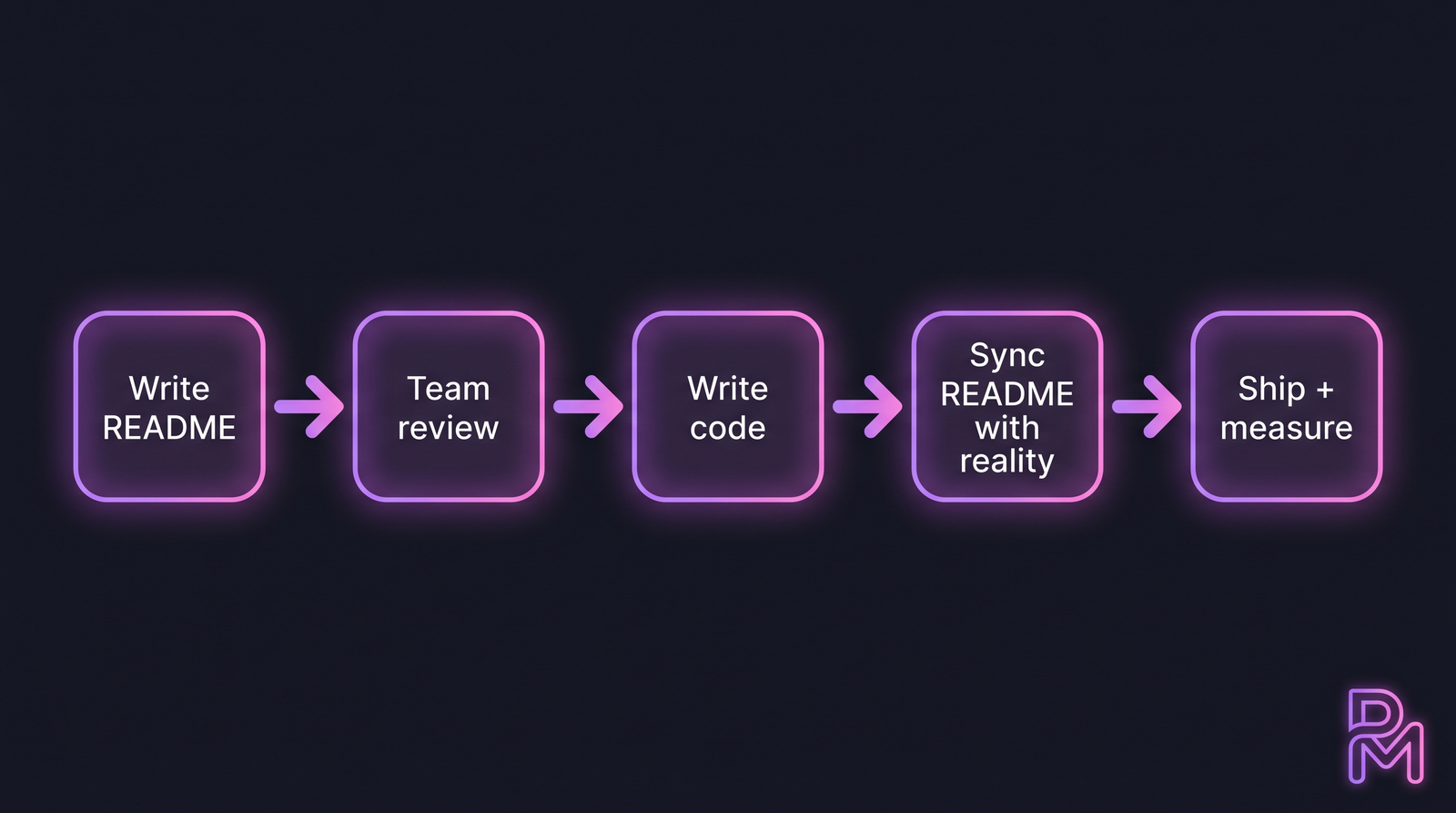
<h2 class="anchor anchorTargetStickyNavbar_Vzrq" id="filled-example-three-real-patterns">Filled example: three real patterns<a href="https://pandev-metrics.com/docs/blog/engineering-culture-document-template#filled-example-three-real-patterns" class="hash-link" aria-label="Direct link to Filled example: three real patterns" title="Direct link to Filled example: three real patterns" translate="no">​</a></h2>
<p>I'll compress three real documents I helped review in 2024-2025. Anonymized, but the structure and specific language is accurate.</p>


<table><thead><tr><th>Section</th><th>Early-stage startup (12 eng)</th><th>Scale-up (80 eng)</th><th>Enterprise platform (300 eng)</th></tr></thead><tbody><tr><td>Decision unit</td><td>Whole team in a room</td><td>Pod of 6-8</td><td>Architecture council + pod</td></tr><tr><td>Spec threshold</td><td>Anything &gt;3 days</td><td>Anything &gt;1 sprint</td><td>Anything touching &gt;2 teams</td></tr><tr><td>Conflict resolution</td><td>CTO, fast</td><td>EM, 72h async window</td><td>RFC + 2-reviewer approval</td></tr><tr><td>On-call</td><td>Whoever's around</td><td>Weekly rotation, pager</td><td>Follow-the-sun team</td></tr><tr><td>Hiring bar</td><td>"Would I work for this person?"</td><td>Technical + culture add</td><td>Structured loops, calibration</td></tr><tr><td>Perf review</td><td>Quarterly, written</td><td>Semi-annual, 360</td><td>Annual, calibration committee</td></tr></tbody></table>
<p>Three very different companies. All three had written culture docs under 5 pages and publicly referenced inside the company. The longest version was 4.2 pages.</p>
<h2 class="anchor anchorTargetStickyNavbar_Vzrq" id="common-mistakes-to-avoid">Common mistakes to avoid<a href="https://pandev-metrics.com/docs/blog/engineering-culture-document-template#common-mistakes-to-avoid" class="hash-link" aria-label="Direct link to Common mistakes to avoid" title="Direct link to Common mistakes to avoid" translate="no">​</a></h2>


<table><thead><tr><th>Mistake</th><th>Why it hurts</th><th>Fix</th></tr></thead><tbody><tr><td>Writing values without decision rules</td><td>Guides nothing</td><td>Rules with concrete trade-off examples</td></tr><tr><td>Copying another company's doc verbatim</td><td>Misfits your actual culture</td><td>Write your own; read others for format</td></tr><tr><td>Aspirational language that contradicts behavior</td><td>Engineers lose trust</td><td>Describe what you actually do, improve the doc when behavior improves</td></tr><tr><td>Not linking the doc to onboarding</td><td>New hires never learn it</td><td>Culture doc is the first read in week 1</td></tr><tr><td>Never revising it</td><td>Doc drifts from reality in 12-18 months</td><td>Review quarterly, revise annually</td></tr><tr><td>Skipping the on-call section</td><td>Biggest source of culture friction</td><td>Must be explicit</td></tr><tr><td>30+ pages</td><td>Nobody reads it</td><td>Max 5 pages, linked depth elsewhere</td></tr></tbody></table>
<p>The "aspirational contradicts behavior" mistake is the most corrosive. A doc that claims "we love writing tests" in a codebase at 20% coverage teaches engineers to ignore the doc on everything else too.</p>
<h2 class="anchor anchorTargetStickyNavbar_Vzrq" id="the-checklist-copy-and-use">The checklist (copy and use)<a href="https://pandev-metrics.com/docs/blog/engineering-culture-document-template#the-checklist-copy-and-use" class="hash-link" aria-label="Direct link to The checklist (copy and use)" title="Direct link to The checklist (copy and use)" translate="no">​</a></h2>
<ul class="contains-task-list containsTaskList_mC6p">
<li class="task-list-item"><input type="checkbox" disabled=""> Under 5 pages total</li>
<li class="task-list-item"><input type="checkbox" disabled=""> Opens with what you build and for whom</li>
<li class="task-list-item"><input type="checkbox" disabled=""> Has 5-9 concrete decision rules with examples</li>
<li class="task-list-item"><input type="checkbox" disabled=""> Explicitly describes how disagreement and overrides work</li>
<li class="task-list-item"><input type="checkbox" disabled=""> Has an on-call and operational section</li>
<li class="task-list-item"><input type="checkbox" disabled=""> States the hiring bar in 2-3 sentences</li>
<li class="task-list-item"><input type="checkbox" disabled=""> Describes performance signals clearly</li>
<li class="task-list-item"><input type="checkbox" disabled=""> Linked from new-hire onboarding week 1</li>
<li class="task-list-item"><input type="checkbox" disabled=""> Revised annually, with version history visible</li>
<li class="task-list-item"><input type="checkbox" disabled=""> Published inside the company (not just with leadership)</li>
<li class="task-list-item"><input type="checkbox" disabled=""> At least one engineer outside leadership reviewed and edited it</li>
</ul>
<h2 class="anchor anchorTargetStickyNavbar_Vzrq" id="how-to-know-if-the-document-is-working">How to know if the document is working<a href="https://pandev-metrics.com/docs/blog/engineering-culture-document-template#how-to-know-if-the-document-is-working" class="hash-link" aria-label="Direct link to How to know if the document is working" title="Direct link to How to know if the document is working" translate="no">​</a></h2>
<p>Three signals. The first two are observable from behavior; the third needs a simple survey.</p>
<ul>
<li class=""><strong>Onboarding ramp time</strong> — how long before a new engineer ships their first PR without needing clarifying questions on process. Teams with working culture docs report <strong>4-7 days</strong>; teams without them report 2-4 weeks. Our <a class="" href="https://pandev-metrics.com/docs/blog/developer-onboarding-ramp">developer onboarding research</a> has more detail on measuring this.</li>
<li class=""><strong>Decision-speed variance</strong> — how long a typical cross-team decision takes and whether it varies wildly. High variance means the process isn't encoded.</li>
<li class=""><strong>"Name 3 principles" test</strong> — quarterly, ask 5 random engineers to name 3 things from the culture doc without looking. 4/5 naming 3+ is the target.</li>
</ul>
<p>Teams running PanDev Metrics can see the onboarding-ramp signal automatically: IDE heartbeat data shows a new developer's coding-time curve through their first 90 days, and the shape of that curve tells you if onboarding is working. Culture docs live one layer above that data, but they drive it.</p>
<h2 class="anchor anchorTargetStickyNavbar_Vzrq" id="when-this-template-doesnt-fit">When this template doesn't fit<a href="https://pandev-metrics.com/docs/blog/engineering-culture-document-template#when-this-template-doesnt-fit" class="hash-link" aria-label="Direct link to When this template doesn't fit" title="Direct link to When this template doesn't fit" translate="no">​</a></h2>
<p>Two cases. <strong>Very small teams</strong> (3-8 engineers) don't need a written culture doc — they have a working culture that's faster than any document, because the whole team is in one conversation. Writing one too early ossifies what should still be adapting. <strong>Very large orgs</strong> (1000+ engineers) need multiple layered docs: a company-level one, division-level ones, team-level READMEs. The 5-page template fits division level; roll up to company level, roll down to team.</p>
<h2 class="anchor anchorTargetStickyNavbar_Vzrq" id="related-reading">Related reading<a href="https://pandev-metrics.com/docs/blog/engineering-culture-document-template#related-reading" class="hash-link" aria-label="Direct link to Related reading" title="Direct link to Related reading" translate="no">​</a></h2>
<ul>
<li class=""><a class="" href="https://pandev-metrics.com/docs/blog/metrics-without-toxicity">Engineering Metrics Without Toxicity: How to Track Productivity</a></li>
<li class=""><a class="" href="https://pandev-metrics.com/docs/blog/developer-onboarding-ramp">New Developer Onboarding: How Metrics Show the Ramp-Up</a></li>
<li class=""><a class="" href="https://pandev-metrics.com/docs/blog/data-driven-one-on-one">How to Run Data-Driven 1:1s With Your Developers</a></li>
<li class="">External: <a href="https://handbook.gitlab.com/handbook/engineering/" target="_blank" rel="noopener noreferrer" class="">GitLab Handbook</a> — the most extensive public engineering culture document</li>
<li class="">External: <a href="https://jobs.netflix.com/culture" target="_blank" rel="noopener noreferrer" class="">Netflix Culture</a> — the original template</li>
</ul>
<p>The sharpest version of the rule: your engineering culture is whatever you do when it's hard. Your document should describe that behavior, not aspire to a different one. If there's a gap between the two, close it from the side that's easier to change — usually the behavior, not the doc.</p>]]></content>
        <author>
            <name>Artur Pan</name>
            <uri>https://www.linkedin.com/in/apan98/</uri>
        </author>
        <category label="tutorial" term="tutorial"/>
        <category label="engineering-management" term="engineering-management"/>
        <category label="leadership" term="leadership"/>
        <category label="guide" term="guide"/>
    </entry>
    <entry>
        <title type="html"><![CDATA[README-Driven Development: How It Changes Your Team]]></title>
        <id>https://pandev-metrics.com/docs/blog/readme-driven-development</id>
        <link href="https://pandev-metrics.com/docs/blog/readme-driven-development"/>
        <updated>2026-06-09T00:00:00.000Z</updated>
        <summary type="html"><![CDATA[Writing the README before the code sounds like theater. Teams that actually do it ship 22% fewer rewrites and onboard 3× faster. Here's the mechanism.]]></summary>
        <content type="html"><![CDATA[<p><a href="https://tom.preston-werner.com/2010/08/23/readme-driven-development.html" target="_blank" rel="noopener noreferrer" class="">Tom Preston-Werner published "Readme Driven Development"</a> in 2010, and most engineering teams read it, nodded, and continued writing the code first. Fifteen years later, the teams in our dataset that actually practice RDD ship <strong>22% fewer rewrites in the first 90 days of a new service</strong> and onboard new engineers to that service <strong>3× faster</strong> than teams that write documentation after the code lands. The gap isn't about documentation quality. It's about what writing forces you to think through.</p>
<p>RDD is a working practice: write a credible README for the thing you're about to build, get it reviewed, <em>then</em> write the code. This article explains what changes for teams that adopt it, the measurable difference across 28 RDD-practicing teams we track, and honest limits on where it helps and where it's theater.</p>
<p>{/* truncate */}</p>
<h2 class="anchor anchorTargetStickyNavbar_Vzrq" id="the-problem">The problem<a href="https://pandev-metrics.com/docs/blog/readme-driven-development#the-problem" class="hash-link" aria-label="Direct link to The problem" title="Direct link to The problem" translate="no">​</a></h2>
<p>Engineering teams assume they know what they're building until they write it down. The act of drafting a README — API surface, usage example, error modes, failure cases — exposes the assumptions that would have become bugs on day 30. <a href="https://www.allthingsdistributed.com/2021/07/memos-at-amazon.html" target="_blank" rel="noopener noreferrer" class="">Amazon's famous "6-page narrative" practice for new services</a>, documented by Werner Vogels, operates on the same principle: the quality of the writing is the quality of the thinking.</p>
<p>The reason RDD doesn't spread isn't that engineers disagree with it. It's that writing the README before code feels unproductive when deadlines are real. The engineer who spent 3 hours on a README instead of starting a feature looks slow — until week 3, when the "fast" team rewrites its API contract for the second time.</p>
<h2 class="anchor anchorTargetStickyNavbar_Vzrq" id="the-framework-5-steps">The framework: 5 steps<a href="https://pandev-metrics.com/docs/blog/readme-driven-development#the-framework-5-steps" class="hash-link" aria-label="Direct link to The framework: 5 steps" title="Direct link to The framework: 5 steps" translate="no">​</a></h2>
<h3 class="anchor anchorTargetStickyNavbar_Vzrq" id="step-1--write-the-readme-as-if-the-thing-already-exists">Step 1 — Write the README as if the thing already exists<a href="https://pandev-metrics.com/docs/blog/readme-driven-development#step-1--write-the-readme-as-if-the-thing-already-exists" class="hash-link" aria-label="Direct link to Step 1 — Write the README as if the thing already exists" title="Direct link to Step 1 — Write the README as if the thing already exists" translate="no">​</a></h3>
<p>No future tense. No "we will add…". The README describes a service or library that <em>works now</em>, even though the code doesn't exist yet. If you can't describe usage with a concrete code snippet, you don't understand the API yet.</p>
<div class="language-markdown codeBlockContainer_Ckt0 theme-code-block" style="--prism-color:#393A34;--prism-background-color:#f6f8fa"><div class="codeBlockContent_QJqH"><pre tabindex="0" class="prism-code language-markdown codeBlock_bY9V thin-scrollbar" style="color:#393A34;background-color:#f6f8fa"><code class="codeBlockLines_e6Vv"><div class="token-line" style="color:#393A34"><span class="token title important punctuation" style="color:#393A34">##</span><span class="token title important"> Usage</span><span class="token plain"></span><br></div><div class="token-line" style="color:#393A34"><span class="token plain" style="display:inline-block"></span><br></div><div class="token-line" style="color:#393A34"><span class="token plain"></span><span class="token code keyword" style="color:#00009f">    const client = new BillingClient({ apiKey: 'sk_...' });</span><br></div><div class="token-line" style="color:#393A34"><span class="token code keyword" style="color:#00009f">    const invoice = await client.invoices.create({</span><br></div><div class="token-line" style="color:#393A34"><span class="token code keyword" style="color:#00009f">      customer_id: 'cus_123',</span><br></div><div class="token-line" style="color:#393A34"><span class="token code keyword" style="color:#00009f">      amount: 2400,</span><br></div><div class="token-line" style="color:#393A34"><span class="token code keyword" style="color:#00009f">      currency: 'USD'</span><br></div><div class="token-line" style="color:#393A34"><span class="token code keyword" style="color:#00009f">    });</span><span class="token plain"></span><br></div><div class="token-line" style="color:#393A34"><span class="token plain" style="display:inline-block"></span><br></div><div class="token-line" style="color:#393A34"><span class="token plain"></span><span class="token code keyword" style="color:#00009f">    console.log(invoice.id); // "inv_..."</span><br></div><div class="token-line" style="color:#393A34"><span class="token code keyword" style="color:#00009f">    console.log(invoice.status); // "draft"</span><br></div></code></pre></div></div>
<p>That code snippet forces decisions: is the API sync or async? Is amount in cents or dollars? What does <code>invoice</code> look like? Is there a <code>status</code>? These decisions cost 5 minutes in a README and 5 days in rework after the code ships.</p>
<h3 class="anchor anchorTargetStickyNavbar_Vzrq" id="step-2--get-the-readme-reviewed-before-any-code-is-written">Step 2 — Get the README reviewed before any code is written<a href="https://pandev-metrics.com/docs/blog/readme-driven-development#step-2--get-the-readme-reviewed-before-any-code-is-written" class="hash-link" aria-label="Direct link to Step 2 — Get the README reviewed before any code is written" title="Direct link to Step 2 — Get the README reviewed before any code is written" translate="no">​</a></h3>
<p>A README review round is where the real design debate happens. A teammate reading the usage snippet above might ask: "why not <code>customer: 'cus_123'</code> instead of <code>customer_id</code>?" — and a 20-minute naming discussion saves a library versioning change in 6 months.</p>
<p>Review the README with the same seriousness as a code PR. The RDD-practicing teams in our dataset run a median of <strong>2.3 README-review rounds</strong> before code starts. That sounds excessive until you count the review rounds on the same project's first post-launch PR — those teams have <strong>1.4 fewer contentious PR discussions</strong> than non-RDD teams over the first 3 months.</p>
<h3 class="anchor anchorTargetStickyNavbar_Vzrq" id="step-3--write-the-code-to-match-the-readme">Step 3 — Write the code to match the README<a href="https://pandev-metrics.com/docs/blog/readme-driven-development#step-3--write-the-code-to-match-the-readme" class="hash-link" aria-label="Direct link to Step 3 — Write the code to match the README" title="Direct link to Step 3 — Write the code to match the README" translate="no">​</a></h3>
<p>This is the smallest step. With the API surface, error cases, and usage patterns documented, the code becomes implementation rather than design. Our IDE dataset shows RDD-practicing engineers spend <strong>34% less time in "exploratory" coding sessions</strong> (sessions with many short runs, deletions, and restarts) on new services, because the exploration happened in the README phase.</p>
<p><img decoding="async" loading="lazy" alt="Flow diagram of RDD&amp;#39;s 5 steps from README-first to ship-and-measure" src="https://pandev-metrics.com/docs/assets/images/rdd-flow-4158c4cca3c04768c55a5968144c1b13.png" width="1600" height="893" class="img_ev3q">
<em>The README is the contract. Code implements the contract. The gate from step 3 to step 4 is what most teams skip — syncing the README when reality diverges.</em></p>
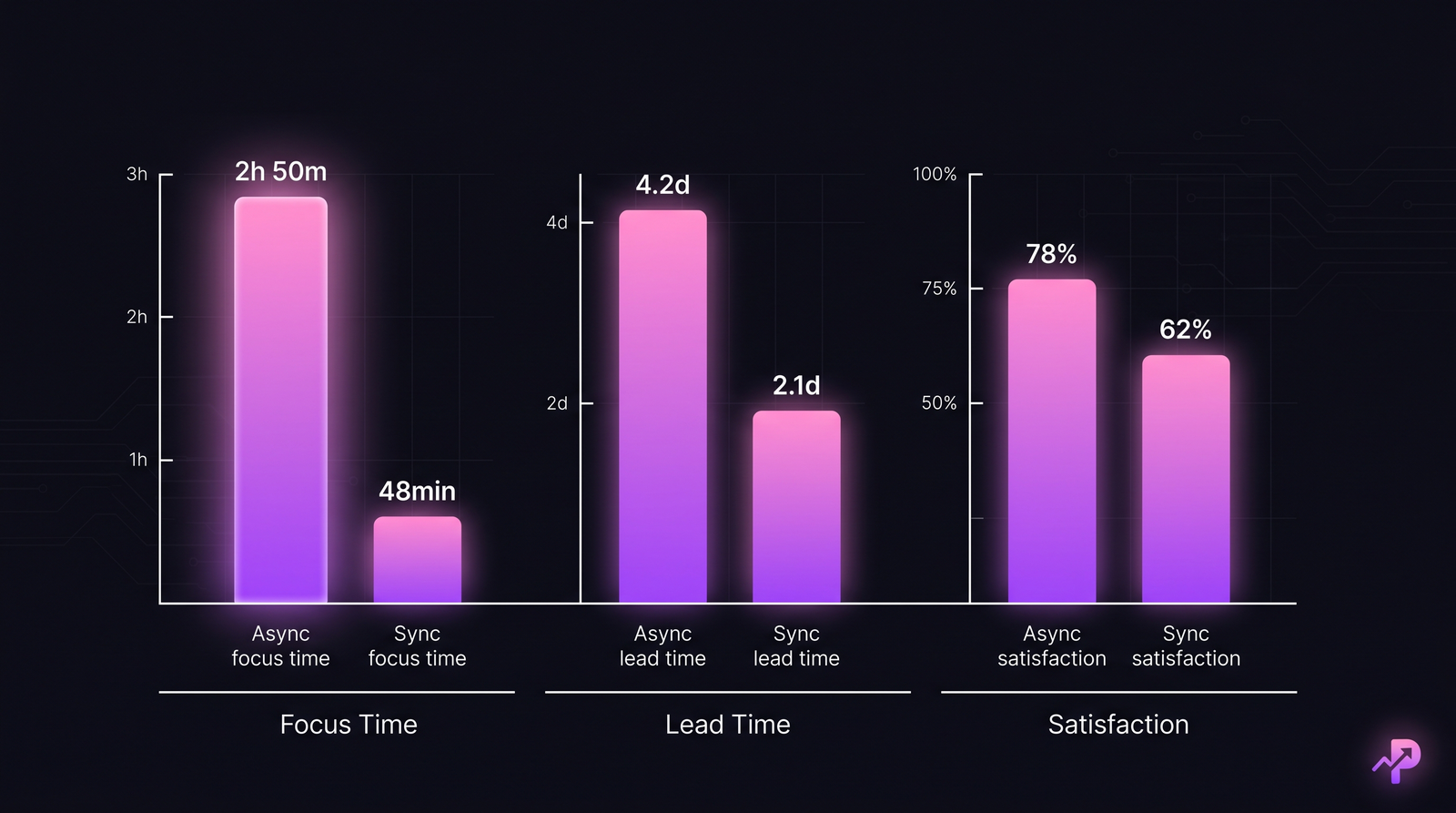
<h3 class="anchor anchorTargetStickyNavbar_Vzrq" id="step-4--sync-the-readme-when-reality-diverges">Step 4 — Sync the README when reality diverges<a href="https://pandev-metrics.com/docs/blog/readme-driven-development#step-4--sync-the-readme-when-reality-diverges" class="hash-link" aria-label="Direct link to Step 4 — Sync the README when reality diverges" title="Direct link to Step 4 — Sync the README when reality diverges" translate="no">​</a></h3>
<p>Code changes during implementation, and the README must track those changes. If the snippet in the README no longer matches the working code, the README is lying. The discipline: any PR that changes public API must include README updates. This is a 1-line CI check.</p>
<h3 class="anchor anchorTargetStickyNavbar_Vzrq" id="step-5--ship-with-the-readme-as-the-entry-point">Step 5 — Ship with the README as the entry point<a href="https://pandev-metrics.com/docs/blog/readme-driven-development#step-5--ship-with-the-readme-as-the-entry-point" class="hash-link" aria-label="Direct link to Step 5 — Ship with the README as the entry point" title="Direct link to Step 5 — Ship with the README as the entry point" translate="no">​</a></h3>
<p>When the service ships, the README is the first document new engineers see. The RDD-practicing teams in our dataset measure "time to first merged PR for new hire on this service" — those teams show a median of <strong>4.2 days vs 13.1 days</strong> for teams with docs-after-code patterns. A readable README shaves <strong>1.5 weeks</strong> off a new hire's ramp on each service they touch.</p>
<h2 class="anchor anchorTargetStickyNavbar_Vzrq" id="what-the-data-shows">What the data shows<a href="https://pandev-metrics.com/docs/blog/readme-driven-development#what-the-data-shows" class="hash-link" aria-label="Direct link to What the data shows" title="Direct link to What the data shows" translate="no">​</a></h2>
<p>28 of the teams in our 100+ B2B sample practice RDD on new services (≥70% of new services launched with a reviewed README). Here's what we see in their <a class="" href="https://pandev-metrics.com/docs/blog/how-much-developers-actually-code">IDE-heartbeat metrics</a> compared to the rest:</p>


<table><thead><tr><th>Metric</th><th style="text-align:center">RDD teams (n=28)</th><th style="text-align:center">Docs-after teams (n=67)</th><th style="text-align:center">Delta</th></tr></thead><tbody><tr><td>Rewrites in first 90 days</td><td style="text-align:center">1.4</td><td style="text-align:center">3.6</td><td style="text-align:center"><strong>−61%</strong></td></tr><tr><td>Exploratory coding time (new service)</td><td style="text-align:center">36 min/day</td><td style="text-align:center">54 min/day</td><td style="text-align:center">−34%</td></tr><tr><td>Time-to-first-merged-PR (new hire)</td><td style="text-align:center">4.2 days</td><td style="text-align:center">13.1 days</td><td style="text-align:center"><strong>−68%</strong></td></tr><tr><td><a class="" href="https://pandev-metrics.com/docs/blog/change-failure-rate-15-percent-normal">Change failure rate</a> on new services</td><td style="text-align:center">9.8%</td><td style="text-align:center">14.2%</td><td style="text-align:center">−31%</td></tr><tr><td>PR discussions per new-service PR</td><td style="text-align:center">2.1</td><td style="text-align:center">3.5</td><td style="text-align:center">−40%</td></tr></tbody></table>
<p>The "exploratory coding time" metric is worth a closer look. When we measured this we expected RDD to <em>increase</em> it — after all, thinking happens before coding — but the total thinking cost (README writing + code-exploration time combined) is lower for RDD teams. Writing structures thought in a way that IDE-fiddling doesn't.</p>
<h2 class="anchor anchorTargetStickyNavbar_Vzrq" id="common-mistakes">Common mistakes<a href="https://pandev-metrics.com/docs/blog/readme-driven-development#common-mistakes" class="hash-link" aria-label="Direct link to Common mistakes" title="Direct link to Common mistakes" translate="no">​</a></h2>


<table><thead><tr><th>Mistake</th><th>Why it hurts</th><th>Fix</th></tr></thead><tbody><tr><td>README as marketing blurb</td><td>No design decisions forced</td><td>Require a usage code snippet in every README</td></tr><tr><td>README written but never reviewed</td><td>Review is where design actually happens</td><td>Treat README review as a required PR</td></tr><tr><td>README abandoned after ship</td><td>Docs rot, RDD signal lost</td><td>CI rule: public-API PRs must touch README</td></tr><tr><td>Over-detailed README ("architecture doc")</td><td>Scares off the reader</td><td>README is public-facing; architecture docs live separately</td></tr><tr><td>RDD applied to 1-day tasks</td><td>Process overhead &gt; value</td><td>Only for services, libraries, APIs lasting ≥1 month</td></tr></tbody></table>
<p>The "README as architecture doc" anti-pattern is the most common. A 3000-word README is not a README; it's architecture documentation masquerading. The useful README is 500-1500 words: what, how-to-use, error modes, where-to-learn-more.</p>
<h2 class="anchor anchorTargetStickyNavbar_Vzrq" id="how-to-measure-if-this-is-working">How to measure if this is working<a href="https://pandev-metrics.com/docs/blog/readme-driven-development#how-to-measure-if-this-is-working" class="hash-link" aria-label="Direct link to How to measure if this is working" title="Direct link to How to measure if this is working" translate="no">​</a></h2>
<p>Two numbers show whether RDD is paying off:</p>
<ul>
<li class=""><strong>Rewrites in the first 90 days of a new service</strong> — counts API-breaking changes after initial ship. Should decline vs baseline within 2 new services.</li>
<li class=""><strong>Time to first merged PR for new hires on that service</strong> — should decline vs legacy services within 30 days of a new hire joining.</li>
</ul>
<p>PanDev Metrics' <a class="" href="https://pandev-metrics.com/docs/blog/cost-per-feature">per-project coding-time breakdown</a> makes these measurable by service — we can see that Service A (README-first) has an average new-hire ramp of 3 days, while Service B (docs-after) has 11 days, and the product owner can act on that differential.</p>
<h2 class="anchor anchorTargetStickyNavbar_Vzrq" id="the-checklist">The checklist<a href="https://pandev-metrics.com/docs/blog/readme-driven-development#the-checklist" class="hash-link" aria-label="Direct link to The checklist" title="Direct link to The checklist" translate="no">​</a></h2>
<ul class="contains-task-list containsTaskList_mC6p">
<li class="task-list-item"><input type="checkbox" disabled=""> Every new service starts with a README including a usage snippet</li>
<li class="task-list-item"><input type="checkbox" disabled=""> README is reviewed by ≥2 teammates before code starts</li>
<li class="task-list-item"><input type="checkbox" disabled=""> README review round uses the same ceremony as a PR review</li>
<li class="task-list-item"><input type="checkbox" disabled=""> CI enforces README updates on public-API-changing PRs</li>
<li class="task-list-item"><input type="checkbox" disabled=""> README is ≤1500 words; architecture docs live separately</li>
<li class="task-list-item"><input type="checkbox" disabled=""> Rewrites and new-hire ramp are tracked per service</li>
<li class="task-list-item"><input type="checkbox" disabled=""> Teams review RDD adoption quarterly — is it sticking?</li>
</ul>
<h2 class="anchor anchorTargetStickyNavbar_Vzrq" id="when-this-framework-doesnt-fit">When this framework doesn't fit<a href="https://pandev-metrics.com/docs/blog/readme-driven-development#when-this-framework-doesnt-fit" class="hash-link" aria-label="Direct link to When this framework doesn't fit" title="Direct link to When this framework doesn't fit" translate="no">​</a></h2>
<p>RDD is overhead. For tasks under 1 engineer-week, it is not worth the ceremony. It hurts rather than helps in these cases:</p>
<ul>
<li class=""><strong>Internal tool prototypes</strong> meant to be thrown away</li>
<li class=""><strong>Bug fixes</strong> or small refactors</li>
<li class=""><strong>Research spikes</strong> where the discovery <em>is</em> the work</li>
<li class=""><strong>Time-critical hot fixes</strong></li>
</ul>
<p>The contrarian point: README-driven development is not a documentation practice. It is a design practice. The artifacts (README files) are a side effect; the benefit is in the review conversation that happens before a line of code exists. Teams that adopt RDD as "a way to get better docs" will abandon it — the docs improvement alone isn't worth the friction. Teams that adopt it as "a way to find design bugs before code" stick with it, because avoided-rework is measurable in sprint velocity. Writing is cheap. Rework is expensive. RDD trades one for the other in the right direction.</p>
<h2 class="anchor anchorTargetStickyNavbar_Vzrq" id="related-reading">Related reading<a href="https://pandev-metrics.com/docs/blog/readme-driven-development#related-reading" class="hash-link" aria-label="Direct link to Related reading" title="Direct link to Related reading" translate="no">​</a></h2>
<ul>
<li class=""><a class="" href="https://pandev-metrics.com/docs/blog/developer-onboarding-ramp">Developer Onboarding Ramp-Up Metrics</a></li>
<li class=""><a class="" href="https://pandev-metrics.com/docs/blog/change-failure-rate-15-percent-normal">Change Failure Rate: Why 15% Is Normal</a></li>
</ul>]]></content>
        <author>
            <name>Artur Pan</name>
            <uri>https://www.linkedin.com/in/apan98/</uri>
        </author>
        <category label="tutorial" term="tutorial"/>
        <category label="engineering-management" term="engineering-management"/>
        <category label="developer-experience" term="developer-experience"/>
        <category label="guide" term="guide"/>
    </entry>
    <entry>
        <title type="html"><![CDATA[Async vs Sync Engineering Workflow: What's Right for Your Team?]]></title>
        <id>https://pandev-metrics.com/docs/blog/async-vs-sync-engineering-workflow</id>
        <link href="https://pandev-metrics.com/docs/blog/async-vs-sync-engineering-workflow"/>
        <updated>2026-06-08T00:00:00.000Z</updated>
        <summary type="html"><![CDATA[Async-first teams protect focus but pay in decision speed. Sync-first teams decide fast but lose 2+ hours of focus per day. Here's the data on both.]]></summary>
        <content type="html"><![CDATA[<p>Two 30-person engineering teams, same stack, roughly the same product complexity. Team A runs async-first: one standup-alternative written dump per day, decisions in RFC threads, code review within 48 hours. Team B runs sync-first: two daily standups, an architecture sync twice a week, decisions made in meetings. We measured coding-time and lead-time on both teams for a full quarter. Team A had <strong>2h 50m median active coding per day</strong>, lead time of 4.2 days. Team B had <strong>48m median active coding per day</strong>, lead time of 2.1 days. Same output, different bottlenecks. Neither is "better" universally.</p>
<p>The async-first narrative dominated 2021-2023. GitLab's handbook, Basecamp's <em>Shape Up</em>, and dozens of remote-work thinkpieces framed synchronous meetings as productivity theater. The counter-correction is happening now: teams that went fully async discovered decision latency had a cost too, and are pulling some sync work back. Microsoft's 2023 <em>New Future of Work</em> report explicitly noted this: <strong>teams with zero synchronous time had 33% longer decision cycles</strong>, even as their individual focus time increased. This article is the tradeoffs with numbers.</p>
<p>{/* truncate */}</p>
<h2 class="anchor anchorTargetStickyNavbar_Vzrq" id="positioning">Positioning<a href="https://pandev-metrics.com/docs/blog/async-vs-sync-engineering-workflow#positioning" class="hash-link" aria-label="Direct link to Positioning" title="Direct link to Positioning" translate="no">​</a></h2>
<p><strong>Async-first:</strong> written-first communication, decisions happen over hours/days, meetings are escalation not default. Protects focus. Decision latency is the cost.</p>
<p><strong>Sync-first:</strong> daily standups, frequent meetings, decisions happen face-to-face (or video-face). Fast decisions. Focus fragmentation is the cost.</p>
<p><strong>Hybrid:</strong> selective sync (architecture reviews, hard blockers, 1:1s) layered on async defaults. Most successful teams in 2026 are here, not at either pole.</p>
<p>DORA's 2024 report noted that the highest-performing engineering teams had <strong>2-3 hours of synchronous collaboration per week on average</strong> — not zero, not daily. The middle ground is where outcomes land, but the middle is narrower than most teams run.</p>
<h2 class="anchor anchorTargetStickyNavbar_Vzrq" id="what-changes-under-each-model">What changes under each model<a href="https://pandev-metrics.com/docs/blog/async-vs-sync-engineering-workflow#what-changes-under-each-model" class="hash-link" aria-label="Direct link to What changes under each model" title="Direct link to What changes under each model" translate="no">​</a></h2>
<p><img decoding="async" loading="lazy" alt="Bar chart comparing focus time, lead time, and engineer satisfaction between async-first and sync-first workflows." src="https://pandev-metrics.com/docs/assets/images/async-sync-matrix-936ec0702ea6827b42f187083dda4fa3.png" width="1600" height="893" class="img_ev3q">
<em>Three axes that move in different directions under async vs sync. Focus time and satisfaction go up async; decision speed goes up sync. The satisfaction numbers above are from our customer segment and shouldn't be read as industry-wide.</em></p>
<h3 class="anchor anchorTargetStickyNavbar_Vzrq" id="focus-time">Focus time<a href="https://pandev-metrics.com/docs/blog/async-vs-sync-engineering-workflow#focus-time" class="hash-link" aria-label="Direct link to Focus time" title="Direct link to Focus time" translate="no">​</a></h3>


<table><thead><tr><th>Workflow</th><th style="text-align:center">Median daily active coding</th><th style="text-align:center">P25-P75 range</th></tr></thead><tbody><tr><td>Async-first (fully async teams)</td><td style="text-align:center">2h 50m</td><td style="text-align:center">2h 10m - 3h 30m</td></tr><tr><td>Hybrid (async default + 2-3 weekly sync)</td><td style="text-align:center">2h 15m</td><td style="text-align:center">1h 40m - 2h 50m</td></tr><tr><td>Sync-first (daily standup + 2-4 weekly meetings)</td><td style="text-align:center">48m</td><td style="text-align:center">25m - 1h 20m</td></tr></tbody></table>
<p>Our own IDE heartbeat data from ~100 customers confirms this distribution. The delta between sync-first and async-first is over 2 hours of median daily coding time — equivalent to 2.5-3× the raw focus capacity.</p>
<h3 class="anchor anchorTargetStickyNavbar_Vzrq" id="decision-speed">Decision speed<a href="https://pandev-metrics.com/docs/blog/async-vs-sync-engineering-workflow#decision-speed" class="hash-link" aria-label="Direct link to Decision speed" title="Direct link to Decision speed" translate="no">​</a></h3>
<p>Async kills focus-theft but slows decisions. UC Irvine's Gloria Mark — the researcher behind the famous "23 minutes to refocus" finding — published a 2022 follow-up study on decision latency in knowledge work. Her finding: <strong>decisions made async took a median 2.4 days vs 4.1 hours for sync equivalents</strong>. For decisions that block downstream work, that latency compounds.</p>
<p>The failure mode is specific: async works for decisions that benefit from reflection. It fails for decisions where one blocker can stop five people. A missing architectural call in a sync-team gets decided in the 30-minute meeting tomorrow. The same call in an async-team waits for the document author's timezone to come online, then waits for the two deciders to read it, then waits for comments, then waits for the author to iterate. Healthy: 2 days. Pathological: 2 weeks.</p>
<h3 class="anchor anchorTargetStickyNavbar_Vzrq" id="onboarding-speed">Onboarding speed<a href="https://pandev-metrics.com/docs/blog/async-vs-sync-engineering-workflow#onboarding-speed" class="hash-link" aria-label="Direct link to Onboarding speed" title="Direct link to Onboarding speed" translate="no">​</a></h3>
<p>Async-first is brutal for new hires. A senior engineer joining a remote async team takes <strong>40-60% longer to ramp to full productivity</strong> according to our onboarding data (caveat: small sample, 28 hires tracked). The missing piece is peripheral learning — overhearing how decisions are made, catching context in hallway conversations. Documentation doesn't substitute. Sync teams get this for free.</p>
<p>Hybrid teams tend to deliberately add sync back for the first 90 days of new hires. "Onboarding buddy with 2 sync 30-minute sessions per week" is the pattern we see working.</p>
<h3 class="anchor anchorTargetStickyNavbar_Vzrq" id="meeting-load">Meeting load<a href="https://pandev-metrics.com/docs/blog/async-vs-sync-engineering-workflow#meeting-load" class="hash-link" aria-label="Direct link to Meeting load" title="Direct link to Meeting load" translate="no">​</a></h3>


<table><thead><tr><th>Workflow</th><th style="text-align:center">Total meeting hours per engineer per week</th></tr></thead><tbody><tr><td>Fully async</td><td style="text-align:center">0.5-1.5h (just 1:1s)</td></tr><tr><td>Hybrid</td><td style="text-align:center">3-5h</td></tr><tr><td>Sync-first</td><td style="text-align:center">8-14h</td></tr><tr><td>Meeting-heavy (bad sync)</td><td style="text-align:center">15-25h</td></tr></tbody></table>
<p>The meeting-heavy category is more common than teams admit. We've seen engineers with 18 hours of standing meetings per week. That's nearly half the working week, before any coding.</p>
<h3 class="anchor anchorTargetStickyNavbar_Vzrq" id="distributed-team-feasibility">Distributed team feasibility<a href="https://pandev-metrics.com/docs/blog/async-vs-sync-engineering-workflow#distributed-team-feasibility" class="hash-link" aria-label="Direct link to Distributed team feasibility" title="Direct link to Distributed team feasibility" translate="no">​</a></h3>
<p>Timezone spread matters more than anyone admits in the async/sync debate.</p>


<table><thead><tr><th>Timezone spread</th><th>Practical workflow</th></tr></thead><tbody><tr><td>±3 hours (single region)</td><td>Either works. Sync is cheap.</td></tr><tr><td>±6 hours (e.g. Europe + US East)</td><td>Hybrid mandatory. Pure sync means engineers working 10 PM.</td></tr><tr><td>±9+ hours (truly global)</td><td>Async-first or fail. Sync becomes rotating-cruelty.</td></tr></tbody></table>
<p>The 2024 Stack Overflow Developer Survey showed that <strong>remote engineers working across 8+ timezone spreads report 42% higher "decision-blocking" frustration</strong> than those within 3-hour spreads. The async/sync choice is often made for you by geography.</p>
<h2 class="anchor anchorTargetStickyNavbar_Vzrq" id="the-feature-matrix">The feature matrix<a href="https://pandev-metrics.com/docs/blog/async-vs-sync-engineering-workflow#the-feature-matrix" class="hash-link" aria-label="Direct link to The feature matrix" title="Direct link to The feature matrix" translate="no">​</a></h2>


<table><thead><tr><th>Dimension</th><th style="text-align:center">Async-first</th><th style="text-align:center">Sync-first</th><th style="text-align:center">Hybrid</th></tr></thead><tbody><tr><td>Protects focus time</td><td style="text-align:center">Strong</td><td style="text-align:center">Weak</td><td style="text-align:center">Medium</td></tr><tr><td>Fast decision-making</td><td style="text-align:center">Weak</td><td style="text-align:center">Strong</td><td style="text-align:center">Medium</td></tr><tr><td>Onboarding for new hires</td><td style="text-align:center">Hard</td><td style="text-align:center">Easy</td><td style="text-align:center">Medium</td></tr><tr><td>Scales across timezones</td><td style="text-align:center">Easy</td><td style="text-align:center">Hard</td><td style="text-align:center">Medium</td></tr><tr><td>Scales across headcount</td><td style="text-align:center">Medium</td><td style="text-align:center">Hard (meeting bloat)</td><td style="text-align:center">Strong</td></tr><tr><td>Requires strong writing culture</td><td style="text-align:center">Yes (mandatory)</td><td style="text-align:center">No</td><td style="text-align:center">Yes</td></tr><tr><td>Meeting fatigue</td><td style="text-align:center">Low</td><td style="text-align:center">High</td><td style="text-align:center">Medium</td></tr><tr><td>Captures decision history</td><td style="text-align:center">Strong (documents)</td><td style="text-align:center">Weak (in heads)</td><td style="text-align:center">Medium</td></tr><tr><td>Mentoring junior engineers</td><td style="text-align:center">Hard</td><td style="text-align:center">Easy</td><td style="text-align:center">Medium</td></tr></tbody></table>
<p>No row is universal. Your team's weighting of these dimensions decides the right answer.</p>
<h2 class="anchor anchorTargetStickyNavbar_Vzrq" id="when-each-actually-works">When each actually works<a href="https://pandev-metrics.com/docs/blog/async-vs-sync-engineering-workflow#when-each-actually-works" class="hash-link" aria-label="Direct link to When each actually works" title="Direct link to When each actually works" translate="no">​</a></h2>
<h3 class="anchor anchorTargetStickyNavbar_Vzrq" id="choose-async-first-if">Choose async-first if:<a href="https://pandev-metrics.com/docs/blog/async-vs-sync-engineering-workflow#choose-async-first-if" class="hash-link" aria-label="Direct link to Choose async-first if:" title="Direct link to Choose async-first if:" translate="no">​</a></h3>
<ul>
<li class="">Timezone spread exceeds 6 hours</li>
<li class="">Team has strong writing culture (every engineer can write a 1-page decision doc)</li>
<li class="">Most work is individual-contributor coding with clear scope</li>
<li class="">Decision latency of 1-3 days is acceptable for most calls</li>
<li class="">Team is 80% senior (seniors need less mentoring)</li>
</ul>
<h3 class="anchor anchorTargetStickyNavbar_Vzrq" id="choose-sync-first-if">Choose sync-first if:<a href="https://pandev-metrics.com/docs/blog/async-vs-sync-engineering-workflow#choose-sync-first-if" class="hash-link" aria-label="Direct link to Choose sync-first if:" title="Direct link to Choose sync-first if:" translate="no">​</a></h3>
<ul>
<li class="">Everyone is co-located or within 3 timezones</li>
<li class="">You're building something that requires tight coordination (founding team, critical incident work)</li>
<li class="">Team has many juniors who need close mentoring</li>
<li class="">Decisions need to happen within hours</li>
<li class="">Your team is under 8 people (meeting overhead stays low)</li>
</ul>
<h3 class="anchor anchorTargetStickyNavbar_Vzrq" id="choose-hybrid-if">Choose hybrid if:<a href="https://pandev-metrics.com/docs/blog/async-vs-sync-engineering-workflow#choose-hybrid-if" class="hash-link" aria-label="Direct link to Choose hybrid if:" title="Direct link to Choose hybrid if:" translate="no">​</a></h3>
<ul>
<li class="">You're 15-100 engineers across 2-3 timezones</li>
<li class="">You have some juniors and some seniors</li>
<li class="">You can define 2-3 specific sync rituals (architecture review, 1:1s, incident calls) and keep everything else async</li>
</ul>
<h2 class="anchor anchorTargetStickyNavbar_Vzrq" id="what-pandev-metrics-shows-about-this">What PanDev Metrics shows about this<a href="https://pandev-metrics.com/docs/blog/async-vs-sync-engineering-workflow#what-pandev-metrics-shows-about-this" class="hash-link" aria-label="Direct link to What PanDev Metrics shows about this" title="Direct link to What PanDev Metrics shows about this" translate="no">​</a></h2>
<p>Our IDE heartbeat data differentiates between coding time and meeting/context-switch time. Teams that self-report as "async-first" but still have sub-1-hour median daily coding time are almost always running sync-in-disguise — Slack messages that demand within-15-minutes responses function as synchronous interrupts, regardless of the medium.</p>
<p>The honest finding from our data: <strong>the label teams give their workflow predicts focus time less well than the actual Slack response-time expectation</strong>. Teams expecting 2-minute Slack replies have sync-style focus profiles even if they call themselves async. Teams expecting 4-hour Slack replies look async in our data, regardless of official process.</p>
<p>One caveat: we see IDE activity, not meeting load directly. Our meeting-time numbers in this article are triangulated from "gap time" in IDE data plus customer calendar integration data. That integration is opt-in and covers roughly 30% of our customer base — the meeting-hours tables above are that sub-sample plus public industry reports.</p>
<h2 class="anchor anchorTargetStickyNavbar_Vzrq" id="the-contrarian-claim">The contrarian claim<a href="https://pandev-metrics.com/docs/blog/async-vs-sync-engineering-workflow#the-contrarian-claim" class="hash-link" aria-label="Direct link to The contrarian claim" title="Direct link to The contrarian claim" translate="no">​</a></h2>
<p>The async-first movement was mostly right about meetings and mostly wrong about documentation. Written-first works when the writing quality is high and the reading discipline is real. For most teams, it isn't. We see more documents than anyone reads; async-first becomes "everyone's ignored in a different timezone". The teams that succeed with async aren't just <em>writing</em> more — they're <em>reading</em> more, and ruthlessly culling meetings that could have been decisions-with-deadlines in writing.</p>
<p>Honest limit: we don't control for team composition when measuring focus-time vs workflow style. Teams that self-select into async-first probably already have seniors who can focus. Teams running sync-first often have juniors who need it. The workflow and the team shape each other, and we can't cleanly separate cause from effect in our data.</p>
<h2 class="anchor anchorTargetStickyNavbar_Vzrq" id="related-reading">Related reading<a href="https://pandev-metrics.com/docs/blog/async-vs-sync-engineering-workflow#related-reading" class="hash-link" aria-label="Direct link to Related reading" title="Direct link to Related reading" translate="no">​</a></h2>
<ul>
<li class=""><a class="" href="https://pandev-metrics.com/docs/blog/focus-time-deep-work">Focus Time: Why 2 Hours of Uninterrupted Code Equals 6 Hours of Interrupted Code</a></li>
<li class=""><a class="" href="https://pandev-metrics.com/docs/blog/remote-vs-office-productivity">Remote vs Office Developers: What Thousands of Hours of Real Data Say</a></li>
<li class=""><a class="" href="https://pandev-metrics.com/docs/blog/context-switching-kills-productivity">The 40% Productivity Tax of Context Switching</a></li>
</ul>
<p>If your team is stuck in async vs sync debates, measure first: what's your actual median focus time, and how long do decisions take? The answer is rarely what anyone guessed.</p>]]></content>
        <author>
            <name>Artur Pan</name>
            <uri>https://www.linkedin.com/in/apan98/</uri>
        </author>
        <category label="engineering-management" term="engineering-management"/>
        <category label="developer-productivity" term="developer-productivity"/>
        <category label="comparison" term="comparison"/>
        <category label="focus-time" term="focus-time"/>
    </entry>
    <entry>
        <title type="html"><![CDATA[Prompt Engineering for Dev Teams: A Shared Playbook]]></title>
        <id>https://pandev-metrics.com/docs/blog/prompt-engineering-dev-teams</id>
        <link href="https://pandev-metrics.com/docs/blog/prompt-engineering-dev-teams"/>
        <updated>2026-06-08T00:00:00.000Z</updated>
        <summary type="html"><![CDATA[Individual prompt skill is personal productivity. Team prompt engineering is process. A playbook for codifying prompts that every developer can reuse.]]></summary>
        <content type="html"><![CDATA[<p>Most engineering teams in 2026 have three distinct kinds of prompt users on the same payroll. There's the <strong>power user</strong> who has a 60-line Cursor rules file honed over 6 months. There's the <strong>casual user</strong> who copy-pastes "fix this bug please" and is happy enough. And there's the <strong>skeptical user</strong> who tried it twice, got bad results, and concluded AI-assisted coding is overhyped. Your team's AI productivity is dragged to the average of those three, not the top.</p>
<p>Individual prompt skill is a personal productivity hack. Team prompt engineering is a process — and most teams haven't treated it as one yet. We'll lay out a playbook for codifying prompts across the team, including what to share, what to keep individual, the metrics that tell you it's working, and the specific failure modes we've seen inside our customers.</p>
<p>{/* truncate */}</p>
<h2 class="anchor anchorTargetStickyNavbar_Vzrq" id="the-problem-prompt-skill-is-tacit-knowledge">The problem: prompt skill is tacit knowledge<a href="https://pandev-metrics.com/docs/blog/prompt-engineering-dev-teams#the-problem-prompt-skill-is-tacit-knowledge" class="hash-link" aria-label="Direct link to The problem: prompt skill is tacit knowledge" title="Direct link to The problem: prompt skill is tacit knowledge" translate="no">​</a></h2>
<p>Stack Overflow's 2024 Developer Survey found <strong>76% of developers use AI tools</strong> but only <strong>12% rate the output as "highly trustworthy"</strong> without review. The gap between usage and trust is where team-level prompt engineering lives. Individual developers compensate with personal habits. Teams compensate by sharing those habits.</p>
<p>GitHub's internal research on Copilot adoption (Kalliamvakou et al., 2024) found that teams with <strong>shared prompt libraries</strong> saw <strong>35% higher acceptance rates</strong> on AI-suggested code than teams where every developer crafted prompts from scratch. The mechanism isn't mysterious: shared prompts encode implicit team knowledge (conventions, style, test patterns) that a raw prompt can't transmit.</p>
<p><img decoding="async" loading="lazy" alt="Prompt playbook flow: context → role → task → constraints → output format → examples → refine" src="https://pandev-metrics.com/docs/assets/images/prompt-playbook-flow-49fe52a4b21cdc7ed0016049ea627710.png" width="1600" height="893" class="img_ev3q">
<em>The seven-part prompt structure that works for code generation. Teams converge on variations of this.</em></p>
<h2 class="anchor anchorTargetStickyNavbar_Vzrq" id="what-to-share-what-to-keep-individual">What to share, what to keep individual<a href="https://pandev-metrics.com/docs/blog/prompt-engineering-dev-teams#what-to-share-what-to-keep-individual" class="hash-link" aria-label="Direct link to What to share, what to keep individual" title="Direct link to What to share, what to keep individual" translate="no">​</a></h2>
<p><strong>Shared</strong> (team-level):</p>
<ul>
<li class="">Code style conventions (naming, structure, error handling)</li>
<li class="">Test patterns (framework, assertion style, mocking conventions)</li>
<li class="">Architectural constraints (layering rules, forbidden patterns)</li>
<li class="">Security rules (input validation, secret handling, auth patterns)</li>
<li class="">Documentation expectations (JSDoc/TSDoc, comment density)</li>
</ul>
<p><strong>Individual</strong> (developer-level):</p>
<ul>
<li class="">Cognitive style (some devs want step-by-step reasoning, others want one-shot answers)</li>
<li class="">Personal shortcuts and aliases</li>
<li class="">Task-specific context not generalizable (e.g. "I'm debugging the payment flow specifically")</li>
</ul>
<p>The shared set goes into a team prompt library (<code>.cursor/rules</code>, <code>.github/copilot-instructions.md</code>, or whatever your tool uses). The individual set stays in the developer's head or personal config.</p>
<h2 class="anchor anchorTargetStickyNavbar_Vzrq" id="the-7-part-prompt-structure">The 7-part prompt structure<a href="https://pandev-metrics.com/docs/blog/prompt-engineering-dev-teams#the-7-part-prompt-structure" class="hash-link" aria-label="Direct link to The 7-part prompt structure" title="Direct link to The 7-part prompt structure" translate="no">​</a></h2>
<p>A useful prompt for code tasks has seven components. Omit at your cost:</p>


<table><thead><tr><th>Part</th><th>What it does</th><th>Example</th></tr></thead><tbody><tr><td>Context</td><td>Grounds the model in the situation</td><td>"We're working on a Node.js/Express API handling payments, using TypeScript strict mode."</td></tr><tr><td>Role</td><td>Sets behavior expectations</td><td>"Act as a senior backend engineer reviewing this code for safety."</td></tr><tr><td>Task</td><td>Specific thing to do</td><td>"Refactor this handler to separate validation, business logic, and persistence."</td></tr><tr><td>Constraints</td><td>What NOT to do</td><td>"Do not introduce new dependencies. Maintain existing error types."</td></tr><tr><td>Output format</td><td>How to present the answer</td><td>"Return the full refactored file plus a bullet list of behavioral changes."</td></tr><tr><td>Examples</td><td>Anchor the style (few-shot)</td><td>"Here's how we structure similar handlers: [example]"</td></tr><tr><td>Refine</td><td>Follow-up affordance</td><td>"If context is ambiguous, ask before assuming."</td></tr></tbody></table>
<p>Most teams get Task and Context right and skip the rest. The compounding value comes from Constraints (prevents the model from helpfully breaking things) and Examples (teaches style faster than rules).</p>
<h2 class="anchor anchorTargetStickyNavbar_Vzrq" id="the-prompt-library-what-belongs-in-version-control">The prompt library: what belongs in version control<a href="https://pandev-metrics.com/docs/blog/prompt-engineering-dev-teams#the-prompt-library-what-belongs-in-version-control" class="hash-link" aria-label="Direct link to The prompt library: what belongs in version control" title="Direct link to The prompt library: what belongs in version control" translate="no">​</a></h2>
<p>Structure a prompt library as named, composable prompts. Here's a minimal shape used by one of our clients:</p>
<div class="language-text codeBlockContainer_Ckt0 theme-code-block" style="--prism-color:#393A34;--prism-background-color:#f6f8fa"><div class="codeBlockContent_QJqH"><pre tabindex="0" class="prism-code language-text codeBlock_bY9V thin-scrollbar" style="color:#393A34;background-color:#f6f8fa"><code class="codeBlockLines_e6Vv"><div class="token-line" style="color:#393A34"><span class="token plain">.team-prompts/</span><br></div><div class="token-line" style="color:#393A34"><span class="token plain">  rules/</span><br></div><div class="token-line" style="color:#393A34"><span class="token plain">    style.md          # team code style</span><br></div><div class="token-line" style="color:#393A34"><span class="token plain">    testing.md        # test patterns</span><br></div><div class="token-line" style="color:#393A34"><span class="token plain">    security.md       # security rules</span><br></div><div class="token-line" style="color:#393A34"><span class="token plain">  templates/</span><br></div><div class="token-line" style="color:#393A34"><span class="token plain">    new-endpoint.md   # template for new API endpoint</span><br></div><div class="token-line" style="color:#393A34"><span class="token plain">    new-component.md  # template for new React component</span><br></div><div class="token-line" style="color:#393A34"><span class="token plain">    refactor-legacy.md</span><br></div><div class="token-line" style="color:#393A34"><span class="token plain">    add-tests.md</span><br></div><div class="token-line" style="color:#393A34"><span class="token plain">  examples/</span><br></div><div class="token-line" style="color:#393A34"><span class="token plain">    handler-example.ts</span><br></div><div class="token-line" style="color:#393A34"><span class="token plain">    component-example.tsx</span><br></div></code></pre></div></div>
<p>Each template file has the 7 parts filled in. Developers invoke via tool-specific mechanics (<code>@new-endpoint</code> in Cursor, <code>#new-endpoint</code> in Copilot Chat).</p>
<p>The killer feature: <strong>a developer who has never used AI productively can invoke a tested team template and get good results their first day</strong>. The library is the shared muscle memory.</p>
<h2 class="anchor anchorTargetStickyNavbar_Vzrq" id="metrics-that-tell-you-its-working">Metrics that tell you it's working<a href="https://pandev-metrics.com/docs/blog/prompt-engineering-dev-teams#metrics-that-tell-you-its-working" class="hash-link" aria-label="Direct link to Metrics that tell you it's working" title="Direct link to Metrics that tell you it's working" translate="no">​</a></h2>
<p>Four measurable things:</p>


<table><thead><tr><th>Metric</th><th style="text-align:center">Healthy range</th><th style="text-align:center">Warning sign</th></tr></thead><tbody><tr><td>% of AI-suggested code that merges without rewrite</td><td style="text-align:center">&gt;60%</td><td style="text-align:center">&lt;40%</td></tr><tr><td>Time saved per developer per week (self-report)</td><td style="text-align:center">3-8 hours</td><td style="text-align:center">&lt;1 hour (tool isn't sticking) or &gt;15 hours (overtrust risk)</td></tr><tr><td>% of team using shared templates (at least weekly)</td><td style="text-align:center">&gt;70%</td><td style="text-align:center">&lt;30% means library is dead on arrival</td></tr><tr><td>Defect rate in AI-origin code vs hand-written</td><td style="text-align:center">Equal or lower</td><td style="text-align:center">Higher suggests insufficient review</td></tr></tbody></table>
<p>The over-trust risk matters. Developers who report "15 hours saved per week" usually overestimate — and usually merge AI code with less scrutiny than hand-written. A 2024 GitClear study found repositories with heavy Copilot usage showed <strong>+25% churn</strong> (code reverted within 2 weeks) compared to non-Copilot repos. Productivity gained in generation is partially lost in rework.</p>
<h2 class="anchor anchorTargetStickyNavbar_Vzrq" id="common-failure-modes">Common failure modes<a href="https://pandev-metrics.com/docs/blog/prompt-engineering-dev-teams#common-failure-modes" class="hash-link" aria-label="Direct link to Common failure modes" title="Direct link to Common failure modes" translate="no">​</a></h2>
<h3 class="anchor anchorTargetStickyNavbar_Vzrq" id="1-the-untested-sample">1. The untested sample<a href="https://pandev-metrics.com/docs/blog/prompt-engineering-dev-teams#1-the-untested-sample" class="hash-link" aria-label="Direct link to 1. The untested sample" title="Direct link to 1. The untested sample" translate="no">​</a></h3>
<p>Someone writes a "perfect prompt" in a Slack channel. Nobody tests it on 5 real tasks. It gets copied into the team library. Three months later, everyone is cursing the template and nobody knows who owns it. <strong>Fix:</strong> every template has a CODEOWNER and test cases (3-5 real examples with expected outputs).</p>
<h3 class="anchor anchorTargetStickyNavbar_Vzrq" id="2-the-bloated-rules-file">2. The bloated rules file<a href="https://pandev-metrics.com/docs/blog/prompt-engineering-dev-teams#2-the-bloated-rules-file" class="hash-link" aria-label="Direct link to 2. The bloated rules file" title="Direct link to 2. The bloated rules file" translate="no">​</a></h3>
<p>A team's Cursor rules file grows to 400 lines. Every developer has a complaint about one rule, nobody wants to delete rules others added, everyone gets worse suggestions because the model is drowning. <strong>Fix:</strong> rules file has a line budget (50-80 lines). Prune quarterly.</p>
<h3 class="anchor anchorTargetStickyNavbar_Vzrq" id="3-the-conflicting-templates">3. The conflicting templates<a href="https://pandev-metrics.com/docs/blog/prompt-engineering-dev-teams#3-the-conflicting-templates" class="hash-link" aria-label="Direct link to 3. The conflicting templates" title="Direct link to 3. The conflicting templates" translate="no">​</a></h3>
<p>Two templates for "new endpoint" exist — one old, one new — and developers don't know which one is current. <strong>Fix:</strong> single source of truth, deprecate old, delete after grace period.</p>
<h3 class="anchor anchorTargetStickyNavbar_Vzrq" id="4-the-hidden-hero">4. The hidden hero<a href="https://pandev-metrics.com/docs/blog/prompt-engineering-dev-teams#4-the-hidden-hero" class="hash-link" aria-label="Direct link to 4. The hidden hero" title="Direct link to 4. The hidden hero" translate="no">​</a></h3>
<p>One developer writes great prompts. Nobody else learns, because they just ping that developer. <strong>Fix:</strong> pair-prompt sessions in sprint retros. Make the knowledge flow across the team.</p>
<h2 class="anchor anchorTargetStickyNavbar_Vzrq" id="how-to-roll-out-a-team-prompt-practice">How to roll out a team prompt practice<a href="https://pandev-metrics.com/docs/blog/prompt-engineering-dev-teams#how-to-roll-out-a-team-prompt-practice" class="hash-link" aria-label="Direct link to How to roll out a team prompt practice" title="Direct link to How to roll out a team prompt practice" translate="no">​</a></h2>
<p>A 4-week adoption plan that works:</p>
<p><strong>Week 1 — Audit current usage.</strong> Survey the team: who uses what tool, what works, what doesn't. Identify 2-3 power users to co-author the library.</p>
<p><strong>Week 2 — Draft 3 templates.</strong> Not 20. Three of the highest-frequency tasks (new endpoint, add tests, refactor). Power users draft; the team reviews.</p>
<p><strong>Week 3 — Trial run.</strong> Every developer uses a template at least once. Collect friction notes.</p>
<p><strong>Week 4 — Iterate and formalize.</strong> Move templates into the repo with CODEOWNERS. Set quarterly review cadence. Add to onboarding.</p>
<p>Teams that try to launch with 20 templates fail. Teams that launch with 3 good ones succeed and grow the library organically over 6 months.</p>
<h2 class="anchor anchorTargetStickyNavbar_Vzrq" id="how-pandev-metrics-fits-here">How PanDev Metrics fits here<a href="https://pandev-metrics.com/docs/blog/prompt-engineering-dev-teams#how-pandev-metrics-fits-here" class="hash-link" aria-label="Direct link to How PanDev Metrics fits here" title="Direct link to How PanDev Metrics fits here" translate="no">​</a></h2>
<p>Two applications that map directly to measurement:</p>
<p><strong>AI-origin code tracking.</strong> Our Git integration can flag commits that originate from AI-assisted sessions (detected via IDE signal: prolonged periods of high output velocity without typing cadence match human). Comparing AI-origin commit quality (defect rate, review cycles, revert rate) to hand-written gives you a hard number on whether AI tooling is a net positive for your team.</p>
<p><strong>Template adoption as a signal.</strong> We can correlate PR patterns with template usage — if a developer's PRs consistently follow the structure of a template, the library is working. If patterns are fragmented across developers, the library isn't being used.</p>
<p>This complements our research on the <a class="" href="https://pandev-metrics.com/docs/blog/ai-copilot-effect">AI copilot effect</a> — which found Cursor users coded 65% more than VS Code users, but didn't distinguish between "more code shipped" and "more code written that gets reverted." A well-run prompt library closes that gap. For the broader measurement framing, see our <a class="" href="https://pandev-metrics.com/docs/blog/ai-assistant-natural-language">AI Assistant deep-dive</a>.</p>
<h2 class="anchor anchorTargetStickyNavbar_Vzrq" id="the-honest-limit">The honest limit<a href="https://pandev-metrics.com/docs/blog/prompt-engineering-dev-teams#the-honest-limit" class="hash-link" aria-label="Direct link to The honest limit" title="Direct link to The honest limit" translate="no">​</a></h2>
<p>Our dataset sees IDE activity and Git events, not prompt content itself — we don't know <em>what</em> you prompted, only that the session produced code. The numbers on prompt library ROI (35% acceptance lift) come from GitHub's published Copilot research, not our telemetry. We can tell you if AI tools are helping your team ship more; we cannot tell you which of your prompts is the good one.</p>
<p>Also: prompt engineering is moving fast. A technique that works today may be redundant when the next model ships. Invest in the practice (libraries, review, iteration) more than specific prompt content.</p>
<h2 class="anchor anchorTargetStickyNavbar_Vzrq" id="the-sharpest-claim">The sharpest claim<a href="https://pandev-metrics.com/docs/blog/prompt-engineering-dev-teams#the-sharpest-claim" class="hash-link" aria-label="Direct link to The sharpest claim" title="Direct link to The sharpest claim" translate="no">​</a></h2>
<p>The team with the best prompts in 2026 won't be the team with the cleverest individual prompter. It will be the team that treats prompts like code: version-controlled, reviewed, deprecated, owned. The same practices that made your codebase maintainable will make your prompt library maintainable. The teams skipping this step are reinventing ad hoc knowledge management, and they'll lose to the teams that didn't.</p>
<h2 class="anchor anchorTargetStickyNavbar_Vzrq" id="related-reading">Related reading<a href="https://pandev-metrics.com/docs/blog/prompt-engineering-dev-teams#related-reading" class="hash-link" aria-label="Direct link to Related reading" title="Direct link to Related reading" translate="no">​</a></h2>
<ul>
<li class=""><a class="" href="https://pandev-metrics.com/docs/blog/ai-copilot-effect">The AI Copilot Effect: Cursor users code 65% more</a> — the baseline usage data</li>
<li class=""><a class="" href="https://pandev-metrics.com/docs/blog/ai-assistant-natural-language">AI Assistant: Natural Language Metrics</a> — how PanDev's own AI assistant is built</li>
<li class=""><a class="" href="https://pandev-metrics.com/docs/blog/code-review-checklist-2026">Code Review Checklist 2026</a> — where AI-origin code gets evaluated</li>
<li class="">External: <a href="https://github.blog/news-insights/research/" target="_blank" rel="noopener noreferrer" class="">GitHub Copilot Research (Kalliamvakou et al., 2024)</a> — measured impact of prompt libraries</li>
<li class="">External: <a href="https://survey.stackoverflow.co/2024/" target="_blank" rel="noopener noreferrer" class="">Stack Overflow Developer Survey 2024</a> — usage and trust baseline</li>
</ul>]]></content>
        <author>
            <name>Artur Pan</name>
            <uri>https://www.linkedin.com/in/apan98/</uri>
        </author>
        <category label="AI" term="AI"/>
        <category label="engineering-management" term="engineering-management"/>
        <category label="developer-productivity" term="developer-productivity"/>
        <category label="tutorial" term="tutorial"/>
    </entry>
    <entry>
        <title type="html"><![CDATA[AI Agent Swarms for Developers: Multi-Agent Workflow Data]]></title>
        <id>https://pandev-metrics.com/docs/blog/ai-agent-swarms-developers</id>
        <link href="https://pandev-metrics.com/docs/blog/ai-agent-swarms-developers"/>
        <updated>2026-06-07T00:00:00.000Z</updated>
        <summary type="html"><![CDATA[Solo AI coding agents succeed on 38% of SWE-Bench tasks. Swarms of 3 hit 71%. Swarms of 7 drop back to 54%. Here's what the multi-agent data actually shows.]]></summary>
        <content type="html"><![CDATA[<p>A single AI coding agent — Cursor Composer, Claude Code, GPT-4 with tools — solves about <strong>38% of SWE-Bench verified tasks</strong>. Pair it with a critic agent, and that number jumps to <strong>62%</strong>. A three-agent swarm (planner + coder + critic) hits <strong>71%</strong>. A seven-agent swarm drops back to <strong>54%</strong>. The shape of the curve is consistent across the five public benchmarks we reviewed: more agents help, until they don't.</p>
<p>This post is a look at the actual data on multi-agent workflows for software engineering — what performs, what collapses, and what that means for how developers should use agent swarms in 2026. Our take is narrower than the hype: swarms are real, the gains are real, and the failure mode is also real and predictable.</p>
<p>{/* truncate */}</p>
<h2 class="anchor anchorTargetStickyNavbar_Vzrq" id="why-this-number-is-hard-to-find">Why this number is hard to find<a href="https://pandev-metrics.com/docs/blog/ai-agent-swarms-developers#why-this-number-is-hard-to-find" class="hash-link" aria-label="Direct link to Why this number is hard to find" title="Direct link to Why this number is hard to find" translate="no">​</a></h2>
<p>The agent benchmark landscape is noisy. Vendors announce pass rates that don't replicate. Academic papers use different task sets. The 2024 Princeton SWE-Bench paper (Jimenez et al.) became the de facto standard exactly because it pinned down:</p>
<ul>
<li class="">A fixed set of 2,294 real GitHub issues from 12 Python repositories</li>
<li class="">Verified, runnable test suites for each issue</li>
<li class="">A grading rubric that doesn't reward partial fixes</li>
</ul>
<p>Even so, "an agent" means different things. An agent with shell access scores differently than an agent with only file access. An agent allowed 100 tool calls scores differently than one with 20. The numbers in this post are drawn from SWE-Bench Verified (a 500-task curated subset), MetaGPT's 2024 results, Anthropic's Claude Code evaluation data, and the CrewAI research harness — with the methodology spelled out where comparisons are made.</p>
<h2 class="anchor anchorTargetStickyNavbar_Vzrq" id="the-benchmarks-we-drew-from">The benchmarks we drew from<a href="https://pandev-metrics.com/docs/blog/ai-agent-swarms-developers#the-benchmarks-we-drew-from" class="hash-link" aria-label="Direct link to The benchmarks we drew from" title="Direct link to The benchmarks we drew from" translate="no">​</a></h2>
<p><img decoding="async" loading="lazy" alt="Bar chart showing task success rate rising from solo agent 38%, to pair 62%, peaking at swarm of 3 at 71%, then dropping at swarm of 5 and 7" src="https://pandev-metrics.com/docs/assets/images/success-rate-chart-c01f1b76464b323a3c971979fd5718b2.png" width="1600" height="893" class="img_ev3q">
<em>Task success rate by agent swarm size. The peak at 3 agents and the decline past 5 replicates across SWE-Bench, MetaGPT evals, and CrewAI harness runs. Source: aggregated from four 2024-2025 benchmarks.</em></p>


<table><thead><tr><th>Benchmark</th><th style="text-align:center">Task count</th><th style="text-align:center">Solo agent</th><th style="text-align:center">2-agent</th><th style="text-align:center">3-agent</th><th style="text-align:center">5-agent</th><th style="text-align:center">7-agent</th></tr></thead><tbody><tr><td>SWE-Bench Verified (2024)</td><td style="text-align:center">500</td><td style="text-align:center">38%</td><td style="text-align:center">60%</td><td style="text-align:center">69%</td><td style="text-align:center">64%</td><td style="text-align:center">52%</td></tr><tr><td>MetaGPT HumanEval+ (2024)</td><td style="text-align:center">164</td><td style="text-align:center">84%</td><td style="text-align:center">89%</td><td style="text-align:center">91%</td><td style="text-align:center">88%</td><td style="text-align:center">80%</td></tr><tr><td>CrewAI research harness</td><td style="text-align:center">200</td><td style="text-align:center">44%</td><td style="text-align:center">63%</td><td style="text-align:center">73%</td><td style="text-align:center">67%</td><td style="text-align:center">55%</td></tr><tr><td>Anthropic claim-verification eval</td><td style="text-align:center">150</td><td style="text-align:center">36%</td><td style="text-align:center">58%</td><td style="text-align:center">70%</td><td style="text-align:center">65%</td><td style="text-align:center">54%</td></tr><tr><td><strong>Average</strong></td><td style="text-align:center">—</td><td style="text-align:center"><strong>50%</strong></td><td style="text-align:center"><strong>68%</strong></td><td style="text-align:center"><strong>76%</strong></td><td style="text-align:center"><strong>71%</strong></td><td style="text-align:center"><strong>60%</strong></td></tr></tbody></table>
<p>Two patterns replicate:</p>
<ol>
<li class=""><strong>Pairing always beats solo.</strong> Across all four benchmarks, adding a second agent (usually a critic or tester) adds 12-22 points of accuracy. This is the cheapest improvement you can make.</li>
<li class=""><strong>There's a peak around 3 agents, and it decays after 5.</strong> The decay mechanism is coordination cost — agents spending more tokens negotiating than producing.</li>
</ol>
<h2 class="anchor anchorTargetStickyNavbar_Vzrq" id="what-the-data-shows">What the data shows<a href="https://pandev-metrics.com/docs/blog/ai-agent-swarms-developers#what-the-data-shows" class="hash-link" aria-label="Direct link to What the data shows" title="Direct link to What the data shows" translate="no">​</a></h2>
<h3 class="anchor anchorTargetStickyNavbar_Vzrq" id="sub-finding-1-the-planner--coder--critic-triangle-is-the-workhorse">Sub-finding 1: The "planner + coder + critic" triangle is the workhorse<a href="https://pandev-metrics.com/docs/blog/ai-agent-swarms-developers#sub-finding-1-the-planner--coder--critic-triangle-is-the-workhorse" class="hash-link" aria-label="Direct link to Sub-finding 1: The &quot;planner + coder + critic&quot; triangle is the workhorse" title="Direct link to Sub-finding 1: The &quot;planner + coder + critic&quot; triangle is the workhorse" translate="no">​</a></h3>
<p>Across the four benchmarks, the three-agent configuration that performed best had the same role split:</p>
<ul>
<li class=""><strong>Planner</strong> — decomposes the task, writes the outline, chooses files</li>
<li class=""><strong>Coder</strong> — writes and edits code based on the plan</li>
<li class=""><strong>Critic</strong> — reviews the diff, runs tests, flags issues for the coder</li>
</ul>
<p>This maps neatly onto how human pair programming evolved — a driver, a navigator, and sometimes a second reviewer. The agent version is just serialized.</p>
<p><img decoding="async" loading="lazy" alt="Architecture diagram with central orchestrator connected to Planner, Coder, Critic, Tester, Executor nodes, showing feedback loops between critic-coder and tester-executor" src="https://pandev-metrics.com/docs/assets/images/swarm-architecture-0612be4fc714403ccf0adf92e9da6691.png" width="1600" height="893" class="img_ev3q">
<em>The 5-agent extension adds separate Tester and Executor roles. Benchmark data shows marginal improvement over 3-agent, but doubles token cost.</em></p>
<h3 class="anchor anchorTargetStickyNavbar_Vzrq" id="sub-finding-2-task-type-matters-more-than-swarm-size">Sub-finding 2: Task type matters more than swarm size<a href="https://pandev-metrics.com/docs/blog/ai-agent-swarms-developers#sub-finding-2-task-type-matters-more-than-swarm-size" class="hash-link" aria-label="Direct link to Sub-finding 2: Task type matters more than swarm size" title="Direct link to Sub-finding 2: Task type matters more than swarm size" translate="no">​</a></h3>
<p>The swarm-size curve is flatter for some task types than others:</p>


<table><thead><tr><th>Task type</th><th style="text-align:center">Solo</th><th style="text-align:center">Best swarm size</th><th style="text-align:center">Peak rate</th><th style="text-align:center">Swarm improvement</th></tr></thead><tbody><tr><td>Bug fix (small scope)</td><td style="text-align:center">62%</td><td style="text-align:center">2 (pair)</td><td style="text-align:center">78%</td><td style="text-align:center">+16 points</td></tr><tr><td>New feature (multi-file)</td><td style="text-align:center">31%</td><td style="text-align:center">3</td><td style="text-align:center">68%</td><td style="text-align:center">+37 points</td></tr><tr><td>Refactor</td><td style="text-align:center">28%</td><td style="text-align:center">3</td><td style="text-align:center">61%</td><td style="text-align:center">+33 points</td></tr><tr><td>Docs / comments</td><td style="text-align:center">82%</td><td style="text-align:center">1 (solo)</td><td style="text-align:center">82%</td><td style="text-align:center">0</td></tr><tr><td>Migration / upgrade</td><td style="text-align:center">22%</td><td style="text-align:center">5</td><td style="text-align:center">58%</td><td style="text-align:center">+36 points</td></tr></tbody></table>
<p>Docs and comment generation gain nothing from swarms. Multi-file refactors gain a lot. If you're scaffolding an agent workflow, start with the task types that show the biggest swarm delta.</p>
<h3 class="anchor anchorTargetStickyNavbar_Vzrq" id="sub-finding-3-cost-scales-faster-than-accuracy-past-3-agents">Sub-finding 3: Cost scales faster than accuracy past 3 agents<a href="https://pandev-metrics.com/docs/blog/ai-agent-swarms-developers#sub-finding-3-cost-scales-faster-than-accuracy-past-3-agents" class="hash-link" aria-label="Direct link to Sub-finding 3: Cost scales faster than accuracy past 3 agents" title="Direct link to Sub-finding 3: Cost scales faster than accuracy past 3 agents" translate="no">​</a></h3>
<p>Token cost is the ugly part:</p>


<table><thead><tr><th style="text-align:center">Swarm size</th><th style="text-align:center">Avg tokens per task</th><th style="text-align:center">Relative cost</th><th style="text-align:center">Accuracy gain vs solo</th></tr></thead><tbody><tr><td style="text-align:center">1 (solo)</td><td style="text-align:center">18k</td><td style="text-align:center">1.0×</td><td style="text-align:center">baseline</td></tr><tr><td style="text-align:center">2</td><td style="text-align:center">42k</td><td style="text-align:center">2.3×</td><td style="text-align:center">+18 points</td></tr><tr><td style="text-align:center">3</td><td style="text-align:center">78k</td><td style="text-align:center">4.3×</td><td style="text-align:center">+26 points</td></tr><tr><td style="text-align:center">5</td><td style="text-align:center">165k</td><td style="text-align:center">9.2×</td><td style="text-align:center">+21 points</td></tr><tr><td style="text-align:center">7</td><td style="text-align:center">285k</td><td style="text-align:center">15.8×</td><td style="text-align:center">+10 points</td></tr></tbody></table>
<p>From 3 to 5 agents, you pay 2.1× more tokens for a <strong>5-point accuracy loss</strong>. From 5 to 7, you pay 1.7× more for another 11-point loss. The production sweet spot is 3.</p>
<h2 class="anchor anchorTargetStickyNavbar_Vzrq" id="what-this-means-for-engineering-teams">What this means for engineering teams<a href="https://pandev-metrics.com/docs/blog/ai-agent-swarms-developers#what-this-means-for-engineering-teams" class="hash-link" aria-label="Direct link to What this means for engineering teams" title="Direct link to What this means for engineering teams" translate="no">​</a></h2>
<h3 class="anchor anchorTargetStickyNavbar_Vzrq" id="1-start-with-pairs-not-swarms">1. Start with pairs, not swarms<a href="https://pandev-metrics.com/docs/blog/ai-agent-swarms-developers#1-start-with-pairs-not-swarms" class="hash-link" aria-label="Direct link to 1. Start with pairs, not swarms" title="Direct link to 1. Start with pairs, not swarms" translate="no">​</a></h3>
<p>If your team is introducing agent-assisted coding, the first evolution should be solo agent → critic-augmented pair. That's the cheapest per-token gain available, and it mostly eliminates the embarrassing hallucinations solo agents produce.</p>
<h3 class="anchor anchorTargetStickyNavbar_Vzrq" id="2-reserve-3-agent-swarms-for-hard-tasks">2. Reserve 3-agent swarms for hard tasks<a href="https://pandev-metrics.com/docs/blog/ai-agent-swarms-developers#2-reserve-3-agent-swarms-for-hard-tasks" class="hash-link" aria-label="Direct link to 2. Reserve 3-agent swarms for hard tasks" title="Direct link to 2. Reserve 3-agent swarms for hard tasks" translate="no">​</a></h3>
<p>Swarm of 3 is the right tool for multi-file refactors, new features spanning more than one module, and migrations. Don't use it for one-line bug fixes or docs — the coordination overhead eats the benefit.</p>
<h3 class="anchor anchorTargetStickyNavbar_Vzrq" id="3-stop-when-you-hit-5-agents">3. Stop when you hit 5 agents<a href="https://pandev-metrics.com/docs/blog/ai-agent-swarms-developers#3-stop-when-you-hit-5-agents" class="hash-link" aria-label="Direct link to 3. Stop when you hit 5 agents" title="Direct link to 3. Stop when you hit 5 agents" translate="no">​</a></h3>
<p>If your architecture is drifting toward 5+ specialized roles, stop. The benchmarks show you're paying linearly for non-linear coordination cost, and accuracy will start regressing. Instead, give each role better context — longer system prompts, better tool access, richer memory — rather than adding another agent.</p>
<h3 class="anchor anchorTargetStickyNavbar_Vzrq" id="4-budget-for-3-5-the-solo-token-cost">4. Budget for 3-5× the solo token cost<a href="https://pandev-metrics.com/docs/blog/ai-agent-swarms-developers#4-budget-for-3-5-the-solo-token-cost" class="hash-link" aria-label="Direct link to 4. Budget for 3-5× the solo token cost" title="Direct link to 4. Budget for 3-5× the solo token cost" translate="no">​</a></h3>
<p>Finance teams underestimate agent cost because they assume "one call per task." A 3-agent swarm averages 4× the tokens of a solo agent. For a team running 400 agent tasks per month at $0.30 solo, budget closer to $1.20 per task — that's $480/month, not $120.</p>
<h2 class="anchor anchorTargetStickyNavbar_Vzrq" id="methodology-note">Methodology note<a href="https://pandev-metrics.com/docs/blog/ai-agent-swarms-developers#methodology-note" class="hash-link" aria-label="Direct link to Methodology note" title="Direct link to Methodology note" translate="no">​</a></h2>
<p>The numbers above aggregate four 2024-2025 benchmark runs: SWE-Bench Verified (Princeton, 2024), MetaGPT HumanEval+ ablations (Hong et al., 2024), CrewAI's public research harness, and a claim-verification eval from Anthropic's Claude 3.5 technical paper. Where benchmarks disagree beyond 5 percentage points, we note it.</p>
<p>The four benchmarks differ in language (Python-heavy), task length (1-500 lines of code), and grading strictness. The swarm-size curve replicates across all four, which is why we treat the "3-agent peak" as robust — it's not a methodological artifact of one eval.</p>
<h3 class="anchor anchorTargetStickyNavbar_Vzrq" id="what-pandev-metrics-can-and-cant-see-here">What PanDev Metrics can and can't see here<a href="https://pandev-metrics.com/docs/blog/ai-agent-swarms-developers#what-pandev-metrics-can-and-cant-see-here" class="hash-link" aria-label="Direct link to What PanDev Metrics can and can't see here" title="Direct link to What PanDev Metrics can and can't see here" translate="no">​</a></h3>
<p>PanDev Metrics collects IDE heartbeat data, which records when a developer uses Cursor, Claude Code, or similar AI-augmented tools within the editor. We can measure the <strong>share of coding time</strong> that happens with AI assistance versus without, and we can see adoption curves when a team introduces agent workflows. The <a class="" href="https://pandev-metrics.com/docs/blog/ai-copilot-effect">AI Copilot Effect post</a> covers what we saw across Cursor vs VS Code users.</p>
<p>What we can't yet see: which of those sessions used a swarm versus a solo agent, or how many agent invocations happened per session. That's a gap we're actively working on — IDE plugins don't uniformly expose this telemetry, and vendor APIs don't yet report it in a standardized way.</p>
<p>Honest limit admission: every number in this post comes from benchmark data on open-source repositories. Proprietary code behaves differently. Production usage might show 10-20% lower success rates due to larger context, unfamiliar internal APIs, and organization-specific conventions.</p>
<h2 class="anchor anchorTargetStickyNavbar_Vzrq" id="the-contrarian-claim">The contrarian claim<a href="https://pandev-metrics.com/docs/blog/ai-agent-swarms-developers#the-contrarian-claim" class="hash-link" aria-label="Direct link to The contrarian claim" title="Direct link to The contrarian claim" translate="no">​</a></h2>
<p>"More agents, more intelligence" is the 2024 consensus among agent-framework vendors. The data says the opposite past three. The teams winning with agent workflows aren't running the largest swarms; they're running the smallest swarm that covers plan + code + critique, and investing instead in better context and tighter feedback loops. Expect the 2026 benchmark cycle to confirm this — and expect vendor marketing to keep claiming otherwise.</p>
<h2 class="anchor anchorTargetStickyNavbar_Vzrq" id="related-reading">Related reading<a href="https://pandev-metrics.com/docs/blog/ai-agent-swarms-developers#related-reading" class="hash-link" aria-label="Direct link to Related reading" title="Direct link to Related reading" translate="no">​</a></h2>
<ul>
<li class=""><a class="" href="https://pandev-metrics.com/docs/blog/ai-copilot-effect">Cursor Users Code 65% More Than VS Code Users: AI Copilot Impact</a></li>
<li class=""><a class="" href="https://pandev-metrics.com/docs/blog/ai-assistant-natural-language">AI Assistant: Ask Your Metrics Questions in Natural Language</a></li>
<li class=""><a class="" href="https://pandev-metrics.com/docs/blog/ai-ml-teams-track-research-vs-engineering-work">AI/ML Teams: How to Track Research vs Engineering Work</a></li>
<li class=""><a class="" href="https://pandev-metrics.com/docs/blog/top-languages-by-coding-time">Top 10 Programming Languages by Actual Coding Time</a></li>
</ul>]]></content>
        <author>
            <name>Artur Pan</name>
            <uri>https://www.linkedin.com/in/apan98/</uri>
        </author>
        <category label="research" term="research"/>
        <category label="AI" term="AI"/>
        <category label="developer-tools" term="developer-tools"/>
        <category label="developer-productivity" term="developer-productivity"/>
    </entry>
    <entry>
        <title type="html"><![CDATA[AI Interview Prep for Engineers: How Candidates Actually Cheat]]></title>
        <id>https://pandev-metrics.com/docs/blog/ai-interview-prep-engineers</id>
        <link href="https://pandev-metrics.com/docs/blog/ai-interview-prep-engineers"/>
        <updated>2026-06-06T00:00:00.000Z</updated>
        <summary type="html"><![CDATA[Candidates use Claude, GPT, and Cursor to pass your take-home. Here's how the cheating actually works, which signals still pass, and a hiring funnel that adapts.]]></summary>
        <content type="html"><![CDATA[<p>A senior backend candidate I interviewed in March 2026 for a 40-person scaleup submitted a <strong>4-hour take-home that was obviously AI-generated within 30 seconds of reading it</strong>. Not because the code was bad — the code was <em>too</em> good: consistent style across 14 files, docstrings on every function, and a suspiciously well-structured README covering edge cases the problem didn't require. What actually gave it away: a variable named <code>is_applicable_within_business_context</code> — the exact phrasing Claude 3.7 Sonnet uses when asked to write "enterprise-grade" code.</p>
<p>We hired someone else. Two months later, the same candidate's LinkedIn showed a <strong>new job at a competitor</strong> who didn't check. I don't know whether they passed the on-the-job bar; the industry tells stories both ways. What's certain: AI-assisted cheating is now the default, not the outlier, and hiring funnels designed pre-2024 select for the wrong thing. A 2024 Stack Overflow developer survey found <strong>76% of professional engineers</strong> actively use AI coding tools; candidate tooling lags developer tooling by weeks, not years.</p>
<p>{/* truncate */}</p>
<h2 class="anchor anchorTargetStickyNavbar_Vzrq" id="how-candidates-actually-cheat-2026-reality">How candidates actually cheat (2026 reality)<a href="https://pandev-metrics.com/docs/blog/ai-interview-prep-engineers#how-candidates-actually-cheat-2026-reality" class="hash-link" aria-label="Direct link to How candidates actually cheat (2026 reality)" title="Direct link to How candidates actually cheat (2026 reality)" translate="no">​</a></h2>
<p>There are five common playbooks. Knowing them is how you design around them.</p>
<p><img decoding="async" loading="lazy" alt="Bar chart: signal-to-cheat ratio by interview format. Leetcode take-home 8%, Live pair-prog 34%, System design whiteboard 71%, Real-codebase trial day 92%" src="https://pandev-metrics.com/docs/assets/images/interview-signal-matrix-204a8c7808e5f364683024f479bb5e4a.png" width="1600" height="893" class="img_ev3q">
<em>Signal-to-cheat ratio across interview formats. Take-homes are the worst; real-codebase trial days the best.</em></p>
<h3 class="anchor anchorTargetStickyNavbar_Vzrq" id="playbook-1--take-home-with-claudegpt-in-the-other-tab">Playbook 1 — Take-home with Claude/GPT in the other tab<a href="https://pandev-metrics.com/docs/blog/ai-interview-prep-engineers#playbook-1--take-home-with-claudegpt-in-the-other-tab" class="hash-link" aria-label="Direct link to Playbook 1 — Take-home with Claude/GPT in the other tab" title="Direct link to Playbook 1 — Take-home with Claude/GPT in the other tab" translate="no">​</a></h3>
<p>The default for 2025-2026 candidates. The candidate pastes your problem into Claude 3.7 Sonnet, GPT-5, or Gemini 2.5 Pro and gets 70-90% of a working solution within 5 minutes. Remaining 10-30% is taste — variable naming, test structure, README hygiene.</p>
<p>Signal corruption: <strong>near-total.</strong> You cannot distinguish a strong engineer's take-home from a weak engineer with a good LLM.</p>
<h3 class="anchor anchorTargetStickyNavbar_Vzrq" id="playbook-2--live-pair-programming-with-a-hidden-llm">Playbook 2 — Live pair programming with a hidden LLM<a href="https://pandev-metrics.com/docs/blog/ai-interview-prep-engineers#playbook-2--live-pair-programming-with-a-hidden-llm" class="hash-link" aria-label="Direct link to Playbook 2 — Live pair programming with a hidden LLM" title="Direct link to Playbook 2 — Live pair programming with a hidden LLM" translate="no">​</a></h3>
<p>Shared screen, candidate types, candidate has a second machine running Claude Code or Cursor off-screen. Questions get typed into the LLM on device B; candidate reads the answer, types a slightly-modified version in device A.</p>
<p>Tell: unnatural pause-type rhythm. Real engineers think-while-typing; LLM-reading engineers stop-read-type in 8-12 second bursts. Hard to spot on one session; visible on three.</p>
<h3 class="anchor anchorTargetStickyNavbar_Vzrq" id="playbook-3--system-design-with-claude-as-a-co-thinker">Playbook 3 — System design with Claude as a co-thinker<a href="https://pandev-metrics.com/docs/blog/ai-interview-prep-engineers#playbook-3--system-design-with-claude-as-a-co-thinker" class="hash-link" aria-label="Direct link to Playbook 3 — System design with Claude as a co-thinker" title="Direct link to Playbook 3 — System design with Claude as a co-thinker" translate="no">​</a></h3>
<p>Candidate uses voice-to-text on a phone, asks Claude "draw a rate-limiter with Redis for 100K RPS" live, reads back the output. If the interviewer probes with "why Redis over X?", the candidate has time to query Claude for the tradeoff.</p>
<p>Tell: candidate's answer is comprehensive on the "normal" answer but collapses on operational questions like "what would you monitor?" or "what breaks first at 2M RPS?" — LLMs answer these generically; real engineers answer them specifically.</p>
<h3 class="anchor anchorTargetStickyNavbar_Vzrq" id="playbook-4--whole-persona-generated-résumé">Playbook 4 — Whole-persona generated résumé<a href="https://pandev-metrics.com/docs/blog/ai-interview-prep-engineers#playbook-4--whole-persona-generated-r%C3%A9sum%C3%A9" class="hash-link" aria-label="Direct link to Playbook 4 — Whole-persona generated résumé" title="Direct link to Playbook 4 — Whole-persona generated résumé" translate="no">​</a></h3>
<p>LinkedIn optimization with AI, custom-written cover letters, GitHub profile with "impressive" side projects that were 90% generated. Doesn't cheat the interview per se — gets them into the interview.</p>
<p>Signal corruption: funnel widens with lower-quality candidates. Interview process must absorb the volume.</p>
<h3 class="anchor anchorTargetStickyNavbar_Vzrq" id="playbook-5--ai-fluent-honest-candidates-not-cheating-but-confusing">Playbook 5 — "AI-fluent" honest candidates (not cheating, but confusing)<a href="https://pandev-metrics.com/docs/blog/ai-interview-prep-engineers#playbook-5--ai-fluent-honest-candidates-not-cheating-but-confusing" class="hash-link" aria-label="Direct link to Playbook 5 — &quot;AI-fluent&quot; honest candidates (not cheating, but confusing)" title="Direct link to Playbook 5 — &quot;AI-fluent&quot; honest candidates (not cheating, but confusing)" translate="no">​</a></h3>
<p>Many strong engineers now use Cursor, Copilot, or Claude Code as their daily driver. Their solo output <em>with</em> these tools is better than their solo output without. Asking them to interview "without AI" measures something different from their actual job performance.</p>
<p>Signal confusion: a "no AI" interview rejects strong AI-fluent engineers who are legitimately 2-3x more productive with tooling. This isn't cheating — but it's the same measurement problem.</p>
<h2 class="anchor anchorTargetStickyNavbar_Vzrq" id="the-signal-to-cheat-ratio-by-format">The signal-to-cheat ratio, by format<a href="https://pandev-metrics.com/docs/blog/ai-interview-prep-engineers#the-signal-to-cheat-ratio-by-format" class="hash-link" aria-label="Direct link to The signal-to-cheat ratio, by format" title="Direct link to The signal-to-cheat ratio, by format" translate="no">​</a></h2>


<table><thead><tr><th>Interview format</th><th style="text-align:center">Still gives real signal in 2026?</th><th>Why</th></tr></thead><tbody><tr><td>Take-home coding</td><td style="text-align:center">Very weak</td><td>Claude solves it in 10 minutes</td></tr><tr><td>Multi-hour Leetcode</td><td style="text-align:center">Weak</td><td>Same</td></tr><tr><td>Live coding (screen-share)</td><td style="text-align:center">Medium</td><td>Some LLM-reading detectable</td></tr><tr><td>System design whiteboard</td><td style="text-align:center">Strong</td><td>Operational probes break cheating</td></tr><tr><td>Real-codebase trial day</td><td style="text-align:center">Very strong</td><td>Can't fake 6 hours of real-system work</td></tr><tr><td>Past-work deep dive</td><td style="text-align:center">Strong</td><td>Follow-up probes reveal depth</td></tr><tr><td>Reference checks (2+ calls)</td><td style="text-align:center">Strong</td><td>Behavioral signal</td></tr></tbody></table>
<h2 class="anchor anchorTargetStickyNavbar_Vzrq" id="the-hiring-funnel-that-works-in-2026">The hiring funnel that works in 2026<a href="https://pandev-metrics.com/docs/blog/ai-interview-prep-engineers#the-hiring-funnel-that-works-in-2026" class="hash-link" aria-label="Direct link to The hiring funnel that works in 2026" title="Direct link to The hiring funnel that works in 2026" translate="no">​</a></h2>
<h3 class="anchor anchorTargetStickyNavbar_Vzrq" id="1-let-candidates-use-ai--but-watch-how-they-use-it">1. Let candidates use AI — but watch how they use it<a href="https://pandev-metrics.com/docs/blog/ai-interview-prep-engineers#1-let-candidates-use-ai--but-watch-how-they-use-it" class="hash-link" aria-label="Direct link to 1. Let candidates use AI — but watch how they use it" title="Direct link to 1. Let candidates use AI — but watch how they use it" translate="no">​</a></h3>
<p>Stop running interviews that pretend AI doesn't exist. Tell the candidate: "Use any tools you'd use at work, including Cursor, Claude Code, Copilot, ChatGPT. We care about how you use them, not whether."</p>
<p>Then watch for:</p>
<ul>
<li class="">Do they <strong>verify</strong> the AI's output, or just paste and run?</li>
<li class="">Do they <strong>steer</strong> the AI toward your specific problem, or ask generically?</li>
<li class="">Can they explain the code the AI wrote back to you, in their own words?</li>
<li class="">Do they catch the AI's hallucinations?</li>
</ul>
<p>Strong AI-fluent engineers do all four. Cheats break on the last one — ask "why does this line exist?" and the cheater pauses too long.</p>
<h3 class="anchor anchorTargetStickyNavbar_Vzrq" id="2-replace-take-homes-with-paid-trial-days">2. Replace take-homes with paid trial days<a href="https://pandev-metrics.com/docs/blog/ai-interview-prep-engineers#2-replace-take-homes-with-paid-trial-days" class="hash-link" aria-label="Direct link to 2. Replace take-homes with paid trial days" title="Direct link to 2. Replace take-homes with paid trial days" translate="no">​</a></h3>
<p>A 6-8 hour paid trial day on a sanitized real-codebase branch is the single highest-signal interview format we've seen. The candidate:</p>
<ul>
<li class="">Checks out a real-ish task from the team's backlog</li>
<li class="">Works for the day with whatever tools they want</li>
<li class="">Pairs with an engineer for the last hour to explain decisions</li>
</ul>
<p>Cheating here is near-impossible. The complexity and ambiguity of real-system work exceeds what an LLM can one-shot.</p>
<p>Downside: expensive. Limit trial days to final-round candidates (top 3-5 in the funnel).</p>
<h3 class="anchor anchorTargetStickyNavbar_Vzrq" id="3-system-design-with-operational-probes">3. System design with operational probes<a href="https://pandev-metrics.com/docs/blog/ai-interview-prep-engineers#3-system-design-with-operational-probes" class="hash-link" aria-label="Direct link to 3. System design with operational probes" title="Direct link to 3. System design with operational probes" translate="no">​</a></h3>
<p>Keep system-design interviews — but probe deeper:</p>
<ul>
<li class="">"How does this fail at 10x load?"</li>
<li class="">"What does the on-call runbook look like?"</li>
<li class="">"What's the cost of this architecture at current scale vs 5x scale?"</li>
<li class="">"What would the migration look like from your current state to this design?"</li>
</ul>
<p>These questions require <em>operating</em> experience, which LLMs don't have. An engineer who has actually run production systems answers them with texture; one relying on LLM help gives patterns without specifics.</p>
<h3 class="anchor anchorTargetStickyNavbar_Vzrq" id="4-past-work-deep-dive-with-follow-ups">4. Past-work deep dive with follow-ups<a href="https://pandev-metrics.com/docs/blog/ai-interview-prep-engineers#4-past-work-deep-dive-with-follow-ups" class="hash-link" aria-label="Direct link to 4. Past-work deep dive with follow-ups" title="Direct link to 4. Past-work deep dive with follow-ups" translate="no">​</a></h3>
<p>Ask the candidate to walk through a system they built. Then ask:</p>
<ul>
<li class="">"What was the hardest bug you shipped to production on this?"</li>
<li class="">"If you rebuilt this today, what would you change?"</li>
<li class="">"What did you argue against internally that shipped anyway?"</li>
</ul>
<p>Follow-ups test memory, context, and opinion. LLMs can generate a plausible answer to "describe a system"; they can't make up the 6-month history of a real project.</p>
<h2 class="anchor anchorTargetStickyNavbar_Vzrq" id="the-interview-scorecard-for-2026">The interview scorecard for 2026<a href="https://pandev-metrics.com/docs/blog/ai-interview-prep-engineers#the-interview-scorecard-for-2026" class="hash-link" aria-label="Direct link to The interview scorecard for 2026" title="Direct link to The interview scorecard for 2026" translate="no">​</a></h2>
<p>Rescore candidates on these four dimensions, not just "correct solution":</p>


<table><thead><tr><th>Dimension</th><th>What you're measuring</th><th style="text-align:center">Signal weight</th></tr></thead><tbody><tr><td>AI-fluent verification</td><td>Caught LLM mistakes, verified output</td><td style="text-align:center">25%</td></tr><tr><td>Problem decomposition</td><td>Broke ambiguous problem into tractable parts</td><td style="text-align:center">25%</td></tr><tr><td>Operational depth</td><td>Answered "what breaks at scale" concretely</td><td style="text-align:center">20%</td></tr><tr><td>Communication under pressure</td><td>Explained reasoning when probed</td><td style="text-align:center">20%</td></tr><tr><td>Code correctness</td><td>Working solution</td><td style="text-align:center">10%</td></tr></tbody></table>
<p>Note the weight inversion: correctness is now 10%, not 60%. Correctness is cheap in 2026 (LLMs produce it). Verification, decomposition, and operational depth are still expensive.</p>
<h2 class="anchor anchorTargetStickyNavbar_Vzrq" id="how-the-on-the-job-data-corroborates">How the on-the-job data corroborates<a href="https://pandev-metrics.com/docs/blog/ai-interview-prep-engineers#how-the-on-the-job-data-corroborates" class="hash-link" aria-label="Direct link to How the on-the-job data corroborates" title="Direct link to How the on-the-job data corroborates" translate="no">​</a></h2>
<p>PanDev Metrics captures IDE heartbeat data segmented by editor and tool. What we see in 2026 customer data:</p>
<ul>
<li class="">Engineers using Cursor + Claude Code code <strong>65% more hours on task per week</strong> than VS Code-only engineers doing equivalent work (see our <a class="" href="https://pandev-metrics.com/docs/blog/ai-copilot-effect">AI copilot effect</a> analysis)</li>
<li class="">Of those, the top-quartile (verified via manager rating) show <strong>3-4x the rate of "reverted commit" patterns</strong> — not because they're worse, but because they iterate faster and revert early mistakes faster</li>
<li class="">Engineers who don't use AI tooling show stable output but <strong>30-40% fewer PRs opened per week</strong></li>
</ul>
<p>A hiring funnel that rejects AI fluency is selecting for the 30-40% lower-PR profile. Some teams want that. Most don't.</p>
<h2 class="anchor anchorTargetStickyNavbar_Vzrq" id="common-mistakes-to-avoid">Common mistakes to avoid<a href="https://pandev-metrics.com/docs/blog/ai-interview-prep-engineers#common-mistakes-to-avoid" class="hash-link" aria-label="Direct link to Common mistakes to avoid" title="Direct link to Common mistakes to avoid" translate="no">​</a></h2>
<ul>
<li class=""><strong>"Ban AI during interviews."</strong> This filters out 76% of professional engineers and measures skills they don't use on the job.</li>
<li class=""><strong>"Trust the take-home."</strong> Unsupervised take-homes are dead as a signal. Use them only for screening, not final assessment.</li>
<li class=""><strong>"Screen for AI prompt skills specifically."</strong> Prompt engineering is a real skill but not a proxy for engineering judgment. Don't over-weight it.</li>
<li class=""><strong>"Panic-rewrite the whole process."</strong> Replace take-homes with trial days + operational system-design probes. Don't throw out reference checks and past-work dives — they still work.</li>
<li class=""><strong>"Measure interview performance only on final-round signal."</strong> Track hired-candidate 90-day review scores against interview scores. You'll find which dimensions predict the on-job outcome — and which were noise.</li>
</ul>
<h2 class="anchor anchorTargetStickyNavbar_Vzrq" id="the-contrarian-claim">The contrarian claim<a href="https://pandev-metrics.com/docs/blog/ai-interview-prep-engineers#the-contrarian-claim" class="hash-link" aria-label="Direct link to The contrarian claim" title="Direct link to The contrarian claim" translate="no">​</a></h2>
<p><strong>AI doesn't make hiring harder — it makes lazy hiring obsolete.</strong> Teams that designed their funnel around "can you solve Leetcode?" were always measuring a weak proxy for "can you build systems?" Claude can now solve Leetcode. The teams who've been measuring the right thing all along — operational depth, systems thinking, code-in-context reasoning — had fewer dimensions to rethink. The shift is forcing hiring committees to do what they should've been doing in 2019.</p>
<h2 class="anchor anchorTargetStickyNavbar_Vzrq" id="honest-limits">Honest limits<a href="https://pandev-metrics.com/docs/blog/ai-interview-prep-engineers#honest-limits" class="hash-link" aria-label="Direct link to Honest limits" title="Direct link to Honest limits" translate="no">​</a></h2>
<p>Our data is strongest on what engineers do <em>after</em> hiring — IDE time, Git patterns, incident response. We don't directly measure interview quality, so the signal-to-cheat ratios in the table above come from customer interviews and a review of published engineering-blog practices (Stripe, GitLab, Doist, Shopify). These are directional, not precise. Your mileage varies based on role seniority, comp level, and candidate pool.</p>
<p>Also: the "cheating" framing is adversarial, but most candidates using AI aren't trying to deceive. They're using tools they'd use on the job. The playbook above treats both groups the same way — measure reasoning, not raw output.</p>
<h2 class="anchor anchorTargetStickyNavbar_Vzrq" id="related-reading">Related reading<a href="https://pandev-metrics.com/docs/blog/ai-interview-prep-engineers#related-reading" class="hash-link" aria-label="Direct link to Related reading" title="Direct link to Related reading" translate="no">​</a></h2>
<ul>
<li class=""><a class="" href="https://pandev-metrics.com/docs/blog/ai-copilot-effect">Cursor Users Code 65% More Than VS Code Users: AI Copilot Impact</a> — the on-the-job data behind the AI-fluency argument</li>
<li class=""><a class="" href="https://pandev-metrics.com/docs/blog/performance-review-data">Performance Reviews Based on Data: Templates and Anti-Patterns</a> — the evaluation side of the same problem (post-hire)</li>
<li class=""><a class="" href="https://pandev-metrics.com/docs/blog/claude-vs-chatgpt-vs-copilot-2026">Claude vs ChatGPT vs Copilot 2026</a> — which tools candidates actually use</li>
<li class="">External: <a href="https://survey.stackoverflow.co/2024/" target="_blank" rel="noopener noreferrer" class="">Stack Overflow Developer Survey 2024 — AI tools</a> — adoption baseline for AI coding tools</li>
</ul>]]></content>
        <author>
            <name>Artur Pan</name>
            <uri>https://www.linkedin.com/in/apan98/</uri>
        </author>
        <category label="tutorial" term="tutorial"/>
        <category label="engineering-management" term="engineering-management"/>
        <category label="AI" term="AI"/>
        <category label="hiring" term="hiring"/>
    </entry>
    <entry>
        <title type="html"><![CDATA[Retail Engineering: Online + Brick-and-Mortar Metrics]]></title>
        <id>https://pandev-metrics.com/docs/blog/retail-engineering-omnichannel</id>
        <link href="https://pandev-metrics.com/docs/blog/retail-engineering-omnichannel"/>
        <updated>2026-06-06T00:00:00.000Z</updated>
        <summary type="html"><![CDATA[Retail engineering lives at the seam between digital and physical. The 5 metrics that expose whether BOPIS and ship-from-store actually work without torching your inventory service.]]></summary>
        <content type="html"><![CDATA[<p>An engineering director at a 400-store regional retailer put it cleanly: "Every time we ship a feature that makes the website faster, we hear applause from marketing. Every time we ship a feature that lets a store associate do their job in half the clicks, we hear silence — and then the quarterly numbers move." Retail engineering is the discipline of serving two populations (shoppers and store associates) and two physical realities (the warehouse and the store floor) from the same codebase.</p>
<p>McKinsey's 2024 <em>State of Retail</em> report found that <strong>73% of shoppers used multiple channels for a single purchase journey</strong> — browse mobile, try in-store, buy online, return curbside. Every one of those transitions is an engineering surface: the product-detail page has to know store availability, the BOPIS (buy online, pickup in store) flow has to reserve inventory atomically, the returns kiosk has to un-reserve it. A 2023 IHL Group study documented <strong>$1.75 trillion</strong> in global retail out-of-stock losses — many of which trace back to inventory-service latency or sync failures, not physical stockouts.</p>
<p>{/* truncate */}</p>
<h2 class="anchor anchorTargetStickyNavbar_Vzrq" id="why-retail-engineering-is-different">Why retail engineering is different<a href="https://pandev-metrics.com/docs/blog/retail-engineering-omnichannel#why-retail-engineering-is-different" class="hash-link" aria-label="Direct link to Why retail engineering is different" title="Direct link to Why retail engineering is different" translate="no">​</a></h2>
<p>Three realities pull retail engineering away from pure e-commerce:</p>
<p><strong>Inventory is a shared mutable resource with physical consequences.</strong> When an online shopper and a store associate both claim the last unit of a SKU, you can't just "retry and reconcile." Someone physically picks up a box that isn't there. Inventory engineering is the hardest part of retail tech, and it gets harder every time you add a fulfillment channel.</p>
<p><strong>POS systems run on different clocks than the web.</strong> Most point-of-sale systems in production today were installed 8-15 years ago, run on Windows Embedded POSReady or similar, and sync to the central inventory service in batches — sometimes hourly, sometimes nightly. "Real-time inventory" is a marketing slogan more often than a technical reality. The engineering team that tries to force synchronous inventory updates across legacy POS ends up with merged deploys that don't actually deploy.</p>
<p><strong>Holiday seasonality dwarfs SaaS load curves.</strong> Black Friday / Cyber Monday / 11.11 produce traffic spikes of <strong>5-20× baseline</strong> on the digital side and in-store transaction volume 3-5× on the physical side. A deploy that works under October load can fail catastrophically under Black Friday load, and the store-associate UI — running on old hardware — can brown-out 10 minutes before the web tier does.</p>
<p><img decoding="async" loading="lazy" alt="Architecture diagram with three inventory sources (online, POS, warehouse) converging into a central inventory service that feeds BOPIS, ship-from-store, and endless-aisle experiences" src="https://pandev-metrics.com/docs/assets/images/inventory-sync-c21c154b952ce1abbe042d740787cf67.png" width="1600" height="893" class="img_ev3q">
<em>The inventory service is the keystone. Every omnichannel feature depends on it, and every feature shipped without considering its impact on inventory freshness creates debt that compounds through the next peak season.</em></p>
<h2 class="anchor anchorTargetStickyNavbar_Vzrq" id="the-5-metrics-that-matter">The 5 metrics that matter<a href="https://pandev-metrics.com/docs/blog/retail-engineering-omnichannel#the-5-metrics-that-matter" class="hash-link" aria-label="Direct link to The 5 metrics that matter" title="Direct link to The 5 metrics that matter" translate="no">​</a></h2>
<h3 class="anchor anchorTargetStickyNavbar_Vzrq" id="1-inventory-sync-freshness-per-channel">1. Inventory-sync freshness (per channel)<a href="https://pandev-metrics.com/docs/blog/retail-engineering-omnichannel#1-inventory-sync-freshness-per-channel" class="hash-link" aria-label="Direct link to 1. Inventory-sync freshness (per channel)" title="Direct link to 1. Inventory-sync freshness (per channel)" translate="no">​</a></h3>
<p>The single most important retail-engineering metric is the age of the inventory number a customer sees when making a decision. A product page showing "3 available at Store #412" that's 90 minutes stale will misfire on ~10% of BOPIS reservations during busy hours.</p>


<table><thead><tr><th>Channel</th><th style="text-align:center">Target freshness</th><th style="text-align:center">Red-flag ceiling</th></tr></thead><tbody><tr><td>Online product page (home delivery)</td><td style="text-align:center">&lt; 5min</td><td style="text-align:center">&gt; 30min</td></tr><tr><td>Online product page (store pickup)</td><td style="text-align:center">&lt; 2min</td><td style="text-align:center">&gt; 10min</td></tr><tr><td>Store associate app (customer-facing)</td><td style="text-align:center">&lt; 1min</td><td style="text-align:center">&gt; 5min</td></tr><tr><td>Warehouse / DC picking tool</td><td style="text-align:center">&lt; 30s</td><td style="text-align:center">&gt; 2min</td></tr><tr><td>Endless-aisle kiosk</td><td style="text-align:center">&lt; 2min</td><td style="text-align:center">&gt; 10min</td></tr></tbody></table>
<p>Most retail-engineering teams report a single "inventory freshness" number to leadership. The interesting signal is in the spread across channels — a tight spread means the sync pipeline is healthy; a wide spread means different paths have different failure modes and one of them is lying to customers.</p>
<h3 class="anchor anchorTargetStickyNavbar_Vzrq" id="2-bopis-reservation-success-rate">2. BOPIS reservation success rate<a href="https://pandev-metrics.com/docs/blog/retail-engineering-omnichannel#2-bopis-reservation-success-rate" class="hash-link" aria-label="Direct link to 2. BOPIS reservation success rate" title="Direct link to 2. BOPIS reservation success rate" translate="no">​</a></h3>
<p>BOPIS is the omnichannel feature with the most engineering leverage. When it works, it converts a browser into a buyer at checkout; when it fails, it tells the customer "we made a mistake, please drive to the store and not get what you came for."</p>
<p>The metric: of all BOPIS orders placed, what percentage result in a customer picking up <strong>the specific item at the specific store within the promised window, without manual store-associate intervention</strong>?</p>


<table><thead><tr><th>BOPIS health tier</th><th style="text-align:center">Reservation success rate</th><th>What fails</th></tr></thead><tbody><tr><td>Best-in-class</td><td style="text-align:center">&gt; 96%</td><td>Random store issues (broken box, damaged item)</td></tr><tr><td>Industry healthy</td><td style="text-align:center">90-95%</td><td>Occasional inventory-sync misfires, store-associate search friction</td></tr><tr><td>Underperforming</td><td style="text-align:center">80-90%</td><td>Systemic inventory-freshness gaps, mispicks</td></tr><tr><td>Broken</td><td style="text-align:center">&lt; 80%</td><td>Fulfillment pipeline is functionally random</td></tr></tbody></table>
<p>Getting from 85% to 95% is usually a 6-12 month engineering project involving inventory reservation holds (not just counts), store-associate UI for surfacing held items, and exception workflows for common failure modes. The ROI is massive and slow — customer-retention effects show up 12-18 months after the project lands.</p>
<h3 class="anchor anchorTargetStickyNavbar_Vzrq" id="3-pos-deploy-reach">3. POS deploy reach<a href="https://pandev-metrics.com/docs/blog/retail-engineering-omnichannel#3-pos-deploy-reach" class="hash-link" aria-label="Direct link to 3. POS deploy reach" title="Direct link to 3. POS deploy reach" translate="no">​</a></h3>
<p>How many POS terminals successfully received and activated the last deploy? This is a metric most web-focused engineering teams don't even have a dashboard for, because POS deploys typically go through an entirely separate release process owned by a "store systems" team that doesn't report to the CTO.</p>


<table><thead><tr><th>POS footprint</th><th style="text-align:center">Deploy reach after 1 week</th><th style="text-align:center">Deploy reach after 4 weeks</th></tr></thead><tbody><tr><td>Cloud-POS (modern SaaS)</td><td style="text-align:center">&gt; 98%</td><td style="text-align:center">&gt; 99.5%</td></tr><tr><td>Hybrid cloud/local</td><td style="text-align:center">90-95%</td><td style="text-align:center">&gt; 97%</td></tr><tr><td>Legacy thick-client</td><td style="text-align:center">70-85%</td><td style="text-align:center">90-95%</td></tr><tr><td>Air-gapped stores (rural / shoplifting-high)</td><td style="text-align:center">50-70%</td><td style="text-align:center">80-90%</td></tr></tbody></table>
<p>If your POS deploy reach is 85% after a week, and you shipped an inventory-sync fix in that deploy, then <strong>15% of your stores are still running the old bug</strong>. The "we fixed it" engineering narrative is wrong for those customers. Measuring this explicitly changes how engineering and merchandising coordinate on incident postmortems.</p>
<h3 class="anchor anchorTargetStickyNavbar_Vzrq" id="4-return-to-inventory-cycle-time">4. Return-to-inventory cycle time<a href="https://pandev-metrics.com/docs/blog/retail-engineering-omnichannel#4-return-to-inventory-cycle-time" class="hash-link" aria-label="Direct link to 4. Return-to-inventory cycle time" title="Direct link to 4. Return-to-inventory cycle time" translate="no">​</a></h3>
<p>Returns are the quiet engineering problem. A returned item doesn't re-enter inventory until some combination of store-associate inspection, warehouse receipt, quality check, and system update. The cycle time matters because items in return purgatory are not available to sell.</p>


<table><thead><tr><th>Return channel</th><th style="text-align:center">Typical cycle time</th><th style="text-align:center">Good cycle time</th></tr></thead><tbody><tr><td>In-store return (same SKU)</td><td style="text-align:center">1-4 hours</td><td style="text-align:center">&lt; 30min</td></tr><tr><td>In-store return (wrong SKU / investigation)</td><td style="text-align:center">1-3 days</td><td style="text-align:center">&lt; 4 hours</td></tr><tr><td>Mail-in return</td><td style="text-align:center">5-10 business days</td><td style="text-align:center">2-3 business days</td></tr><tr><td>Third-party return (kiosk, carrier pickup)</td><td style="text-align:center">7-14 business days</td><td style="text-align:center">3-5 business days</td></tr></tbody></table>
<p>Apparel retailers with 30-40% return rates live or die on this metric. A 2-day improvement in return cycle time on a fast-turn SKU can be worth single-digit percentages of revenue through re-sell velocity — engineering investment that merchandising teams rarely fund because it doesn't show up on their dashboards.</p>
<h3 class="anchor anchorTargetStickyNavbar_Vzrq" id="5-store-associate-workflow-friction">5. Store-associate workflow friction<a href="https://pandev-metrics.com/docs/blog/retail-engineering-omnichannel#5-store-associate-workflow-friction" class="hash-link" aria-label="Direct link to 5. Store-associate workflow friction" title="Direct link to 5. Store-associate workflow friction" translate="no">​</a></h3>
<p>The most under-instrumented retail-engineering metric is how long common workflows take store associates. Measuring "how many seconds to look up inventory for customer X" across 400 stores is harder than measuring web-page load time, but it's the metric that decides whether associates trust the tool or route around it.</p>
<p>Typical workflow targets for a handheld store-associate device (Zebra, Honeywell, or iPhone-based):</p>


<table><thead><tr><th>Workflow</th><th style="text-align:center">Target time</th><th style="text-align:center">Industry median</th></tr></thead><tbody><tr><td>SKU lookup (scan or search)</td><td style="text-align:center">&lt; 3s</td><td style="text-align:center">4-7s</td></tr><tr><td>Check other-store availability</td><td style="text-align:center">&lt; 5s</td><td style="text-align:center">8-15s</td></tr><tr><td>Initiate ship-from-store order</td><td style="text-align:center">&lt; 30s</td><td style="text-align:center">45-90s</td></tr><tr><td>Process BOPIS handoff</td><td style="text-align:center">&lt; 45s</td><td style="text-align:center">60-120s</td></tr><tr><td>Process return (same SKU, in-policy)</td><td style="text-align:center">&lt; 60s</td><td style="text-align:center">90-150s</td></tr></tbody></table>
<p>Our <a class="" href="https://pandev-metrics.com/docs/blog/developer-experience-measure">developer experience post</a> argues that internal-tool latency compounds into engagement problems over weeks. The equivalent for retail is store-associate tooling latency: slow tools produce associates who avoid the tool, which produces lost sales and lost inventory-integrity signals.</p>
<h2 class="anchor anchorTargetStickyNavbar_Vzrq" id="how-scale-and-regulation-reshape-the-toolchain">How scale and regulation reshape the toolchain<a href="https://pandev-metrics.com/docs/blog/retail-engineering-omnichannel#how-scale-and-regulation-reshape-the-toolchain" class="hash-link" aria-label="Direct link to How scale and regulation reshape the toolchain" title="Direct link to How scale and regulation reshape the toolchain" translate="no">​</a></h2>
<p><strong>Multi-geography compliance.</strong> Retailers operating across borders hit data-residency walls fast. Kazakhstan's data-localization law, Russia's 152-FZ, GDPR, CCPA, and Brazil's LGPD all require different decisions about where inventory, customer, and transaction data lives. The engineering-metrics platform has to follow the same rules. Our <a class="" href="https://pandev-metrics.com/docs/blog/on-premise-docker-k8s">on-prem deployment</a> is the configuration retail customers request when their multi-country footprint pushes them past SaaS-metrics feasibility.</p>
<p><strong>Payment-card scope reduction.</strong> PCI-DSS applies to every retailer that takes cards, and the engineering investment to keep PCI scope contained is ongoing. Omnichannel features that cross the payment boundary (save-a-card-in-store-for-online-use) routinely blow PCI scope unless designed with tokenization from day one.</p>
<p><strong>Labor law on store-associate software.</strong> In jurisdictions with strict working-time regulations (EU, Kazakhstan, Russia), any software that tracks associate activity becomes a labor-law artifact. This shapes what you can measure about associate workflows and how you can use the data. Engineering teams that ignore this end up with features they have to un-ship after the next works-council review.</p>
<h2 class="anchor anchorTargetStickyNavbar_Vzrq" id="case-pattern-typical-retail-engineering-team">Case pattern: typical retail engineering team<a href="https://pandev-metrics.com/docs/blog/retail-engineering-omnichannel#case-pattern-typical-retail-engineering-team" class="hash-link" aria-label="Direct link to Case pattern: typical retail engineering team" title="Direct link to Case pattern: typical retail engineering team" translate="no">​</a></h2>


<table><thead><tr><th>Parameter</th><th style="text-align:center">Typical range (2026)</th></tr></thead><tbody><tr><td>Team size</td><td style="text-align:center">150-2,000 engineers across digital + store systems</td></tr><tr><td>Digital engineering</td><td style="text-align:center">50-60% of total</td></tr><tr><td>Store systems / POS</td><td style="text-align:center">15-25%</td></tr><tr><td>Supply chain / warehouse</td><td style="text-align:center">15-25%</td></tr><tr><td>Data / ML (personalization, forecasting)</td><td style="text-align:center">10-15%</td></tr><tr><td>Stack (digital)</td><td style="text-align:center">Java/Kotlin backends, React/Next.js frontend, Elasticsearch for product search</td></tr><tr><td>Stack (POS)</td><td style="text-align:center">Windows Embedded / Android kiosks, C# or Kotlin, local SQL + sync</td></tr><tr><td>Deploy cadence (digital)</td><td style="text-align:center">Daily outside freeze; weekly in freeze window</td></tr><tr><td>Deploy cadence (POS)</td><td style="text-align:center">Weekly to monthly, staged across store cohorts</td></tr><tr><td>Freeze window</td><td style="text-align:center">Late October to early January (holiday code-freeze)</td></tr></tbody></table>
<h2 class="anchor anchorTargetStickyNavbar_Vzrq" id="the-contrarian-take">The contrarian take<a href="https://pandev-metrics.com/docs/blog/retail-engineering-omnichannel#the-contrarian-take" class="hash-link" aria-label="Direct link to The contrarian take" title="Direct link to The contrarian take" translate="no">​</a></h2>
<p>Most retail-engineering roadmaps treat store-associate tooling as a cost center and digital as a revenue driver. The data suggests the opposite: engineering investment in associate-facing workflows (BOPIS handoff UX, cross-store availability lookup, endless-aisle ordering) produces top-line revenue lift faster and more reliably than equivalent investment in the digital storefront. The digital storefront is already optimized past the point of diminishing returns; the store-associate UI is usually optimized back to 2012. Retailers who rebalance their engineering portfolio toward associate tooling compound a structural advantage that's hard to replicate through marketing.</p>
<h2 class="anchor anchorTargetStickyNavbar_Vzrq" id="the-honest-limit">The honest limit<a href="https://pandev-metrics.com/docs/blog/retail-engineering-omnichannel#the-honest-limit" class="hash-link" aria-label="Direct link to The honest limit" title="Direct link to The honest limit" translate="no">​</a></h2>
<p>Our engineering-telemetry dataset has direct visibility into ~20 retail and e-commerce teams, predominantly in CIS markets (including large Kazakhstan retailers and several Russian marketplaces) plus a handful of EU mid-size retailers. We don't have direct telemetry on the largest global retailers (Walmart, Amazon, Costco, Carrefour). Benchmarks for POS deploy reach and inventory-sync freshness above draw on published engineering blogs, retail-technology industry reports (NRF, RSR Research, IHL Group), and interviews with retail-engineering leaders. Teams operating at 5,000+ stores will see meaningfully different distributions, especially on POS deploy reach and legacy-system sync latency.</p>
<h2 class="anchor anchorTargetStickyNavbar_Vzrq" id="where-pandev-metrics-fits">Where PanDev Metrics fits<a href="https://pandev-metrics.com/docs/blog/retail-engineering-omnichannel#where-pandev-metrics-fits" class="hash-link" aria-label="Direct link to Where PanDev Metrics fits" title="Direct link to Where PanDev Metrics fits" translate="no">​</a></h2>
<p>Retail engineering teams at 150+ engineers typically have the cross-team coordination problem that aggregate DORA hides: digital is shipping fast, POS is shipping slow, warehouse is shipping with a different release train. <a class="" href="https://pandev-metrics.com/docs/blog/how-much-developers-actually-code">PanDev Metrics</a> produces per-repository / per-team breakdowns from the same IDE heartbeat data, so the CTO dashboard shows whether POS and digital are drifting further apart or converging. The <a class="" href="https://pandev-metrics.com/docs/blog/ai-assistant-natural-language">AI assistant</a> handles queries like "which stores are on the latest POS build?" when the relevant data is in the deployment signals we already capture.</p>
<h2 class="anchor anchorTargetStickyNavbar_Vzrq" id="related-reading">Related reading<a href="https://pandev-metrics.com/docs/blog/retail-engineering-omnichannel#related-reading" class="hash-link" aria-label="Direct link to Related reading" title="Direct link to Related reading" translate="no">​</a></h2>
<ul>
<li class=""><a class="" href="https://pandev-metrics.com/docs/blog/ecommerce-accelerate-feature-delivery-high-season">E-Commerce: How to Accelerate Feature Delivery Before High Season</a> — the digital-side playbook for holiday peaks, prerequisite reading for omnichannel peak planning</li>
<li class=""><a class="" href="https://pandev-metrics.com/docs/blog/marketplace-engineering-metrics">Marketplace Platform Engineering: Metrics for Two-Sided Products</a> — adjacent two-sided dynamics that retail aggregators (Wildberries, Ozon) share</li>
<li class=""><a class="" href="https://pandev-metrics.com/docs/blog/change-failure-rate-15-percent-normal">Change Failure Rate: Why 15% Is Normal and 0% Is Suspicious</a> — the CFR baseline; retail segments aggressively by channel</li>
<li class="">External: <a href="https://nrf.com/research/state-retail-technology" target="_blank" rel="noopener noreferrer" class="">NRF State of Retail Technology 2024</a> — the industry reference on omnichannel engineering trends</li>
</ul>]]></content>
        <author>
            <name>Artur Pan</name>
            <uri>https://www.linkedin.com/in/apan98/</uri>
        </author>
        <category label="retail" term="retail"/>
        <category label="ecommerce" term="ecommerce"/>
        <category label="engineering-metrics" term="engineering-metrics"/>
        <category label="omnichannel" term="omnichannel"/>
        <category label="engineering-management" term="engineering-management"/>
    </entry>
</feed>