Meeting-Free Days: What the Data Actually Shows

Teams with 2 meeting-free days per week show a median of 2h 34m of daily coding time — versus 1h 12m for teams with no policy. That's a 114% increase, measured from IDE heartbeat telemetry across 100+ B2B companies in our dataset. The same analysis reveals something less marketable: the gain flattens at 2 days. Teams running 3 meeting-free days don't see meaningfully more coding time than teams running 2. The third day produces coordination debt that offsets the focus benefit.
Meeting-free days are the most popular focus-time intervention of 2020-2026. Shopify's 2023 "no-meeting Wednesdays" rollout was widely copied; a 2024 MIT Sloan study reported 39% of surveyed tech companies have some form of meeting-free day policy. What those reports don't have: IDE-level behavioral data showing what actually changes when meetings are removed. This article does.
Why this number is hard to find
Meeting-count reduction is easy to measure. Calendar systems track it natively. What's hard: measuring whether the time "freed up" turns into actual coding — or into longer Slack hours, deeper sprawl, or just less work.
Self-reported productivity surveys are notoriously unreliable. Microsoft Research's 2022 paper on productivity measurement found a 43% divergence between engineers' self-reported "most productive days" and the days IDE data showed highest actual code output. Self-report catches mood. IDE heartbeat catches behavior.
Our dataset
- 100+ B2B companies across North America, Europe, Kazakhstan, and SE Asia
- ~1,000 individual engineers with IDE heartbeat telemetry active for ≥ 90 days
- Timeframe: January 2025 – March 2026
- Segmentation: by declared meeting-free-day policy (0, 1, 2, 3 days/week)
- Signal: median daily active coding minutes, focus-block duration, context-switch frequency
This is observational data, not an RCT. Teams self-select into policy levels. We control for team size and industry where we can; we can't control for "teams that adopted meeting-free days may have been healthier to start."
What the data shows
Finding 1 — Coding time rises, then plateaus
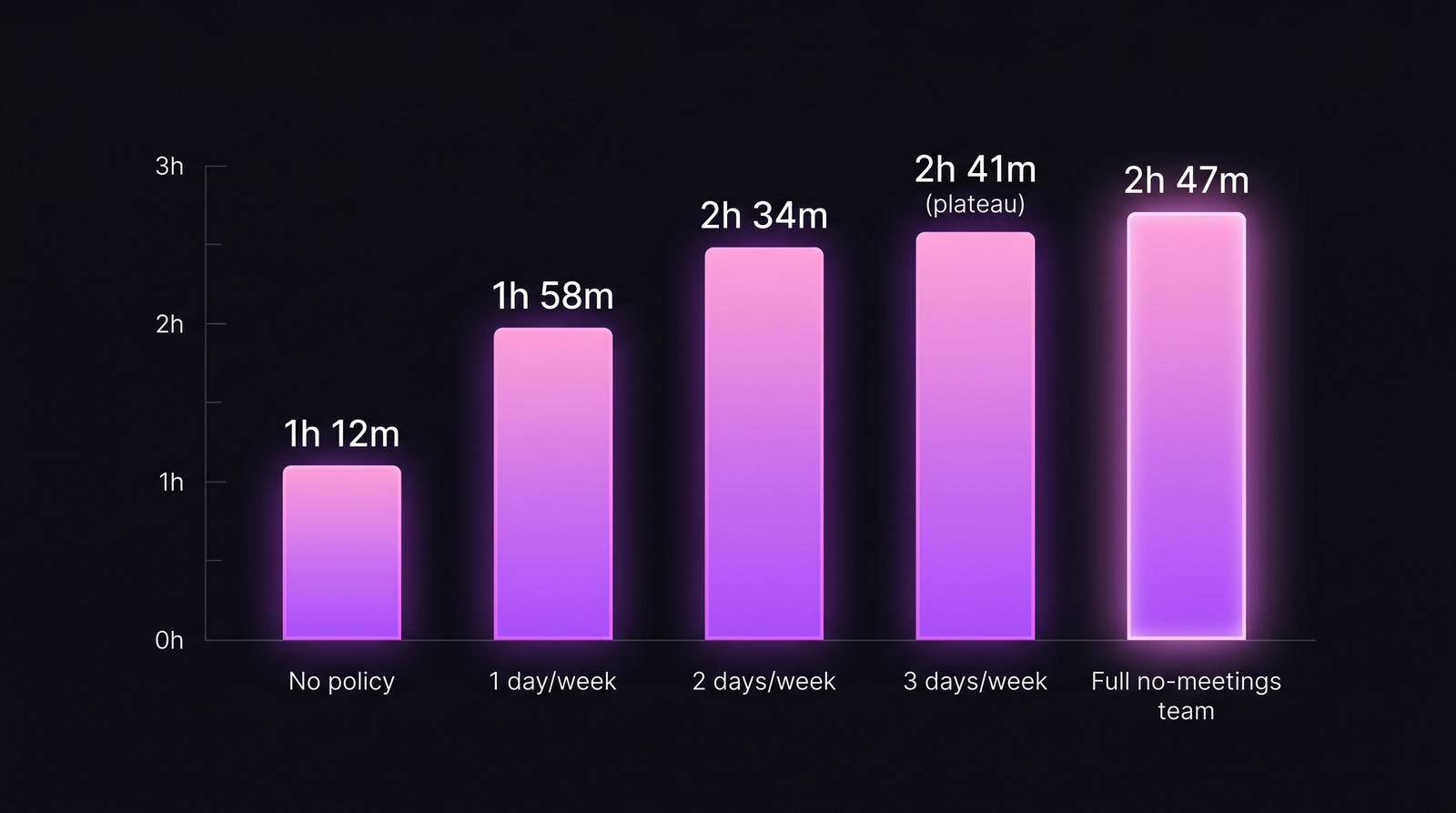 The curve flattens at 2 meeting-free days per week. The third day produces almost no additional coding time.
| Policy | Median daily coding time | Delta vs no policy |
|---|---|---|
| No policy | 1h 12m | baseline |
| 1 meeting-free day / week | 1h 58m | +64% |
| 2 meeting-free days / week | 2h 34m | +114% |
| 3 meeting-free days / week | 2h 41m | +123% |
| Full no-meetings team (rare) | 2h 47m | +132% |
The pattern: massive gain moving from 0 to 1, strong gain from 1 to 2, tiny gain from 2 to 3, negligible gain from 3 to full. The marginal return on each additional meeting-free day collapses after the second.
Why? Coordination cost. Removing one day of meetings shifts the meetings to the remaining days — denser, but still manageable. Removing a third day forces async channels (Slack, docs, PRs) to absorb decisions that didn't fit into the compressed meeting schedule, and async has its own context-switching cost.
Finding 2 — Focus block duration doubles, not coding time
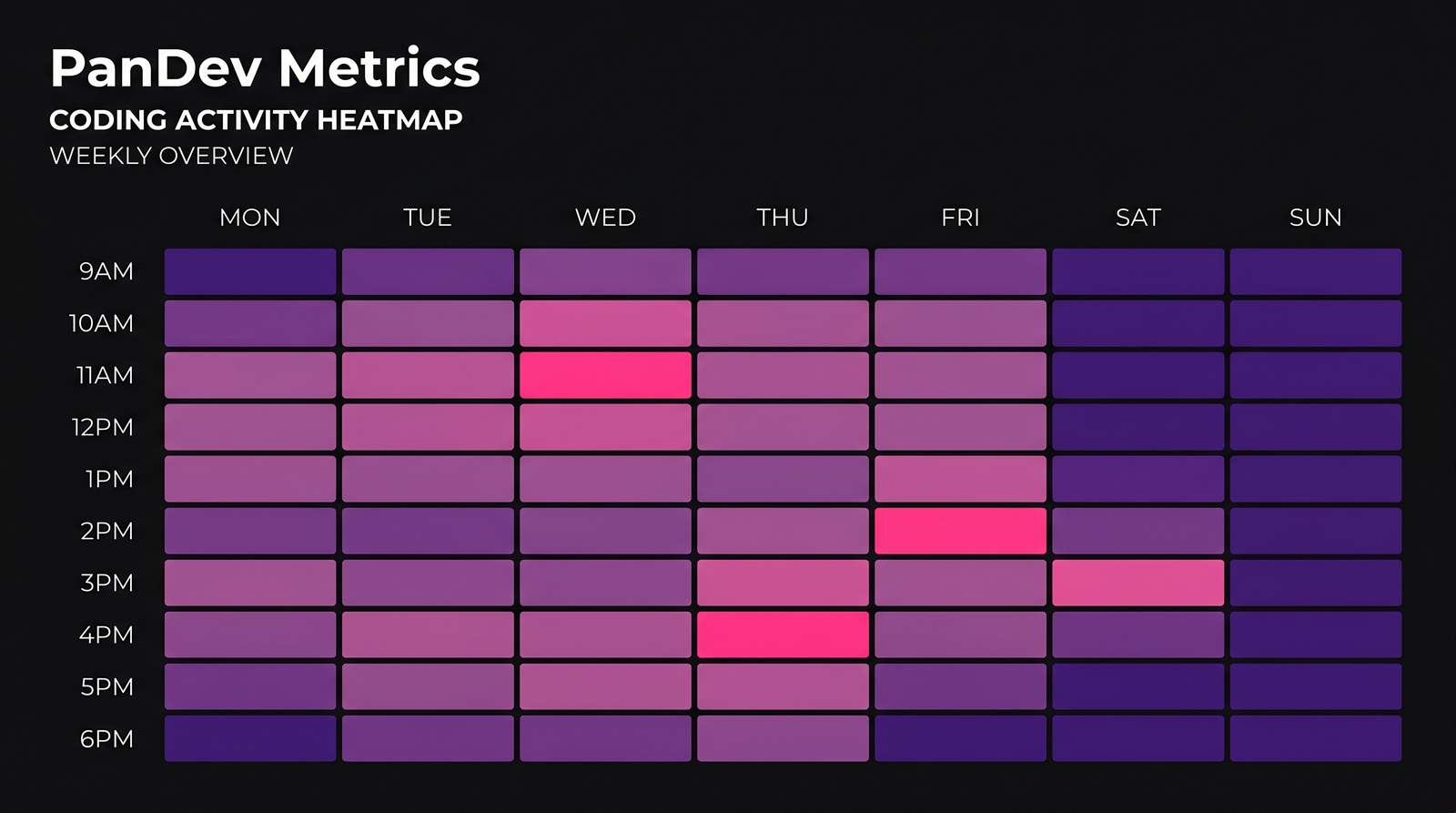 Before: focus fragments across every weekday. After: two concentrated "deep work" days emerge.
The more surprising finding: coding time increases by ~100%, but focus-block duration increases by ~200%.
| Policy | Median focus-block duration | % of coding in blocks ≥ 45 min |
|---|---|---|
| No policy | 31 min | 34% |
| 1 meeting-free day / week | 48 min | 51% |
| 2 meeting-free days / week | 67 min | 68% |
| 3 meeting-free days / week | 72 min | 71% |
Engineers aren't just coding more minutes — they're coding in larger uninterrupted chunks. Our focus-time research shows deep-work blocks of 45+ minutes produce cognitive outputs that fragmented time cannot. The policy's primary effect is shifting the distribution of coding time, not just the total volume.
Finding 3 — The day-of-week effect
Which days become meeting-free matters. Across teams that specified:
| Policy configuration | Mean coding minutes on the meeting-free day |
|---|---|
| Wednesday meeting-free | 3h 58m |
| Tuesday meeting-free | 4h 12m |
| Thursday meeting-free | 4h 08m |
| Monday meeting-free | 2h 46m |
| Friday meeting-free | 2h 24m |
Tuesdays and Thursdays are the best meeting-free days. Mondays and Fridays produce the smallest coding-time gain because Mondays absorb planning meetings that can't be moved and Fridays see early drop-off due to end-of-week fatigue. Wednesday — the most-copied policy — is third-best.
This matches our separate Monday vs Friday productivity research: coding output peaks Tue-Thu and drops at the edges. Meeting-free days compound the strongest on the days already near peak.
Finding 4 — The "wasted meeting-free day" pattern
Not every meeting-free day converts to focus time. Across the teams in our dataset, about 18% of declared meeting-free days show coding time within 10% of a typical meeting day. Three patterns explain most of the "wasted" days:
- Lunch-and-after-school meetings. Teams declared 9-5 meeting-free, but 1:1s crept into 11:30 and 4:15 slots. The blocks shrank below the 45-min focus threshold.
- Async-meeting equivalents. Instead of a video call, the team ran a 2-hour Slack discussion thread. Interrupts on a meeting-free day aren't free.
- Calendar exceptions for leadership. "Just this one meeting on meeting-free Wednesday" becomes weekly policy drift.
Teams with the largest gains had an explicit policy of no exceptions for 2-3 months, allowed rare exceptions with 48-hour notice thereafter, and reviewed exception rate quarterly.
What this means for engineering leaders
1. Start with 2 meeting-free days, not 1
If the goal is coding-time gain, 2 days/week is the sweet spot. One day shows 64% gain; two shows 114%. The step from 1 to 2 is nearly as valuable as the step from 0 to 1, and the step from 2 to 3 isn't. Roll out 2 days, measure, hold there.
2. Pick Tuesday + Thursday
The day-of-week effect is not small. A team running Tue+Thu meeting-free recovers ~25% more focus time than the same team running Mon+Fri.
3. Enforce "no exceptions" for the rollout quarter
The "just this one meeting" pattern destroys the policy within 90 days. Pick a start date, commit hard for a quarter, then allow exceptions with friction (48-hour notice, executive sign-off, logged).
4. Measure coding time AND focus blocks
The coding-time gain is the headline. The focus-block gain is the cognitive-output driver. Teams that measure only total coding minutes miss the bigger win — longer uninterrupted blocks enable the kind of work that produces architectural improvements and complex feature development.
5. Don't extend to 3+ days
The data is clear: 3 days/week produces marginal gain over 2 and material coordination cost. Don't be seduced by "if 2 is good, 3 is better." It's not, and the backlash from stakeholders trying to coordinate with engineering will offset the gain.
Where PanDev Metrics captures this
PanDev Metrics collects IDE heartbeat data through editor plugins (VS Code, IntelliJ, Eclipse, Xcode, Visual Studio). Every coding session is tagged with user, project, language, timestamp — accurate to seconds. For meeting-free-day policy evaluation, the relevant dashboard shows:
- Daily coding minutes, split by day of week
- Focus-block duration distribution (blocks ≥ 45 min)
- Context-switch frequency (project switches per hour)
One customer — a 90-engineer platform team in fintech — rolled out Tue+Thu meeting-free in Q3 2025. By Q1 2026, their focus-block median had climbed from 34 min to 71 min. Their self-reported satisfaction score climbed too, but the IDE data was 3 months ahead of the survey signal. The lead indicator is the behavioral change; the lag indicator is the sentiment shift.
Methodology note
This is observational data. Confounders we couldn't eliminate:
- Policy-adopting teams may have been healthier. Teams with severe organizational dysfunction rarely implement clean policy changes.
- Reporting bias. Teams whose meeting-free-day policy failed quietly often didn't declare a policy at all in our segmentation.
- Industry skew. Our dataset is 58% SaaS, 20% fintech, 10% e-commerce, 12% other. Manufacturing and telecom are underrepresented.
The direction of the findings (more meeting-free days → more coding time, but diminishing returns) is robust across every subset we examined. The absolute magnitude (the 114% at 2 days) may differ for your team. Replicate the measurement before committing to the exact policy.
The contrarian claim
Meeting-free Wednesdays are the wrong day. Shopify's influential 2023 rollout popularized the Wednesday version, and the majority of teams that followed copied the day, not the principle. But Tue+Thu produce measurably more focus time per meeting-free day than Wednesday, and the two-day policy beats the one-day policy by a wider margin than the one-day policy beats none. The most-copied version of the policy is not the most effective version. The data is direct: if you're picking one day, pick Tuesday. If you're picking two, pick Tue+Thu.
Honest limits
Our data is strongest in 10-500-engineer B2B organizations on SaaS, fintech, and e-commerce. The magnitude of the gains likely differs for:
- Very small teams (< 10 engineers) — meeting load is often already low; less room for gain
- Distributed teams across 5+ timezones — async-meeting costs may dominate; findings don't transfer cleanly
- Heavy research / ML teams — coding time is already lower and less tightly correlated with output
- Agencies / consultancies — client meetings can't be declared away
The "focus block" definition (≥ 45 min uninterrupted coding) is ours, not a universal benchmark. Other researchers use 30 min or 60 min; magnitudes change with the threshold, direction does not.
Related reading
- Focus Time: Why 2 Hours of Uninterrupted Code Equals 6 Hours of Fragmented Work — the cognitive model behind the focus-block finding
- Monday vs Friday: How Day of Week Affects Developer Productivity — the weekday effect cited in finding 3
- Slack Productivity for Engineering Teams: Channel Strategy — the async-interrupt counterpart; meeting-free days fail if Slack fills the gap
- External: MIT Sloan Management Review — The Meeting-Free Workplace (2024) — corporate-policy survey underlying the 39% adoption figure